





Selecting the right CNC collet is essential for achieving accurate, stable, and efficient machining results. A collet may be a relatively small component of a CNC toolholding system, but it has a major influence on tool stability, runout, vibration, surface finish, and tool life.
Different machining operations require different levels of gripping force, precision, flexibility, and rigidity. Using the wrong collet can result in tool slipping, excessive runout, premature tool wear, poor surface quality, and inconsistent machining results.
For workshops and manufacturing businesses, working with an experienced Industrial Tools Supplier in Dubai can make it easier to identify suitable tooling components for specific applications. Khokhawala Trading LLC supports industrial customers with tooling solutions designed around different machining and workshop requirements.
This guide explains what CNC collets are, the major types available, and how to choose the right collet for different machining applications.
Table of Contents
- What Is a CNC Collet?
- Why Is Collet Selection Important?
- Common Types of CNC Collets
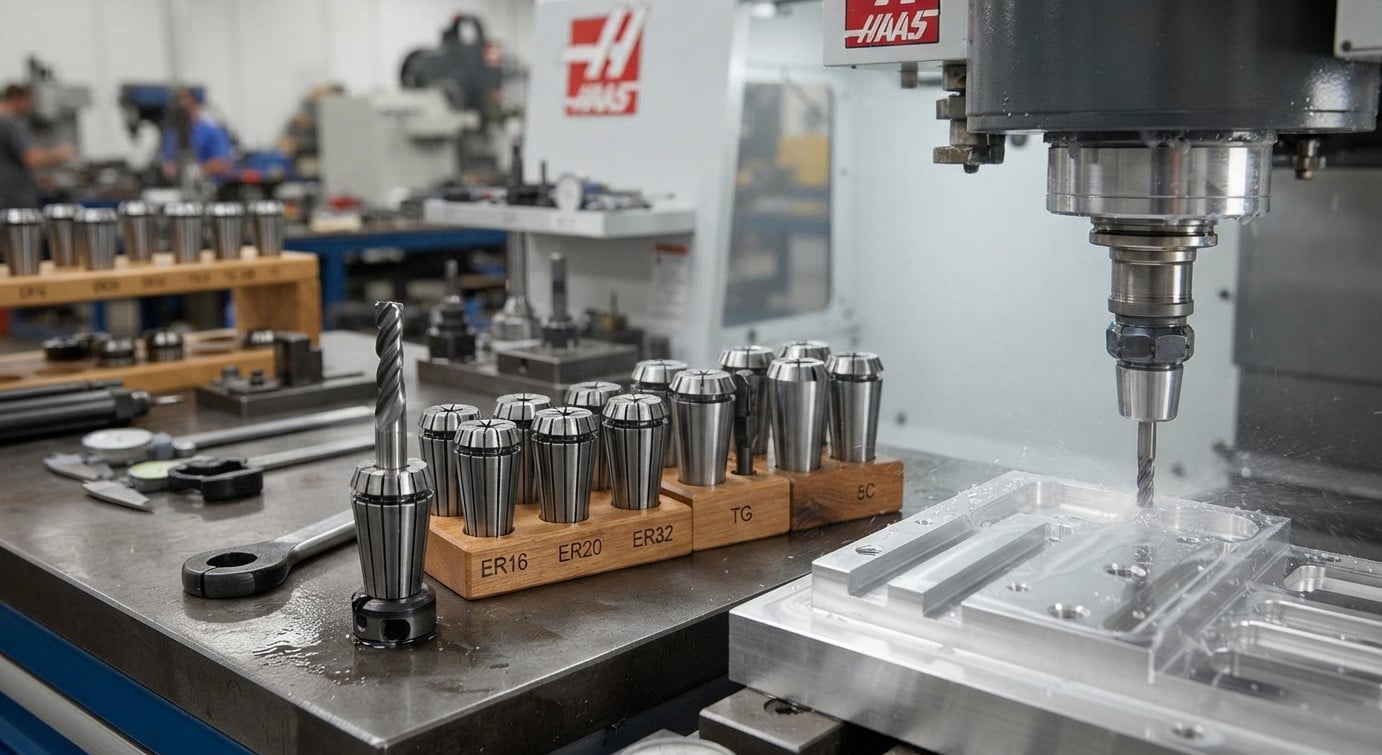
- Understanding ER Collets
- How to Choose the Right CNC Collet
- CNC Collets for Different Machining Applications
- Factors That Affect Collet Performance
- Common CNC Collet Selection Mistakes
- CNC Collet Maintenance Tips
- Frequently Asked Questions
- Conclusion and CTA
What Is a CNC Collet?
A CNC collet is a precision clamping component used to hold a cutting tool securely inside a compatible toolholder or spindle system.
Collets generally use a slotted design that allows them to compress around the tool shank when installed and tightened correctly. This provides a firm and concentric grip on the cutting tool.
A typical CNC toolholding arrangement may consist of:
Machine spindle → Toolholder → Collet nut → Collet → Cutting tool
The collet must be compatible with the toolholder and suitable for the diameter and type of tool being used.
Because the collet is directly involved in tool positioning and clamping, its condition and accuracy can have a significant impact on machining performance.
Why Is Collet Selection Important?
Choosing the correct CNC collet helps ensure that the cutting tool remains secure during machining.
A suitable collet can help provide:
- Better tool stability
- Reduced runout
- Improved machining accuracy
- More consistent tool life
- Reduced vibration
- Better surface finish
- Reliable tool clamping
- Improved machining productivity
An unsuitable or damaged collet can create problems such as tool movement, uneven cutting, vibration, excessive tool wear, and dimensional variation.
Therefore, the collet should be selected as part of the complete toolholding system rather than as an individual component.
Common Types of CNC Collets
Different collet systems are designed for different machines and machining requirements.
Some commonly encountered systems include:
| Collet Type | Typical Application | Main Advantage |
|---|---|---|
| ER Collets | CNC milling, drilling, reaming | Versatility |
| 5C Collets | Lathe and workholding applications | Precision workholding |
| R8 Collets | Milling machines | Simple tool holding |
| TG Collets | Heavy-duty machining | Strong clamping |
| Specialized Collets | Specific machines and applications | Application-specific performance |
The ER system is particularly common in CNC machining because it offers a broad range of sizes and can accommodate different tool shank diameters when used with the appropriate holder.
Understanding ER Collets
ER collets are widely used for CNC milling, drilling, reaming, and other machining operations.
Common ER sizes include:
- ER11
- ER16
- ER20
- ER25
- ER32
- ER40
The correct ER size depends on the tool diameter, required clamping capacity, machining load, and compatible collet chuck.
For example, smaller ER systems are generally suited to smaller-diameter tools and lighter machining, while larger ER systems can accommodate larger tools and higher machining loads.
Why Are ER Collets Popular?
ER collets offer several practical advantages:
- Wide range of available sizes
- Flexible tool diameter capacity
- Easy tool changes
- Suitable for many CNC applications
- Good concentric clamping when properly used
- Availability in different accuracy grades
However, an ER collet should always be selected according to the manufacturer’s specified clamping range rather than simply choosing a size that appears close to the tool diameter.
How to Choose the Right CNC Collet
Several factors should be considered when selecting a CNC collet.
1. Check the Tool Shank Diameter
The first step is to identify the actual diameter of the cutting tool shank.
Do not select a collet based only on the cutting diameter. The shank diameter is what the collet actually grips.
For example, if an end mill has a specific cutting diameter but a different shank diameter, the collet must be selected according to the shank.
Always stay within the specified clamping range of the collet.
2. Match the Collet With the Toolholder
A collet must be compatible with the collet chuck or toolholder.
For example, an ER32 collet should be used with a compatible ER32 system. It cannot simply be installed into a different ER series because the tool diameter appears suitable.
The collet, nut, and holder should be treated as a matched system.
3. Consider Machining Accuracy
Precision machining requires greater control over runout and concentricity.
If the application involves tight tolerances, small cutting tools, finishing operations, or precision components, a higher-accuracy collet may be appropriate.
For general-purpose machining, a standard-quality collet may be sufficient when properly installed and maintained.
4. Consider Cutting Forces
The machining operation determines how much clamping force is required.
Light cutting operations generally place lower loads on the toolholder.
Heavy roughing, deep cutting, and machining hard materials can generate significantly higher forces. In such cases, the toolholding system must provide sufficient rigidity and gripping force.
5. Consider Tool Projection
Tool projection refers to how far the cutting tool extends from the holder.
Long tool projection can increase deflection and vibration, particularly during heavy cutting.
When possible, use the shortest practical tool extension that still provides the required machining clearance.
6. Consider Spindle Speed
High-speed machining requires careful consideration of the complete rotating assembly.
The collet, nut, toolholder, and cutting tool should all be suitable for the intended spindle speed.
Poorly balanced or damaged components can negatively affect performance at high rotational speeds.
7. Consider the Machining Material
Different workpiece materials generate different cutting forces and machining conditions.
Aluminum, mild steel, stainless steel, cast iron, and harder alloys may require different tooling strategies.
When machining difficult materials, stability and secure tool clamping become especially important.
CNC Collets for Different Machining Applications
The ideal collet depends on the machining operation.
Milling
ER collets are commonly used for general CNC milling because they can accommodate a range of tool diameters.
For light and medium milling, an appropriately sized ER system can provide a practical combination of flexibility and toolholding accuracy.
For very heavy cutting, however, another toolholding system may be more suitable depending on the machine and application.
Drilling
Collets can be used to hold drills with compatible shanks.
For precision drilling, minimizing runout is important because excessive runout can affect hole size, tool wear, and hole quality.
The collet should be selected according to the drill shank and required machining accuracy.
Reaming
Reaming requires stable and accurate tool positioning.
A properly selected precision collet can help maintain the required tool alignment and reduce unnecessary runout.
Tapping
Tapping applications may require specialized tapping collets or holders depending on the CNC machine and tapping method.
Rigid tapping and conventional tapping setups have different requirements, so the complete tooling arrangement should be considered before selecting a collet.
High-Speed Machining
High-speed machining places greater demands on toolholding components.
For these applications, factors such as balance, runout, gripping force, tool projection, and rated operating speed become increasingly important.
A high-quality collet alone cannot compensate for an unsuitable toolholder or excessive tool projection. The entire assembly needs to be appropriate for the machining conditions.
Factors That Affect Collet Performance
Even the correct collet can perform poorly if it is improperly installed or maintained.
Collet Cleanliness
Chips, dust, coolant residue, and other contaminants can prevent proper seating.
Always keep the collet, holder, and tool shank clean before assembly.
Collet Condition
Inspect collets regularly for:
- Cracks
- Damaged slots
- Corrosion
- Worn gripping surfaces
- Deformation
- Abnormal wear
A damaged collet should not be used for precision machining.
Correct Assembly
The collet should be installed according to the manufacturer’s recommended procedure.
For systems such as ER, proper engagement between the collet, nut, and holder is important for reliable clamping.
Proper Tightening
Over-tightening or under-tightening can create problems.
Use the recommended tightening procedure and torque specification for the specific tooling system.
Common CNC Collet Selection Mistakes
Choosing Only by Tool Diameter
Tool diameter alone is not enough. The actual shank diameter and collet system must be considered.
Using an Incorrect Collet Range
A collet should not be forced to hold a tool outside its specified range.
Choose a collet designed for the actual tool shank diameter.
Ignoring Runout
High runout can cause uneven cutting and premature tool wear. Precision applications require careful attention to the accuracy of the complete toolholding system.
Using Damaged Collets
Even small amounts of damage can affect tool positioning and gripping performance.
Replace worn or damaged collets instead of continuing to use them.
Excessive Tool Projection
Long tool extensions can reduce rigidity and increase vibration.
Use the shortest practical setup for the operation.
Mixing Incompatible Components
Collets, nuts, holders, and tools must be compatible. Components that appear physically similar should not be mixed unless compatibility is confirmed.
CNC Collet Maintenance Tips
Proper maintenance can help extend collet service life and maintain machining accuracy.
Keep Everything Clean
Clean the collet, nut, holder, and tool shank before installation.
Inspect Regularly
Check for damage, wear, corrosion, and contamination.
Store Collets Properly
Store collets in a clean, dry location where their precision surfaces will not be damaged.
Avoid Dropping Collets
Precision collets can be damaged by impact. Handle them carefully during tool changes and maintenance.
Monitor Machining Performance
Unexpected vibration, tool slipping, increased runout, or sudden changes in surface finish may indicate a problem with the collet or toolholding system.
Frequently Asked Questions
1. What is a CNC collet used for?
A CNC collet is used to securely grip and position the shank of a compatible cutting tool inside a toolholder or spindle system.
2. Which CNC collet is best for general machining?
ER collets are a popular choice for general CNC milling and drilling because they provide flexibility across a range of compatible tool diameters.
3. How do I choose the correct ER collet?
Start with the actual cutting tool shank diameter and select a compatible ER collet within its specified clamping range. Also consider runout, cutting load, tool projection, and spindle speed.
4. Can one collet hold different tool sizes?
Some collet systems have a specified clamping range, allowing one collet to hold different tool diameters within that range. However, the manufacturer’s specified range should always be followed.
5. Does collet runout affect CNC machining?
Yes. Excessive runout can contribute to uneven cutting, vibration, premature tool wear, poor surface finish, and dimensional inconsistencies.
6. When should a CNC collet be replaced?
A collet should be replaced when it shows signs of damage, excessive wear, corrosion, deformation, or when it can no longer provide the required clamping accuracy.
7. Can a CNC collet reduce vibration?
A properly selected and maintained collet can contribute to stable toolholding and reduced vibration. However, vibration can also be caused by tool geometry, tool projection, spindle condition, workholding, cutting parameters, or machine rigidity.
Conclusion
Choosing the right CNC collet is an important step toward achieving accurate, stable, and productive machining. The correct selection should consider the tool shank diameter, collet system, toolholder compatibility, cutting forces, spindle speed, tool projection, machining material, and required accuracy.
ER collets are widely used because of their versatility, but they are not automatically the best choice for every machining application. The complete toolholding system should always be evaluated according to the requirements of the job.
For reliable industrial tooling solutions, Khokhawala Trading LLC can help businesses identify suitable tooling for their machining and workshop requirements. As an Industrial Tools Supplier in Dubai, the company focuses on providing practical solutions for different industrial applications.
CTA
Looking for the right CNC collet for your machining application?
Contact Khokhawala Trading LLC, your trusted Industrial Tools Supplier in Dubai, to discuss your CNC tooling requirements and find a suitable solution for your machine, cutting tools, and production needs.