






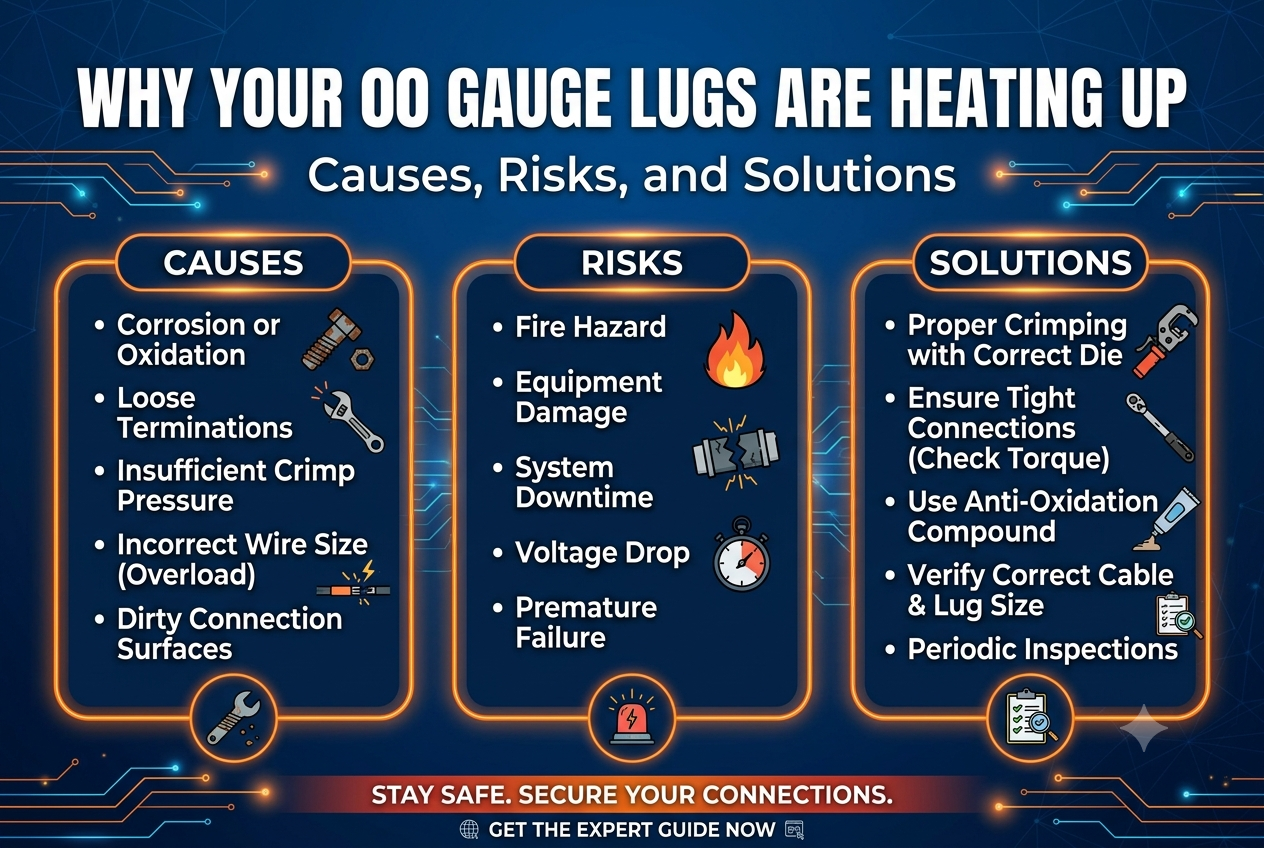
A hot battery cable connection is not something to ignore. If your lugs are getting noticeably warm while the system is under load, the lug itself may not be the problem. More often, heat is a sign that something is wrong with the connection between the cable, lug, and terminal. With 00 gauge battery lugs, that matters even more because these cables are typically used in high-current applications where a poor connection can create trouble quickly.
The positive part is that a warm lug doesn’t automatically mean the entire cable needs replacing. In several instances, the reason comes down to a loose connection, poor crimp, wrong lug size, or corrosion.
Why Does a Battery Lug Get Hot?
Every electrical connection has some resistance. Ideally, that resistance is extremely low.
When current passes through a connection with higher resistance than it should have, some electrical energy gets converted into heat. The more current flowing through the connection, the more noticeable that heat can become.
That’s why a connection that seems perfectly fine on a small electrical circuit can become a serious concern on a battery cable carrying a much larger current.
The lug may be large and made from copper, but that doesn’t guarantee the connection is good. The problem can be sitting inside the crimp, between the lug and terminal, or even where the cable enters the lug.
A Loose Connection Is One of the First Things to Check
Battery connections deal with vibration, movement, and temperature changes.
Over time, a nut can loosen slightly. It may still look secure, but the contact between the lug and terminal is no longer as good as it was when it was installed.
That small change can increase resistance at the connection.
As current continues to pass through it, the connection heats up. Heat can then make the problem worse by causing further changes in the connection.
If you’ve noticed that one battery terminal is warmer than the others, don’t just assume it’s normal because the system is working. A noticeable temperature difference deserves a closer look.
Always disconnect power safely before inspecting or working on a high-current battery connection.
The Crimp Could Be the Weak Point
A 00 gauge cable is only as good as the connection made at its end.
The conductor needs to sit properly inside the lug barrel, and the lug needs to be crimped with suitable tooling. If the crimp is too loose, only part of the conductor may be making proper contact with the lug.
That creates a small high-resistance area.
The opposite problem can happen too. An unsuitable crimping method can deform the lug or damage the cable instead of producing a solid connection.
This is one reason it is better not to improvise with a basic pair of pliers or whatever tool happens to be nearby. Large battery cables require the right lug and the right installation method.
Check That the Lug Matches the Cable
Not every large-looking lug is suitable for every large cable.
A 00 gauge, also called 2/0 AWG, lug is designed for 2/0 cable. SELTERM’s bare copper range is specifically listed for 2/0 or 00 gauge battery cable. The company also notes that some cable manufacturers oversize their cables, so checking the actual dimensions before installation is worthwhile.
The stud size is another measurement that needs to match.
For example, SELTERM offers 00 gauge bare copper lugs for 1/4″, 5/16″, 3/8″, and 1/2″ studs.
The cable gauge tells you what size conductor the lug accepts. It doesn’t tell you which stud hole you need.
Measure the terminal before ordering rather than finding out after the cable has already been cut and crimped.
Corrosion Can Create More Resistance
Moisture and corrosion are another common cause of heating.
Copper handles electrical current very well, but exposed connections can still deteriorate when they spend enough time around moisture, dirt, chemicals, or salt.
Corrosion changes the contact surface. Instead of having clean metal touching clean metal, you may end up with an uneven layer between the two surfaces.
That can increase resistance.
Look for green or dark discoloration around copper connections, buildup around the terminal, or signs that moisture has been getting into the cable end.
If corrosion is present, don’t simply tighten the connection and call it fixed. The contact surfaces and cable end may need to be inspected properly.
The Terminal Connection Matters Too
Sometimes the lug is perfectly fine and the problem is where it connects to the battery, busbar, starter, inverter, or other equipment.
The mating surfaces need to sit flat against each other. Paint, dirt, corrosion, washers in the wrong position, or a poorly fitted terminal can prevent good contact.
The fastener also needs to be tightened according to the equipment manufacturer’s specifications.
Over-tightening isn’t a substitute for a good connection. It can damage hardware or the lug. Under-tightening leaves the connection vulnerable to movement.
For high-current systems, following the manufacturer’s torque requirements is a much better approach than simply tightening the nut until it “feels right.”
Why Heating Shouldn’t Be Ignored
A slightly warm connection and a connection that becomes too hot to touch are obviously not the same thing.
Still, any unexpected heating at a high-current cable connection deserves attention.
A poor connection can continue generating heat while the equipment is operating. In serious cases, prolonged heating can damage insulation, discolor or deform the lug, weaken nearby components, and contribute to electrical failure.
The warning signs can start small.
You might notice a faint smell, darkening around the terminal, softened insulation, or a lug that is considerably warmer than the other connections.
Don’t wait for the cable to fail completely before investigating.
Replacing the Lug May Be the Right Fix
If a lug has been overheated, replacing it may be safer than trying to reuse it.
Heat can change the condition of the metal and the cable connection. If the cable has also been discolored, hardened, or damaged near the lug, that section should be inspected before fitting a new terminal.
When replacing the lug, use one designed for the actual cable size and stud size.
SELTERM’s 00 gauge bare copper lugs are made from 99.9% pure annealed copper and are available in several stud configurations. The listed specifications include a 300 A maximum current rating and a 90°C temperature rating for the 2/0 variants.
Those ratings are useful reference points, but they should not be treated as permission to exceed the limits of the cable, battery, equipment, or complete electrical system.
A Simple Check Can Prevent a Bigger Problem
If you regularly work around batteries, don’t wait for a complete electrical failure before checking the cable connections.
During routine maintenance, look over the 00 gauge lugs and terminals for:
- Loose hardware
- Corrosion or unusual discoloration
- Damaged insulation
- Signs of overheating
- Cracks or deformation around the lug
- A cable that has started pulling away from the terminal
If one connection consistently runs hotter than comparable connections under the same conditions, find out why.
A large battery cable is designed to handle substantial current, but the terminal at the end still has to make a clean, secure connection.