






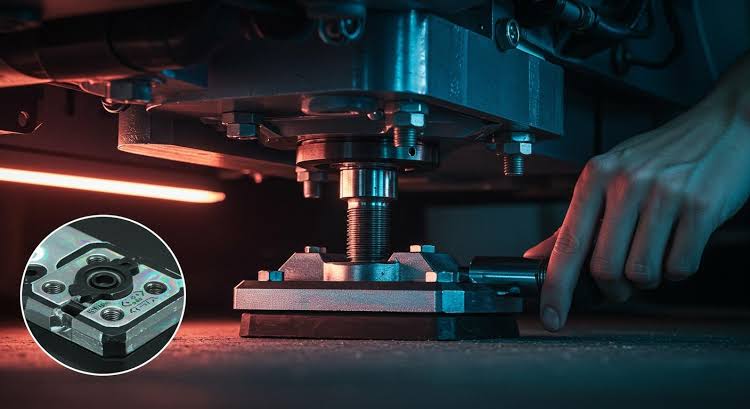
Industrial machines rarely perform at their best when they are sitting on an uneven or unstable surface. Even a small amount of movement can affect accuracy, increase vibration, create unwanted noise, and accelerate wear on equipment. This is why properly selected heavy duty machine leveling feet can be an important part of a stable machine installation.
Leveling feet are used beneath machinery, workstations, frames, conveyors, and other industrial equipment to compensate for uneven floors and provide a reliable support point. However, choosing the right type involves more than checking whether a foot can support the machine’s total weight. Load distribution, floor conditions, vibration, adjustment range, material, and environmental exposure all need to be considered.
What Are Heavy Duty Machine Leveling Feet?
Heavy duty machine leveling feet are adjustable support components designed to carry substantial loads while allowing machinery to be positioned and stabilized accurately. A typical leveling foot consists of a threaded stud or stem connected to a base or pad. By turning the threaded section, an installer can raise or lower the equipment until it is properly aligned.
Unlike simple furniture-leveling components, industrial versions are engineered for demanding applications. They may use stainless steel, carbon steel, reinforced polymers, or other durable materials depending on the operating environment.
The base may also be fixed, swivel, rubber-coated, or designed with a specific surface profile. Each configuration solves a slightly different installation problem.
Why Leveling Matters
An uneven machine can experience several problems:
- Reduced operating accuracy
- Excessive vibration
- Uneven loading on machine components
- Increased noise
- Premature bearing or mechanical wear
- Difficulty maintaining consistent production
- Safety concerns caused by machine movement
For example, consider a precision cutting machine installed on a concrete floor that slopes slightly from one side to another. Without proper leveling, the machine frame may twist as the mounting points carry different loads. Adjustable feet allow the installer to compensate for those differences and establish a stable support plane.
How to Select the Right Leveling Feet
Choosing leveling feet should be treated as an engineering decision rather than a simple hardware purchase. The following process helps narrow down the appropriate specification.
1. Calculate the Actual Load
Start with the total operating weight of the equipment, not just its empty weight. Include tooling, materials, products, fluids, accessories, and other components that will remain on the machine.
Then consider how that weight is distributed.
Suppose a machine weighs 4,000 pounds and uses four leveling feet. Dividing the weight evenly gives 1,000 pounds per foot. In practice, however, the load may not be perfectly balanced, particularly when the machine has a heavy motor, hopper, or moving assembly on one side.
A reasonable safety margin is therefore important. Avoid selecting a foot whose maximum capacity barely exceeds the calculated average load.
2. Determine the Number of Support Points
The number of feet affects load distribution and stability. Four feet are common, but larger machines may require six, eight, or more support points.
More feet do not automatically mean greater stability. If the machine frame is not rigid enough, some feet may carry considerably less load than others.
For large equipment, follow the manufacturer’s mounting recommendations and consider how the frame transfers weight to each support point.
3. Choose the Correct Thread and Adjustment Range
The threaded stem must match the machine’s mounting arrangement. Common considerations include thread diameter, thread pitch, mounting-hole dimensions, and available adjustment height.
The adjustment range is equally important. If the floor has noticeable variations, a short-stem leveling foot may not provide enough correction.
However, excessive extension should also be avoided. A long exposed threaded section can reduce rigidity and create additional leverage on the support point.
4. Consider the Floor Surface
The contact surface between the foot and floor has a major influence on stability.
A broad base distributes pressure over a larger area, which can be useful on concrete or other relatively hard surfaces. Swiveling bases can maintain better contact when the floor is not perfectly perpendicular to the threaded stem.
For floors that could be scratched or where vibration reduction is important, feet with rubber or elastomer contact surfaces may be more appropriate.
5. Match the Material to the Environment
Material selection becomes especially important in demanding environments.
Stainless steel feet are often useful where moisture, cleaning chemicals, or corrosion are concerns. Food-processing and pharmaceutical facilities may also require designs that are easy to clean and minimize areas where contaminants can accumulate.
Standard steel may be suitable for dry manufacturing environments, while reinforced polymer components can offer useful corrosion resistance in particular applications.
Always consider temperature, moisture, chemicals, washdown procedures, and exposure to oils before selecting the material.
Common Mistakes or Challenges
One of the most common mistakes is selecting feet based solely on the machine’s total weight. Load capacity matters, but it is only one part of the equation.
Ignoring Dynamic Loads
A machine that weighs 3,000 pounds while stationary may generate significantly different forces when motors, presses, cutting heads, or other moving components operate.
Dynamic forces can create vibration and moment loads that are not reflected by the static weight alone. Machinery with significant movement may need a more robust support system than a simple static-load calculation suggests.
Using Too Small a Base
A narrow foot can concentrate a large amount of pressure on a small floor area. This can become a problem on certain surfaces or when the machine experiences movement.
A larger base can distribute the load more effectively and improve stability.
Overextending the Threaded Stem
Installers sometimes use the full adjustment range to compensate for an uneven floor. While adjustment is the purpose of the component, excessive extension can make the support less rigid.
If substantial correction is required, addressing the floor or using a different mounting arrangement may produce a better result.
Failing to Recheck Level After Operation
Machinery can settle after installation. Vibration, thermal changes, and repeated loading may also affect its position.
For critical equipment, leveling should be verified after the machine has operated under normal conditions rather than assuming the initial installation will remain unchanged.
Practical Tips for Better Installation
Before installation, clean the mounting points and floor areas thoroughly. Dirt, debris, and metal chips between the foot and mounting surface can introduce instability.
Install all feet loosely enough to allow adjustment, then gradually distribute the machine’s weight across the support points. Avoid fully loading one foot while leaving others unsupported.
For precision equipment, use a suitable precision level rather than relying on visual judgment. Adjust opposing support points gradually instead of making large corrections at a single location.
After leveling, tighten locking nuts or other adjustment mechanisms according to the manufacturer’s instructions. These features help prevent the threaded adjustment from changing during operation.
For machines that generate substantial vibration, consider whether leveling feet alone are sufficient. Anti-vibration mounts, isolation pads, or engineered foundation systems may be necessary when vibration control is a primary requirement.
It is also useful to document the final adjustment positions during installation. This creates a reference point for future maintenance and makes it easier to identify whether a machine has shifted.
Conclusion
Heavy duty machine leveling feet provide more than simple height adjustment. Properly selected and installed, they help machinery remain stable, aligned, and capable of operating consistently on imperfect floors.
The best choice depends on several factors, including total and dynamic load, number of support points, thread size, adjustment range, floor conditions, material, and environmental exposure. Taking time to evaluate these requirements before installation can prevent vibration, instability, premature wear, and costly alignment problems later.
For critical machinery, treat leveling as part of the overall installation design rather than an afterthought. A correctly supported machine is easier to maintain, safer to operate, and better positioned to deliver reliable performance over its service life.