





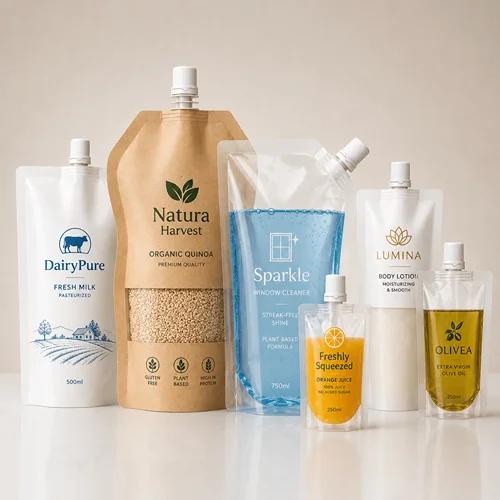
Packaging plays an important role in protecting products, making them easier to use, and presenting them effectively to customers. Different products require different packaging structures, especially when they contain liquids, sauces, creams, gels, powders, or other products that need controlled dispensing. Spout pouches are one packaging format designed around these practical requirements.
Their flexible structure and integrated spout can make them convenient for both storage and everyday use. Depending on the product, businesses can choose different pouch sizes, materials, spout positions, closures, and printing options. This flexibility allows packaging to be developed around specific product requirements rather than relying on one standard format.
What Are Spout Pouches?
Spout pouches are flexible packaging containers that include a built-in spout or nozzle. The spout provides an opening through which the product can be poured, squeezed, or dispensed. Businesses can also use custom printed spout pouches to add product information, branding elements, and visual designs while maintaining a practical packaging format.
Unlike traditional rigid bottles and containers, pouches can use flexible materials that take up less space when the product is being consumed. The exact structure depends on the product, filling process, required shelf life, and intended method of use.
Spout pouches can be used for a wide range of products, including beverages, sauces, condiments, baby food, liquid foods, personal care products, cleaning products, and other compatible applications. Their flexible construction and convenient dispensing design make them suitable for products that require easy handling and controlled access.
Why Businesses Use Spout Pouches
Businesses consider spout pouches for several practical reasons. Their flexible construction can make them lightweight compared with some rigid packaging formats, while the spout provides a controlled way to access the contents.
The packaging can also be designed in different shapes and sizes. Smaller pouches may be suitable for individual servings or travel products, while larger formats can be used for products intended for household or commercial use.
Another advantage is the ability to customize the packaging around the product. Businesses can consider the product’s viscosity, filling requirements, storage conditions, dispensing method, and branding when developing the pouch.
How the Spout Improves Product Use
The spout is one of the most important features of this packaging format. It can help control how the contents are released from the pouch.
For liquid or semi-liquid products, controlled dispensing can reduce unnecessary spills and make the product easier to use. A suitable cap or closure can also help protect the opening when the product is stored between uses.
For products that are consumed or used gradually, resealable spouts can provide additional convenience. Instead of opening the entire package, the customer can use the spout and close it again afterward.
The appropriate spout design depends on the product’s consistency and intended use.
Materials Used for Spout Pouches
The material used in a spout pouch affects its strength, flexibility, barrier performance, and suitability for the packaged product.
Many flexible pouches use multiple material layers. Each layer can provide a particular function, such as structural strength, moisture resistance, protection from oxygen, or suitability for printing.
The material selection should be based on the product rather than appearance alone. Food products, personal care items, household liquids, and other products may have different packaging requirements.
Businesses should also consider storage conditions, transportation, filling processes, and the expected shelf life of the product when selecting a suitable material structure.
Custom Sizes and Shapes
Products come in different quantities and require different packaging capacities. For this reason, pouch dimensions can be an important part of the packaging design.
A small pouch may be appropriate for samples, individual servings, travel products, or promotional packages. Larger pouches may be more suitable for family-size products or products intended for repeated use.
Custom sizing can also help businesses avoid unnecessary empty space. A package that is appropriately sized for its contents can be easier to store, transport, and display.
The shape of the pouch can also influence how it stands on a shelf or how customers hold it during use.
Printing and Brand Presentation
Packaging is also an important communication tool. A spout pouch provides printable surfaces where businesses can display product information and visual branding.
A design may include a company logo, product name, ingredients, directions, warnings, barcode, contact details, or other relevant information. Colors, typography, and graphics can help create a recognizable appearance across a product range.
For businesses with multiple products, consistent packaging design can make the product line easier for customers to identify.
However, packaging design should balance visual elements with readability. Important information should remain clear and easy to locate.
Spout Position and Closure Options
The location of the spout can affect how the pouch is held and used. Depending on the product and pouch design, the spout may be positioned in different areas.
The closure is equally important. A suitable cap can help protect the opening and reduce the risk of leakage after the package has been opened.
For products intended for repeated use, resealability can be especially useful. For single-use products, the requirements may be different.
Businesses should therefore evaluate the entire dispensing system rather than selecting the pouch and closure separately.
Applications Across Different Industries
Spout pouches can be used across several industries because they are available in different structures and sizes.
Food and Beverage Products
Food businesses may use spout pouches for sauces, purees, dressings, beverages, baby food, and other suitable products.
The packaging can make dispensing easier while providing a flexible alternative to some traditional containers.
Personal Care Products
Certain personal care products, such as creams, gels, lotions, and other compatible formulations, may be packaged in flexible pouches with dispensing spouts.
The appropriate material and closure depend on the formulation and storage requirements.
Household Products
Cleaning liquids and other household products may also use dispensing pouches where the packaging structure is suitable.
Controlled dispensing can help users apply the product without opening a larger container.
Protection During Storage and Transportation
Packaging needs to protect the product not only on a retail shelf but also during transportation and storage.
Pouches may be exposed to handling, compression, movement, and changes in environmental conditions before reaching the customer. The material structure and seals therefore need to be appropriate for the product and distribution process.
Businesses should also consider the strength of the pouch around the spout and sealed edges. These areas need to withstand normal handling without creating unnecessary leakage risks.
Testing packaging under realistic conditions can help identify potential weaknesses before larger-scale production.
Custom Spout Pouches and Product Requirements
The main advantage of customized packaging is the ability to consider the actual requirements of the product. Custom spout pouches can be developed around factors such as product quantity, dispensing method, pouch dimensions, material requirements, and visual presentation.
For example, a thick sauce may require a different dispensing opening from a thin liquid. A product intended for repeated use may also require a resealable closure, while a single-use product may use a simpler design.
Customization therefore involves more than adding a logo. The complete packaging structure should work with the product and its intended use.
Storage and Shelf Display
The flexibility of pouch packaging can provide businesses with different storage and display possibilities. Pouches may be designed to stand upright, lie flat, or fit into particular retail arrangements depending on their structure.
For retail products, shelf visibility can be important. A clear product name and well-organized design can help customers identify the product quickly.
Businesses should also consider how many units can fit into cartons and storage areas. Efficient packaging dimensions can help improve organization throughout the supply chain.
Sustainability Considerations
Packaging sustainability depends on several factors, including material selection, manufacturing, transportation, product protection, and disposal.
Flexible packaging can sometimes reduce packaging weight and transportation volume compared with heavier rigid containers. However, the environmental performance of a specific pouch depends on its material structure and whether appropriate recycling systems are available.
Businesses interested in more sustainable packaging should evaluate the complete lifecycle of the package. Reducing unnecessary material, selecting suitable structures, and avoiding excessive packaging can all be part of a broader packaging strategy.
Choosing the Right Spout Pouch
Businesses should consider several factors before selecting a spout pouch format.
Important considerations include:
- Product type and consistency
- Required pouch capacity
- Material structure
- Spout size and position
- Closure type
- Barrier requirements
- Filling process
- Storage conditions
- Transportation requirements
- Printing and branding
- Retail display needs
- Sustainability goals
- Production quantity
Testing samples can be useful before committing to a larger order. Businesses can evaluate the pouch’s durability, dispensing performance, seal quality, appearance, and overall compatibility with the product.
Final Thoughts
Spout pouches provide businesses with a flexible packaging pouches option for products that require convenient dispensing and practical storage. Their combination of flexible materials, customizable dimensions, printed surfaces, spouts, and closures makes them suitable for a wide variety of applications.
The most effective pouch design depends on the product and its intended use. Material selection, pouch size, spout configuration, closure, printing, storage, transportation, and sustainability should all be considered during the packaging development process.
When these factors are evaluated together, spout pouch packaging can provide a practical balance between product protection, ease of use, storage efficiency, and professional presentation.