



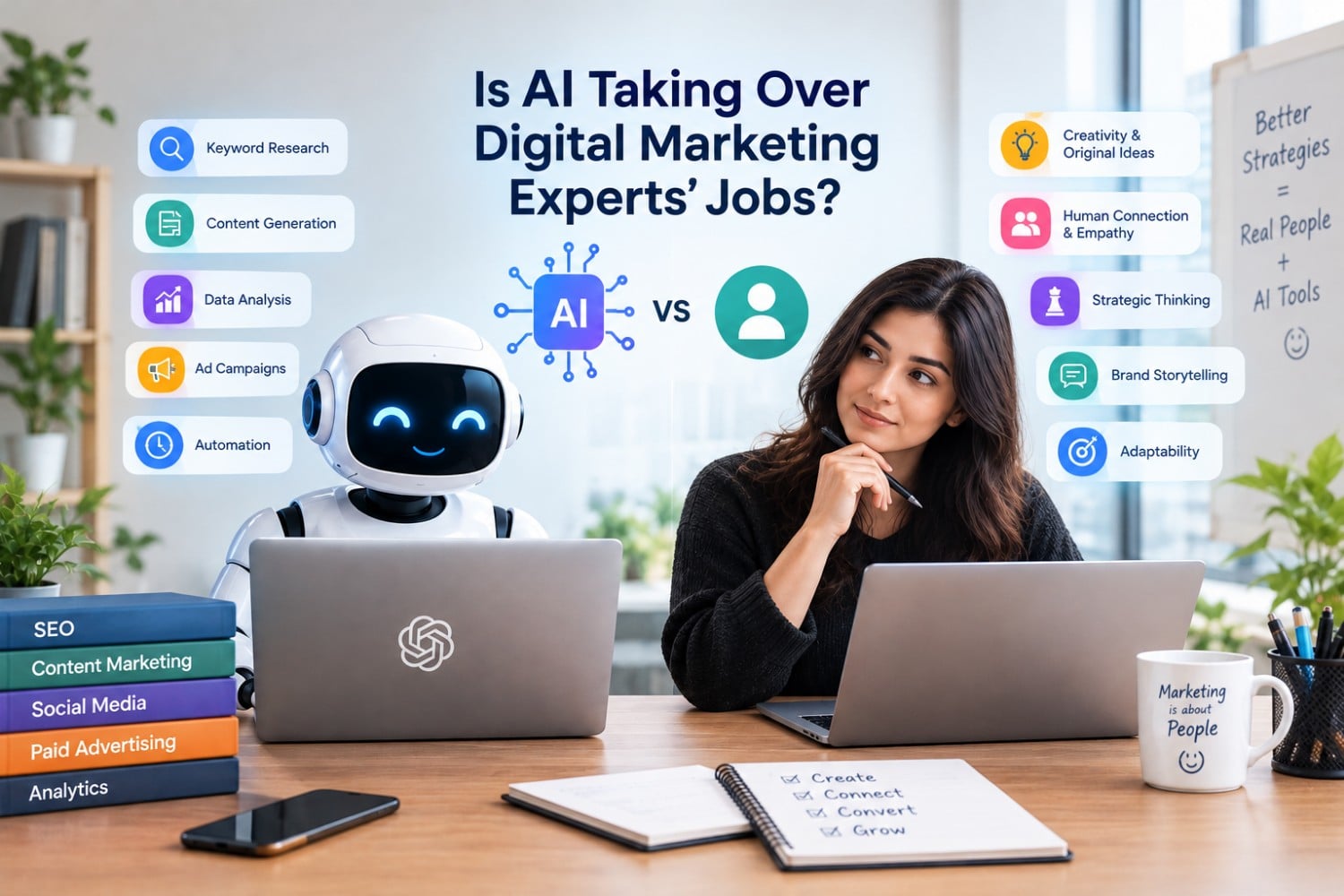
Artificial intelligence is changing the digital marketing industry faster than many businesses expected. AI tools can now analyze data, generate content, identify trends, automate campaigns, create reports, assist with SEO, and even communicate with customers. These capabilities have naturally raised an important question among digital marketing professionals:
Is AI taking over digital marketing experts’ jobs?
The short answer is no. AI is changing how digital marketers work, but it is not simply replacing them.
Instead, AI is becoming a powerful support system that helps marketers complete repetitive tasks faster, analyze larger amounts of information, and make more informed decisions. Digital marketing experts who learn how to use AI effectively may actually become more valuable as the industry evolves.
How AI Is Changing Digital Marketing
Digital marketing has always depended on technology. From analytics platforms and marketing automation software to search engine optimization tools and customer relationship management systems, marketers have continuously adopted new technologies to improve their work. AI is the next major development in this process. Modern AI tools can assist marketers with tasks such as:
- Keyword and search intent research
- Content creation
- Competitor analysis
- Data analysis
- Social media planning
- Email marketing
- Advertising optimization
- Customer segmentation
- Marketing reports
- Chatbot development
- Campaign ideas
- SEO recommendations
These capabilities can significantly reduce the amount of time marketers spend on repetitive or data-heavy tasks. However, reducing the time required to complete a task does not necessarily mean eliminating the person responsible for the overall marketing strategy.
AI Is a Support System, Not a Replacement
The most important distinction is between completing individual marketing tasks and managing an entire marketing strategy. AI can help a digital marketing agency perform a specific task, but successful digital marketing requires understanding the business, audience, market, competitors, brand positioning, and business objectives. For example, AI can analyze keyword data and suggest potential keywords. But a digital marketing expert still needs to determine:
- Which keywords are relevant to the business
- Which keywords match the company’s objectives
- Which audiences should be targeted
- Which keywords have commercial value
- How the content should be positioned
- How the strategy should connect with other marketing channels
AI can provide recommendations, but marketers still need to decide what those recommendations mean and how they should be implemented. This is why AI is better understood as a support system for marketers rather than a replacement for them.
What Tasks Can AI Automate?
AI is particularly effective at repetitive, predictable, and data-heavy tasks. For example, marketers can use AI to help with:
Content Drafting
AI can create initial drafts, outlines, headlines, product descriptions, social media captions, and other forms of marketing content. Instead of starting every piece of content from a blank page, marketers can use AI to create a starting point and then improve it.
Data Analysis
Digital marketers often work with large amounts of data from websites, advertising platforms, analytics tools, and search engines. AI can help identify patterns, summarize performance, detect unusual changes, and highlight potential opportunities. This allows marketers to spend less time manually processing data and more time interpreting it.
SEO Research
AI can assist with keyword research, search intent classification, content outlines, competitor analysis, topic clustering, and other SEO activities. However, SEO professionals still need to determine how these findings should influence the overall strategy.
Advertising Optimization
AI can analyze advertising performance and help identify patterns in clicks, conversions, audiences, and spending. It can also assist with creating different variations of advertising copy. The marketer still needs to establish the campaign objectives, positioning, budget, audience strategy, and overall direction.
Customer Support
AI-powered chatbots can answer common customer questions and provide assistance at any time. This can reduce the workload for customer service teams while allowing human employees to focus on more complex customer problems.
What AI Cannot Easily Replace
Although AI can perform many marketing tasks, there are several areas where human expertise remains extremely important.
Strategy
Digital marketing is not simply a collection of individual tasks. A successful strategy requires understanding how different activities work together.
An expert marketer may need to decide whether a company should prioritize SEO, paid advertising, social media, email marketing, content marketing, or a combination of these channels. AI can provide recommendations, but business strategy ultimately requires judgment.
Creativity
AI can generate ideas, but creativity in marketing goes beyond producing text or images. Strong marketing often requires understanding what will attract attention, create an emotional response, differentiate a brand, and communicate a unique message.
Human marketers can combine cultural understanding, experience, intuition, and creativity in ways that automated systems may not consistently reproduce.
Brand Understanding
Every business has a different identity, audience, reputation, and positioning. A marketing expert can understand the broader context of a brand and ensure that campaigns remain consistent with its objectives and personality.
AI can assist with brand content, but it needs direction and context from people who understand the business.
Decision-Making
Marketing decisions often involve uncertainty. A marketer may need to decide whether to increase advertising spending, change a campaign, target a new audience, launch a new service, or stop investing in an underperforming channel.
These decisions involve business priorities, risk, budgets, competition, and long-term objectives. AI can provide data and predictions, but humans remain responsible for making important decisions.
Relationships
Digital marketing is also about people. Marketers communicate with clients, business owners, customers, influencers, journalists, publishers, and other professionals.
Building relationships requires communication, trust, negotiation, and understanding. These human elements remain extremely important.
AI May Replace Tasks, Not Entire Careers
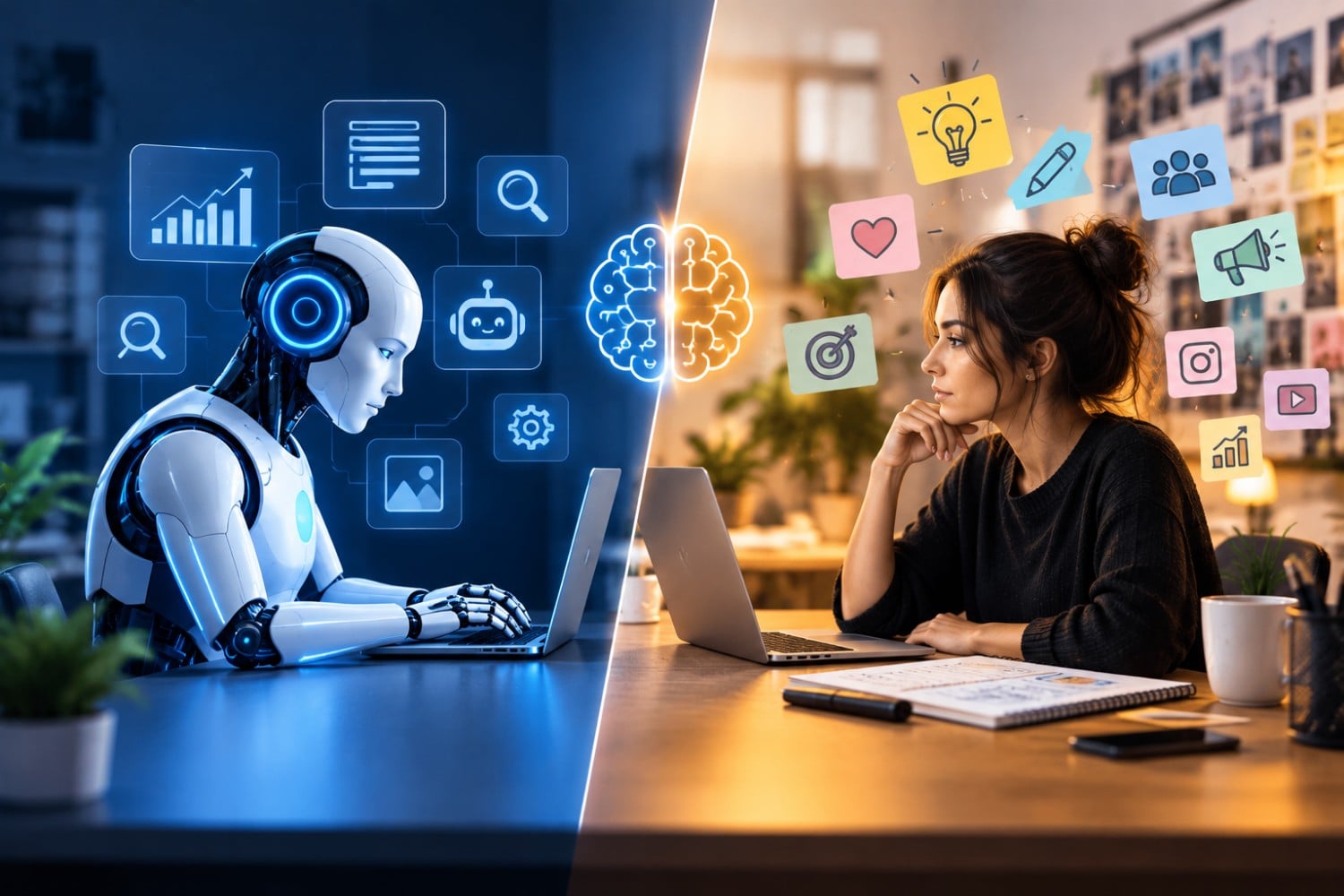 One of the most realistic ways to understand AI’s impact on employment is to separate jobs from tasks. A digital marketing job may involve dozens of different responsibilities. AI may automate some of those responsibilities without eliminating the entire role.
For example, an SEO specialist may previously have spent several hours manually analyzing keywords and competitors. With AI assistance, that process may become significantly faster. The SEO specialist can then spend more time on strategy, technical implementation, content quality, client communication, and performance analysis. In this situation, AI has not replaced the SEO specialist. It has changed how the SEO specialist spends their time.
The Digital Marketer of the Future
The digital marketer of the future is unlikely to compete against AI. Instead, they will know how to work with it. A marketer who understands both digital marketing fundamentals and AI tools can potentially accomplish more than a marketer who relies entirely on manual processes. For example, an AI-assisted marketer might use AI to:
- Analyze large amounts of data.
- Identify potential opportunities.
- Generate several campaign ideas.
- Create an initial content draft.
- Organize research.
- Summarize performance reports.
The marketer can then use their expertise to:
- Evaluate the recommendations.
- Select the most relevant strategy.
- Add original insights.
- Check accuracy.
- Adjust the messaging.
- Implement the campaign.
- Measure the results.
- Make strategic improvements.
This creates a partnership between human expertise and artificial intelligence.
AI Can Make Marketers More Productive
One of the biggest benefits of AI is productivity. A marketer who previously needed several hours to complete a repetitive research or reporting task may be able to accomplish the same task much faster with AI assistance. This gives marketers more time for activities that require human judgment.
For example, instead of spending most of the day manually preparing reports, a marketing agency could use AI to organize and summarize the data and then spend more time explaining what the results actually mean for the business. This can make marketing teams more efficient without necessarily reducing the importance of marketing professionals.
The Risk Is Not AI, but Failing to Adapt
The biggest career risk for digital marketers may not be AI itself. It may be failing to learn how AI is changing the industry. Technology has always changed digital marketing.
Marketers who refused to learn analytics platforms, automation tools, SEO software, social media platforms, or advertising technologies eventually found themselves at a disadvantage.
AI is another major technology that marketers need to understand. Digital marketing professionals who learn how to use AI effectively can improve their productivity and expand their capabilities.
Skills Digital Marketers Should Develop
As AI becomes more common, marketers should focus on developing skills that complement AI rather than competing directly with it. Important skills include:
Strategic Thinking
Understanding business objectives and developing marketing strategies will remain highly valuable.
Data Analysis
Marketers should be able to interpret data rather than simply collect it. AI can identify patterns, but marketers need to understand what those patterns mean.
SEO and Search Strategy
Search is becoming increasingly complex as traditional search engines, AI-generated answers, and other discovery platforms evolve.
Understanding search intent, content quality, technical SEO, entities, and digital visibility will remain important.
Content Strategy
Creating content is becoming easier. Developing a content strategy that produces useful, original, and differentiated information is therefore becoming even more important.
Communication
Client communication, teamwork, negotiation, presentations, and relationship building remain fundamentally human skills.
AI Literacy
Digital marketers should understand how to use AI tools, write effective prompts, evaluate AI-generated outputs, identify errors, and integrate AI into their workflows.
Will Companies Need Fewer Marketers?
AI may change the structure of marketing teams. Some companies may use AI to reduce the amount of time employees spend on repetitive tasks. However, increased productivity can also allow businesses to undertake more marketing activities.
For example, a small marketing team that previously had limited resources may use AI to conduct more research, produce more content, analyze more data, and test more campaign ideas. This means AI can potentially increase the capabilities of a marketing team rather than simply reducing its size. The impact will likely vary depending on the company, industry, marketing function, and level of AI adoption.
Human Expertise Becomes More Valuable
As AI makes basic content and marketing tasks easier to perform, expertise may become more valuable. If almost anyone can generate a basic SEO article with an AI tool, simply producing an article is no longer a significant competitive advantage. The advantage comes from knowing what should be written, why it should be written, who should read it, and what makes the information genuinely useful.
The same principle applies to advertising, social media, email marketing, analytics, and other areas of digital marketing. AI can make execution easier. Expertise determines whether the execution is effective.
AI and Human Marketers Can Work Together
The future of digital marketing does not have to be a competition between humans and AI. A better model is collaboration. AI can handle many repetitive and data-intensive activities while marketers focus on strategy, creativity, decision-making, relationships, and business outcomes. This can create a more efficient marketing workflow:
- AI provides speed and scale.
- Human marketers provide judgment and direction.
- AI processes information.
- Human marketers interpret it.
- AI generates possibilities.
- Human marketers decide which ones are worth pursuing.
- AI assists with execution.
- Human marketers remain responsible for the strategy.
Conclusion
AI is undoubtedly transforming digital marketing, but the idea that it will simply take over digital marketing experts’ jobs is an oversimplification. AI can automate certain tasks, speed up research, analyze large amounts of data, generate initial content, and improve marketing productivity. However, successful digital marketing requires much more than completing individual tasks. Strategy, creativity, business understanding, decision-making, communication, expertise, and relationship building remain critical parts of the profession. The future digital marketer should therefore not view AI as a competitor.
AI should be viewed as a support system that helps marketers work faster, analyze more information, automate repetitive activities, and focus more of their time on high-value work. The marketers most likely to succeed in the future will not necessarily be those who avoid AI. They will be those who understand how to combine AI capabilities with human expertise. AI may change the way digital marketing jobs are performed, but the human marketer remains at the center of the strategy.