




Selecting the right heat exchanger is an important decision for businesses that depend on reliable heating and cooling processes. Industrial systems often operate under different temperatures, pressures and fluid conditions, making equipment selection essential for maintaining consistent performance. A suitable plate heat exchanger Australia solution can help businesses manage thermal energy efficiently while supporting their operational requirements.
Plate heat exchangers are widely used in industrial and commercial environments because of their compact design, flexible configuration and effective heat-transfer capabilities. However, not every heat exchanger is suitable for every application. Factors such as plate material, gasket compatibility, operating temperature, pressure and fluid characteristics should be carefully evaluated before choosing equipment.
Understanding these considerations can help businesses make informed decisions when installing a new heat exchanger or replacing an existing unit.
What Is a Plate Heat Exchanger?
A plate heat exchanger is a piece of thermal equipment that transfers heat between two fluids without allowing them to mix. It consists of a series of thin plates arranged to form separate flow channels for each fluid.
One fluid enters the heat exchanger at a higher temperature, while the other enters at a lower temperature. Heat moves through the plates from the warmer fluid to the cooler fluid, allowing the required heating or cooling process to take place.
The plates are designed to provide a large heat-transfer surface within a relatively compact space. Depending on the model and application, the number of plates and the configuration of the flow channels can be selected to meet specific thermal requirements.
Why Material Selection Matters
Material selection is one of the most important aspects of heat exchanger design. The plates and gaskets are exposed to the operating fluids and must be suitable for the application’s chemical and physical conditions.
Choosing unsuitable materials may lead to corrosion, leakage, premature component deterioration or increased maintenance requirements.
Stainless Steel Plates
Stainless steel is commonly used in plate heat exchangers because it offers useful corrosion resistance and mechanical properties for many applications. It can be suitable for various water-based heating and cooling systems, depending on the fluid chemistry and operating conditions.
The appropriate stainless steel grade should be selected according to the fluid composition, temperature and potential exposure to corrosive substances.
Titanium Plates
Titanium may be suitable for applications involving certain corrosive fluids, including some environments where chloride exposure is a concern. It is used in selected industrial and process applications where its corrosion resistance provides an advantage.
However, titanium is not necessary for every application. Material selection should be based on the actual operating environment and technical requirements.
Other Material Considerations
Different applications may require different plate materials. Businesses should consider fluid compatibility, operating pressure, temperature, cleaning procedures and expected service life before making a decision.
Professional technical guidance can help identify suitable materials for demanding applications.
Understanding Gasket Compatibility
In gasketed plate heat exchangers, gaskets create seals between the plates and help direct the fluids through the correct channels.
The gasket material must be compatible with the process fluids and operating temperatures. An unsuitable gasket may become brittle, swell, deteriorate or lose its sealing ability.
Common gasket materials include elastomers selected for particular operating conditions. The appropriate option depends on the fluid composition, temperature range, cleaning chemicals and pressure requirements.
Before selecting replacement gaskets, businesses should confirm the heat exchanger model and the specifications recommended for the equipment. Similar-looking gaskets are not necessarily interchangeable.
Choosing the Right Heat Exchanger Configuration
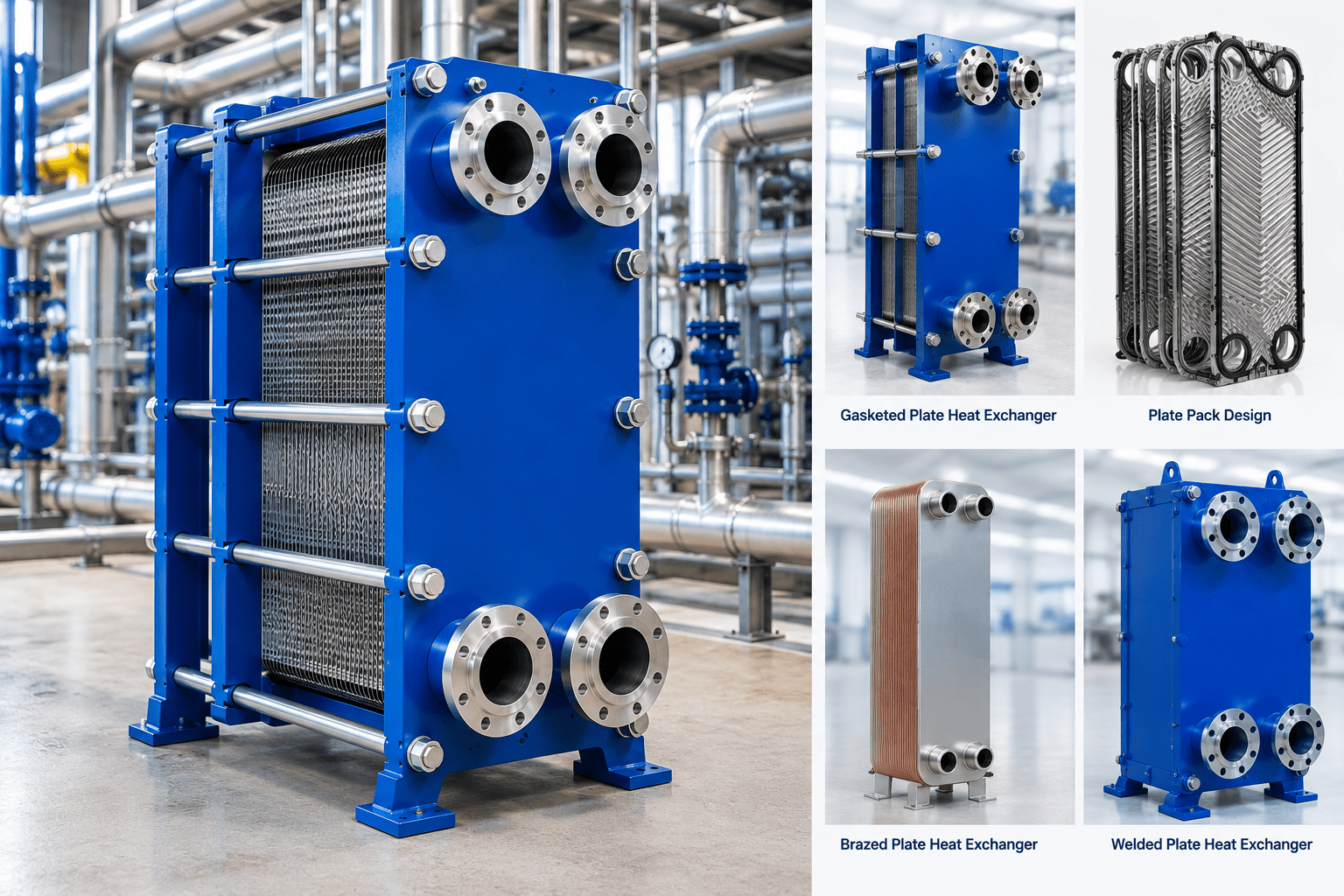
Plate heat exchangers are available in different configurations to suit different applications.
Gasketed Plate Heat Exchangers
Gasketed plate heat exchangers use removable plates held together within a frame. They are often considered where inspection, cleaning or changes to capacity may be required.
Their serviceable design can make them useful for industrial applications where maintenance access is important.
Brazed Plate Heat Exchangers
Brazed plate heat exchangers use a brazing material to bond the plates together. They typically offer a compact design and are used in suitable heating, cooling and refrigeration applications.
Because they are generally not designed to be opened like gasketed units, the intended application, fluid cleanliness and service requirements should be evaluated before selection.
Welded Plate Heat Exchangers
Welded designs may be considered for selected applications where operating conditions or fluid characteristics require a different construction approach. The appropriate design depends on pressure, temperature, fluid compatibility and the manufacturer’s specifications.
Comparing these configurations helps businesses select equipment that suits their process requirements and maintenance expectations.
Important Factors When Selecting a Plate Heat Exchanger Australia
Choosing the right plate heat exchanger Australia involves reviewing the complete operating conditions rather than focusing on equipment dimensions alone.
Heat-Transfer Capacity
The required heat-transfer duty determines how much thermal energy the unit must transfer. Engineers use process temperatures, flow rates and fluid properties to determine the appropriate capacity.
Operating Temperature
The inlet and outlet temperatures of both fluids affect the required heat-transfer surface and equipment configuration. The selected plates, gaskets and other components must also tolerate the expected temperature range.
Operating Pressure
Both fluid circuits must operate within the equipment’s specified pressure limits. Maximum operating pressure and possible pressure fluctuations should be considered during the selection process.
Flow Rate and Pressure Drop
The flow rate affects the heat exchanger’s thermal performance. Pressure drop is also important because excessive resistance can increase pumping requirements or interfere with system operation.
Fluid Properties
Viscosity, chemical composition, suspended particles and fouling potential can influence equipment performance and maintenance requirements.
Accurate information about the process fluids helps ensure that the selected unit is suitable for the application.
Available Installation Space
The physical dimensions of the equipment, pipe connections and maintenance access should be checked before installation. Adequate space can make future inspection and servicing easier.
The Importance of Correct Sizing
Correct sizing helps ensure that a heat exchanger can achieve the required heating or cooling performance under expected operating conditions.
An undersized unit may struggle to meet the required outlet temperatures, while an oversized unit may increase the initial equipment cost without providing a corresponding benefit.
Sizing should account for the thermal duty, flow rates, temperature differences, fluid properties and allowable pressure drop. Engineers may also need to consider future changes in production capacity or operating conditions.
Providing accurate process information to the supplier or equipment designer can improve the selection process and reduce the risk of performance problems.
Maintenance and Replacement Components
Regular maintenance is essential for maintaining reliable heat exchanger performance. Deposits can build up on plate surfaces, while gaskets may deteriorate through age, temperature exposure or chemical incompatibility.
Maintenance requirements vary depending on the application, operating conditions and equipment design.
Routine inspection may include monitoring temperatures, checking pressure differences, examining visible components and looking for signs of leakage. If performance changes unexpectedly, further inspection may be required.
Cleaning should follow the manufacturer’s recommendations. Incorrect cleaning chemicals or procedures can damage plates and gaskets, potentially reducing equipment life.
OEM Plate Heat Exchanger Parts Australia
When components require replacement, businesses searching for OEM Plate heat exchanger parts Australia should confirm that the parts match their equipment specifications.
Depending on the design, replacement components may include heat-transfer plates, gaskets and other associated parts. Incorrect components can affect sealing, fluid distribution and overall performance.
Before ordering replacement parts, confirm the manufacturer, model, plate dimensions, gasket profile and relevant material specifications. These details help reduce the risk of compatibility problems.
Common Heat Exchanger Selection Mistakes
Some selection mistakes can be avoided by collecting accurate operating information before purchasing equipment.
Choosing a heat exchanger based only on price may overlook important differences in materials, capacity and service requirements. Similarly, selecting plate or gasket materials without considering fluid compatibility can create reliability issues.
Another common mistake is overlooking pressure drop, cleaning access or the availability of replacement components. These factors can affect ongoing operating costs and maintenance planning.
Businesses should also avoid assuming that a unit suitable for one process will automatically perform well in another. Each application should be evaluated using its own operating conditions.
Why Choose Brantec?
Brantec provides heat-transfer solutions for industrial and commercial applications in Australia. When evaluating a plate heat exchanger Australia, businesses should consider the specific requirements of their heating, cooling or process system.
Understanding operating temperatures, fluid characteristics, flow rates, pressure requirements and maintenance needs can help identify suitable equipment and components.
For businesses replacing an existing unit or sourcing spare parts, confirming the equipment specifications is an important step towards maintaining compatibility and reliable operation.
Conclusion
Choosing the right plate heat exchanger requires careful consideration of materials, gasket compatibility, equipment configuration and operating conditions. The most suitable solution depends on the application rather than a single feature or specification.
A properly selected plate heat exchanger Australia can support efficient heat transfer, reliable operation and effective temperature control across a range of industrial and commercial applications.
Businesses should evaluate thermal capacity, flow rates, pressure, fluid compatibility and maintenance requirements before making a purchasing decision. When replacement components are needed, verifying compatibility with the existing equipment is equally important.
By taking a structured approach to equipment selection and maintenance, businesses can make informed decisions that support long-term heat exchanger performance.