



The rapid growth of inverter-based resources (IBRs) is transforming modern power systems. Solar photovoltaic plants, battery energy storage systems, and wind farms are connecting to transmission networks at an unprecedented pace. While these technologies provide valuable flexibility and clean energy, they also introduce electrical behaviors that were less common in traditionally synchronous-generator-dominated grids.
One increasingly important issue is subsynchronous oscillation (SSO). These oscillations occur at frequencies below the fundamental power-system frequency and can arise from interactions between generators, transmission networks, power-electronic controls, and series-compensated systems. As IBR penetration increases, understanding and managing these interactions has become an important part of reliable grid integration.
What Are Subsynchronous Oscillations?
Subsynchronous oscillations are electrical or electromechanical oscillations that occur below the nominal system frequency, such as 50 or 60 Hz. They can result from interactions between the electrical network and equipment connected to it.
Historically, subsynchronous resonance (SSR) was closely associated with turbine-generators connected to series-compensated transmission lines. The capacitive characteristics of series compensation could interact with the mechanical shaft modes of a large synchronous generator. Under certain conditions, this interaction could produce growing oscillations and potentially cause severe mechanical or electrical stress.
IBRs introduce a different dimension. Their behavior is strongly influenced by inverter controls, phase-locked loops, current controllers, outer control loops, plant-level controls, and grid strength. These control systems can interact with network impedances over a broad frequency range, creating oscillatory conditions that may not be identified through conventional steady-state studies alone.
Why IBR Projects Face Greater SSO Risk
The increasing deployment of IBRs means that modern grids contain a growing number of fast-acting power-electronic controllers. Unlike synchronous machines, which have physical inertia and established electromechanical characteristics, IBRs respond according to programmed control algorithms.
Several factors can increase the likelihood of problematic oscillations. Weak grid conditions are particularly important because a low short-circuit ratio can make inverter controls more sensitive to changes in voltage and network impedance. Long transmission lines, series compensation, nearby IBR facilities, and multiple converter controls can further complicate the interaction.
Another challenge is that several independently developed IBR projects may eventually operate in the same electrical area. Each project may perform acceptably when evaluated individually, yet interactions can emerge when multiple plants operate together.
This means developers and utilities increasingly need to consider not only whether an individual plant meets connection requirements, but also how its controls interact with the surrounding power system across a range of frequencies and operating conditions.
The Role of Subsynchronous Oscillation Studies
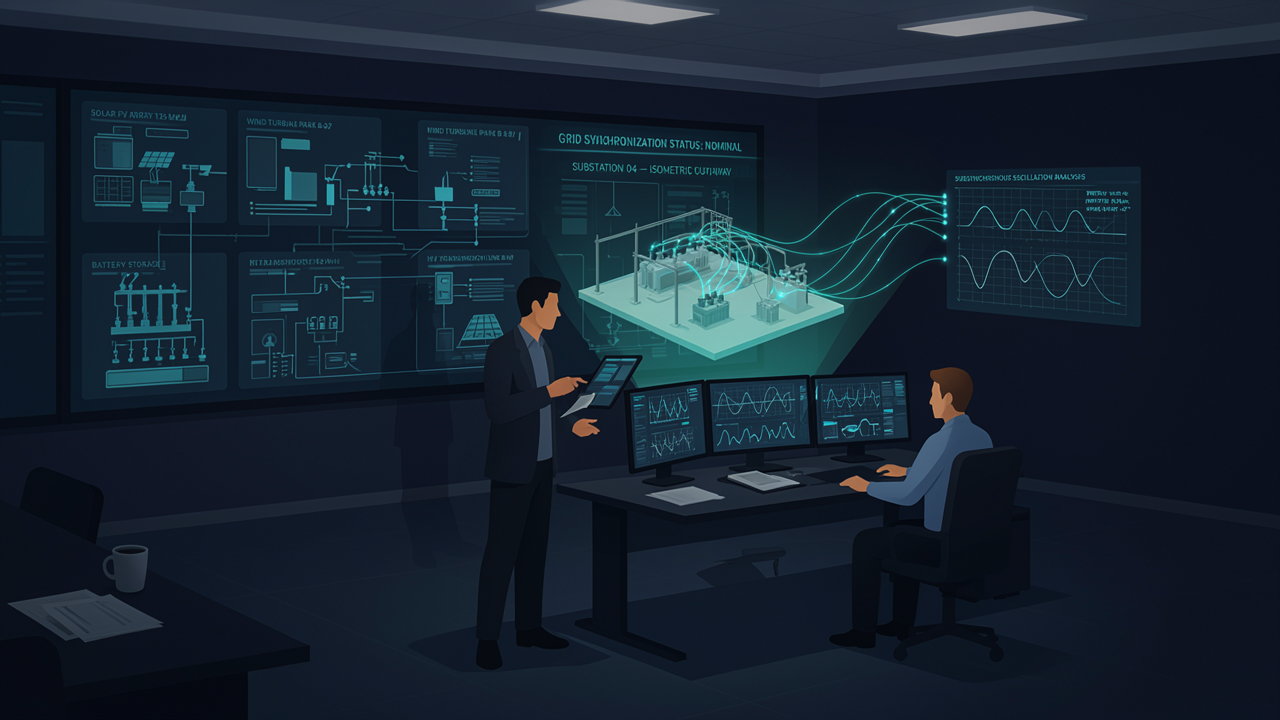
Detailed subsynchronous oscillation studies help engineers identify potential interactions before a project enters commercial operation. These studies typically examine the electrical network, IBR controls, transmission infrastructure, operating conditions, and frequency-dependent system behavior.
A key objective is identifying potentially unstable or poorly damped modes. Engineers may evaluate different generation dispatches, network configurations, transmission outages, compensation levels, and IBR operating points to determine whether an oscillatory condition is likely to occur.
Frequency-domain techniques can be particularly useful for screening. Impedance-based analysis, for example, can help identify interactions between the inverter’s output impedance and the network impedance. Such techniques can provide valuable insight into frequency ranges where the system may be vulnerable.
However, frequency-domain screening should not necessarily be viewed as the final answer. Detailed time-domain and electromagnetic transient analysis may be required when nonlinear controls, switching behavior, detailed converter models, or complex interactions are involved.
SSR, PEDI, and EMT Analysis
For projects where subsynchronous interactions are a concern, SSR and PEDI studies can provide deeper insight into potential resonance and power-electronic-driven interactions. PEDI, or power-electronic-driven interaction, is particularly relevant to modern IBR networks because the source of an oscillation may involve converter controls rather than the traditional turbine-generator mechanism associated with classical SSR.
The distinction matters because an IBR-related oscillation can involve several control loops simultaneously. For example, a converter’s current-control dynamics may interact with a phase-locked loop, while the overall response is affected by network impedance and nearby equipment.
This is where EMT studies for IBRs become especially valuable. Electromagnetic transient simulations represent electrical and control-system behavior at a much higher level of detail than conventional positive-sequence transient-stability models. They can capture fast control responses, converter interactions, switching-related effects where appropriate, and other phenomena that may be difficult to reproduce with simplified models.
EMT analysis is therefore becoming an important tool for investigating complex IBR behavior, particularly in weak-grid environments and areas with multiple converter-based resources.
How Engineers Can Reduce Oscillation Risks
Managing SSO risk begins with accurate modeling. Developers should provide validated inverter models and control parameters that reasonably represent the equipment expected to operate in the field. Inadequate or overly simplified models can produce misleading conclusions.
Engineers should also evaluate a sufficiently broad range of operating scenarios. A study that examines only one normal operating condition may overlook interactions that appear during low generation, high generation, transmission outages, different grid strengths, or changes in nearby IBR output.
Control tuning is another important mitigation option. Depending on the identified mechanism, adjustments to control-loop gains, filtering, damping functions, PLL settings, or plant-level controls may improve system performance. In some cases, network modifications or operational restrictions may also be considered.
Importantly, mitigation should be verified through additional simulations rather than assumed to work based on theoretical expectations. A control adjustment that improves one operating condition could potentially introduce an undesirable response elsewhere.
Preparing IBR Projects for a More Dynamic Grid
As power systems evolve, subsynchronous oscillations should be considered during the early stages of IBR development rather than treated as a late-stage compliance issue. Early screening can identify potential concerns before equipment specifications, controls, and interconnection designs become difficult to change.
A comprehensive approach may combine steady-state analysis, short-circuit assessment, small-signal or frequency-domain techniques, impedance-based screening, and detailed EMT simulations. Using multiple analytical methods allows engineers to examine the system from different perspectives and develop greater confidence in the conclusions.
For developers, utilities, and system operators, the goal is not simply to identify whether an oscillation exists. The larger objective is to understand why it occurs, under what conditions it becomes significant, and what practical measures can maintain adequate stability and damping.
With IBR deployment accelerating, this type of analysis is becoming increasingly important. Careful modeling, validated controls, realistic operating scenarios, and detailed electromagnetic transient assessment can help projects integrate reliably while reducing the risk of unexpected oscillatory behavior.
Keentel Engineering supports advanced power-system analysis and engineering solutions for complex grid-integration challenges, helping project teams better understand dynamic interactions and make informed technical decisions as the power grid becomes increasingly inverter-based.