





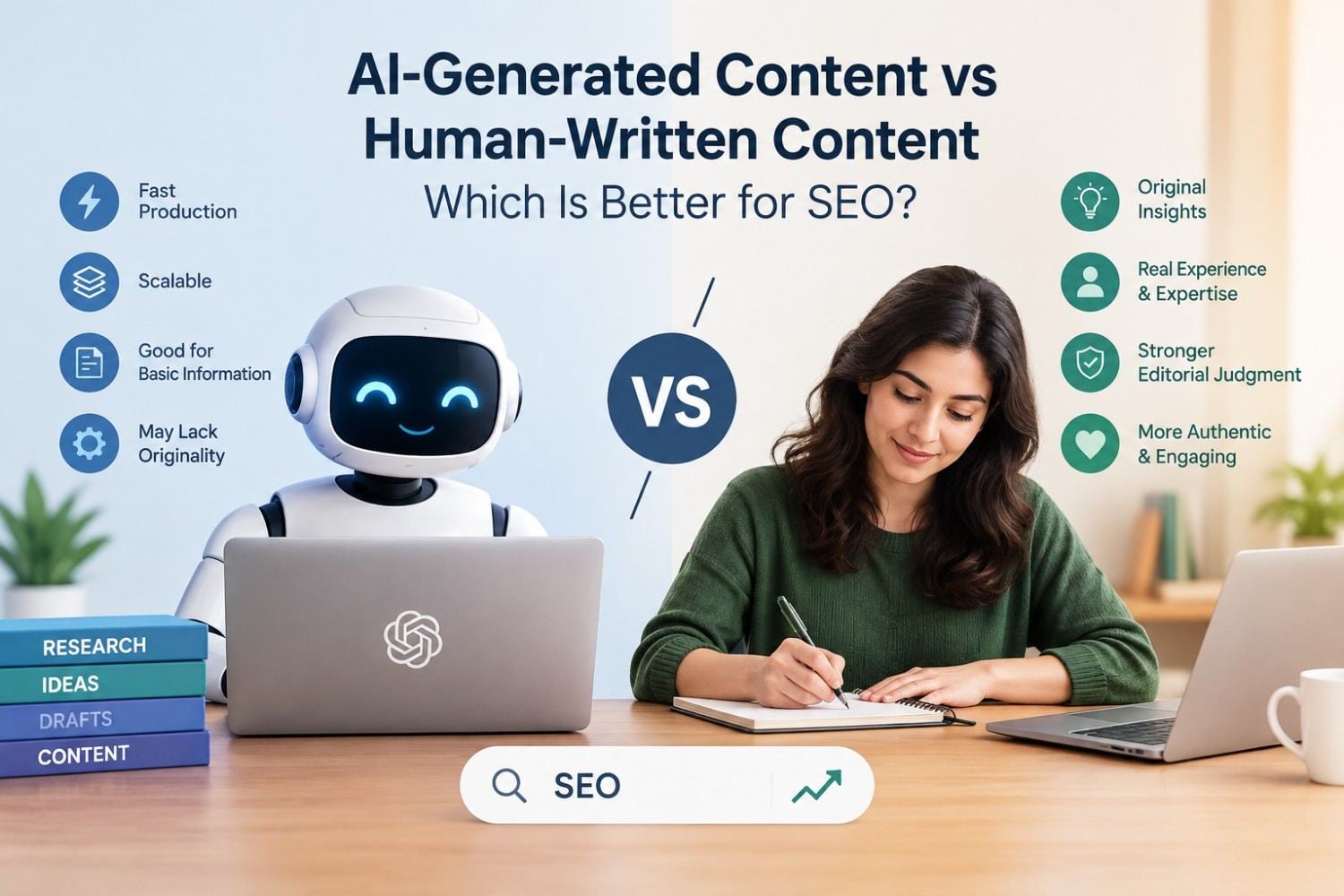
Artificial intelligence has changed the way businesses create content. With AI writing tools now capable of producing articles, blog posts, product descriptions, and other marketing content within seconds, many businesses are asking an important question: Is AI-generated content better than content written by humans for SEO?
The answer is more nuanced than simply choosing one over the other. Search engines are primarily concerned with whether content is useful, relevant, trustworthy, and created to provide value to users. AI can help businesses produce content efficiently, but human involvement remains important for expertise, originality, accuracy, and meaningful insights.
Understanding the differences between AI-generated and human-written content can help businesses develop a more effective SEO content strategy.
What Is AI-Generated Content?
AI-generated content is written or assisted by artificial intelligence tools that use large language models to generate text based on user instructions.
AI tools can create content for a wide range of purposes, including:
- Blog articles
- Website copy
- Product descriptions
- Social media posts
- Email marketing content
- FAQs
- Meta descriptions
- SEO outlines
- Content summaries
AI can produce content quickly and can help marketers overcome writer’s block, generate ideas, organize information, and create initial drafts.
However, AI-generated content may sometimes lack personal experience, original perspectives, and the level of subject-matter expertise that a knowledgeable human writer can provide.
What Is Human-Written Content?
Human-written content is created by a person who researches, evaluates, and develops the information into a finished piece of content.
Human writers can incorporate:
- Personal experience
- Industry knowledge
- Original opinions
- Expert insights
- Case studies
- Real-world examples
- Interviews
- Unique observations
- Brand-specific perspectives
This can make human-written content more distinctive and useful, particularly when the topic requires expertise or first-hand experience.
Human writing can also better reflect a company’s tone, values, audience, and unique selling points.
AI-Generated Content vs Human-Written Content
AI and human writers have different strengths. Understanding these differences is important when deciding how to approach SEO content creation.
1- Speed
AI-generated content has a major advantage when it comes to speed.
An AI tool can create an outline or first draft within seconds or minutes. This allows marketers to produce large amounts of content much faster than a traditional writing process.
Human writers generally require more time because they need to research the topic, organize information, write the content, edit it, and verify important details.
For businesses operating large content websites, AI can therefore be useful for increasing productivity.
2- Originality
Human-written content generally has an advantage when it comes to originality.
AI systems generate text based on patterns learned from existing information. While they can produce useful and unique combinations of words, the underlying ideas may not always be genuinely original.
A human expert can introduce personal experiences, original research, unique opinions, and insights that are difficult to reproduce through generic AI-generated writing.
For competitive SEO topics, this difference can be significant.
3- Expertise and Experience
Human writers can contribute something particularly valuable: first-hand experience.
For example, a professional SEO specialist writing about technical SEO may be able to explain problems they have actually encountered while working on websites.
Similarly, a doctor, lawyer, engineer, financial professional, or business owner can provide practical knowledge that goes beyond information commonly available online.
AI can summarize existing knowledge, but it does not have personal professional experience in the same way a human expert does.
This makes human expertise especially valuable for topics where trust and experience matter.
4- Accuracy
AI can produce factually incorrect information while presenting it in a confident and convincing manner.
This is one of the biggest risks of publishing AI-generated content without human review.
Human writers can also make mistakes, but a professional editorial process can involve fact-checking, reviewing sources, and verifying important claims.
For SEO content, accuracy matters because incorrect information can reduce user trust and damage a website’s reputation.
AI can assist with research and drafting, but important information should be reviewed and verified before publication.
5- Content Quality
AI can produce grammatically correct and well-structured content very quickly. However, AI-generated articles can sometimes feel repetitive, generic, or predictable.
For example, an AI-generated article about digital marketing might provide the same general advice found on hundreds of other websites.
Human writers can improve content quality by adding:
- Original examples
- Personal experiences
- Industry-specific insights
- Data and research
- Unique opinions
- Expert commentary
- Detailed case studies
These elements can make an article more useful and differentiated.
6- Tone and Brand Voice
Human writers are often better at capturing a company’s unique personality and communication style.
AI can follow a defined tone when given appropriate instructions, but generic prompts often result in generic writing.
For businesses, maintaining a consistent brand voice across website content, blogs, social media, and other marketing channels can be important.
AI can help maintain consistency, but human editors should guide and refine the final output.
Is AI-Generated Content Bad for SEO?
 No. AI-generated content is not automatically bad for SEO.
The important question is not simply whether AI was used to create the content. The more important consideration is whether the final content provides genuine value to users.
A business can use AI to help create an article while still producing high-quality content through research, expert review, editing, fact-checking, and the addition of original insights.
The problem occurs when businesses use AI to mass-produce low-quality content primarily to manipulate search rankings.
Publishing hundreds of generic AI-generated articles without proper review can create several problems, including:
- Repetitive content
- Inaccurate information
- Lack of originality
- Poor user experience
- Weak expertise signals
- Little differentiation from competitors
Therefore, using AI as a content-production shortcut without an effective quality-control process can be harmful to an SEO strategy.
Is Human-Written Content Automatically Better for SEO?
Not necessarily.
Human-written content is not automatically high quality simply because a person wrote it.
A human can produce content that is:
- Thin
- Outdated
- Poorly researched
- Repetitive
- Unhelpful
- Incorrect
- Poorly structured
- Over-optimized for keywords
If an AI-assisted article provides significantly more useful information than a poorly written human article, the AI-assisted article may offer greater value to users.
SEO success depends on the quality and usefulness of the final content rather than the label attached to its production process.
What Does Google Look For?
Search engines aim to provide users with useful and relevant results.
This means content should be created primarily for people rather than simply being produced to attract search engine traffic.
Important qualities include:
- Relevance to the search intent
- Helpful and useful information
- Original insights
- Accuracy
- Clear organization
- Demonstrated expertise
- Trustworthiness
- A good user experience
This is why the debate should not simply be “AI vs human.”
The more useful question is:
“Does this content provide something valuable that deserves to rank?”
The Best Approach: AI-Assisted, Human-Reviewed Content
For many businesses, the strongest approach is not choosing between AI and human writers.
Instead, businesses can combine the strengths of both.
AI can be used for:
- Topic research
- Content ideas
- Keyword clustering
- Search intent analysis
- Content outlines
- Initial drafts
- Content expansion
- Summarization
- Editing assistance
- Meta descriptions
- FAQ generation
Human experts can then provide:
- Original insights
- First-hand experience
- Fact-checking
- Expert opinions
- Case studies
- Brand perspective
- Editorial judgment
- Final quality control
This creates a content workflow where AI improves efficiency while humans remain responsible for quality and expertise.
Why Human Input Still Matters for SEO
Search results are becoming increasingly competitive. Creating a basic article that explains commonly available information is often not enough to stand out.
Human involvement can help content answer questions more effectively by adding information that generic AI-generated articles may not contain.
For example, instead of writing a generic article about SEO, an experienced SEO professional could include:
- Results from real campaigns
- Examples from actual websites
- Common technical problems they have encountered
- Lessons learned from failed strategies
- Industry-specific recommendations
- Original data
- Practical implementation steps
This type of information gives readers a reason to choose the content over dozens of similar articles.
AI Content vs Human Content: SEO Comparison
| Factor | AI-Generated Content | Human-Written Content |
| Writing speed | Excellent | Moderate |
| Scalability | Excellent | Limited |
| Cost efficiency | Generally high | Generally lower |
| Original insights | Limited without human input | Strong |
| First-hand experience | Limited | Strong |
| Brand voice | Requires direction | Strong |
| Research assistance | Excellent | Strong |
| Risk of factual errors | Requires review | Requires review |
| Content personalization | Good with proper prompts | Excellent |
| Editorial judgment | Limited | Strong |
| SEO potential | High when properly edited | High |
| Best use | Research, drafting, scaling | Expertise, originality, final content |
Which Is Better for SEO: AI or Human-Written Content?
There is no universal rule that human-written content will always outperform AI-generated content.
For SEO, high-quality human-written content and high-quality AI-assisted content can both perform well.
However, purely automated content that provides little original value is generally a weaker strategy than content that combines AI efficiency with human expertise.
The strongest approach is therefore a human-led content strategy supported by AI.
AI should be treated as a tool that helps writers and marketers work faster, not as a complete replacement for expertise, research, and editorial judgment.
How to Create SEO-Friendly Content With AI
Businesses that want to use AI for SEO should establish a quality-focused workflow.
Step 1: Identify Search Intent
Before generating content, understand what users actually want when they search for a keyword.
Determine whether they are looking for:
- Information
- A product
- A service
- A comparison
- A solution to a problem
- A specific website or brand
Step 2: Create a Strong Content Brief
Give the AI tool clear instructions about the target audience, search intent, topic, structure, tone, and important points that need to be covered.
A detailed brief usually produces more useful results than a simple request to “write an SEO article.”
Step 3: Add Human Expertise
Review the draft and add information that AI cannot easily provide, such as personal experiences, original research, expert opinions, case studies, and real-world examples.
Step 4: Fact-Check the Content
Verify statistics, claims, dates, names, technical information, and other important facts before publishing.
Step 5: Improve the Writing
Remove repetitive sentences, generic statements, unnecessary introductions, and information that does not directly help the reader.
The goal should be to make the article useful rather than simply making it longer.
Step 6: Optimize for Search Intent
Use relevant keywords naturally while ensuring the content actually answers the user’s query.
Avoid excessive keyword repetition or writing sentences simply to include keywords.
Step 7: Conduct a Human Editorial Review
Before publication, a human should review the final article for accuracy, usefulness, originality, readability, and brand alignment.
The Future of AI and SEO Content
AI will continue to play a major role in content marketing and SEO.
As AI tools become more sophisticated, businesses will be able to automate more parts of the content creation process.
However, increased automation may also make generic content more common.
When large numbers of websites can produce similar AI-generated articles within minutes, genuinely useful information, original research, first-hand experience, and expert insights can become even more valuable.
This means the competitive advantage may shift away from simply producing more content toward producing better and more distinctive content.
Conclusion
AI-generated content and human-written content both have advantages and disadvantages.
AI is faster, scalable, and useful for research, brainstorming, outlining, drafting, and many other SEO tasks. Human writers bring expertise, originality, experience, creativity, editorial judgment, and a deeper understanding of the audience.
For SEO, the best content is not necessarily the content written entirely by AI or entirely by a human.
The strongest strategy is to use AI as a productivity tool while keeping humans responsible for research, expertise, fact-checking, originality, and final editorial quality.
In other words, AI can help you create content faster, but human expertise can help make that content worth ranking. Follow BoostUpBlog for more latest updates.