






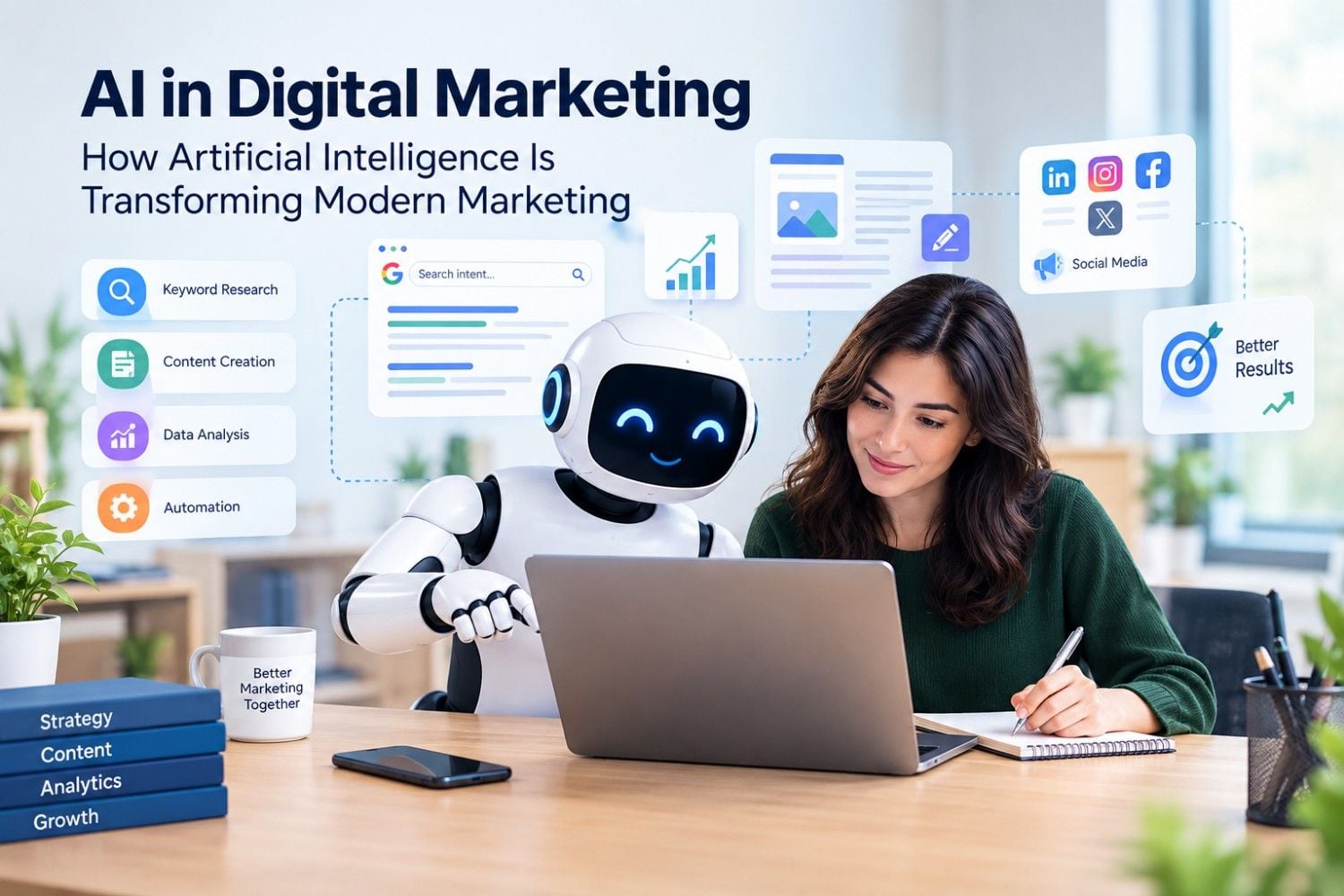
Artificial intelligence is rapidly changing the way businesses approach digital marketing. From analyzing customer behavior and personalizing campaigns to creating content and optimizing advertising strategies, AI is helping marketers make faster and more informed decisions.
As digital channels become increasingly competitive, businesses need more than traditional marketing methods to reach the right audience at the right time. AI provides marketers with tools that can analyze large amounts of data, identify patterns, automate repetitive tasks, and improve the overall customer experience.
What Is AI in Digital Marketing?
AI in digital marketing refers to the use of artificial intelligence technologies to improve marketing activities, decision-making, customer engagement, and campaign performance.
AI can process large amounts of information and identify patterns that may be difficult to detect manually. This allows marketers to better understand their audiences and optimize campaigns based on data rather than assumptions.
AI is now being used across many areas of digital marketing, including:
- Search engine optimization
- Content marketing
- Social media marketing
- Email marketing
- Paid advertising
- Customer segmentation
- Marketing analytics
- Personalization
- Chatbots and customer support
- Conversion rate optimization
Rather than replacing marketers entirely, AI can help marketing teams work more efficiently and focus their time on strategy, creativity, and decision-making.
Why AI Is Important for Digital Marketing
Modern consumers interact with brands across multiple digital channels. They may discover a company through search engines, see an advertisement on social media, visit its website, receive an email, and eventually make a purchase through another channel.
Managing these interactions creates a large amount of data.
AI can analyze this information and help marketers understand customer behavior more effectively. It can identify patterns in website visits, purchases, searches, engagement, and other interactions.
This allows businesses to make more informed decisions about where to invest their marketing resources.
AI-Powered Customer Data Analysis
 One of the biggest advantages of AI in digital marketing is its ability to process large amounts of customer data.
Traditional analysis often requires marketers to manually examine reports and identify trends. AI tools can analyze data much faster and identify patterns across different customer segments.
For example, AI can help identify:
- Which products customers are most interested in
- Which marketing channels generate the most conversions
- Which audiences have the highest engagement
- When customers are most likely to interact with a brand
- Which pages have the highest conversion potential
- Which customers may be more likely to purchase
These insights can help marketers develop more targeted and effective campaigns.
AI and Content Marketing
Content marketing is another area being significantly influenced by artificial intelligence.
AI tools can assist marketers with brainstorming topics, creating outlines, analyzing competitors, improving readability, and identifying content gaps.
However, effective content marketing requires more than generating large quantities of AI-written content.
Businesses still need original ideas, industry expertise, accurate information, and a clear understanding of their audience.
AI works best as a supporting tool that helps marketers improve their workflow rather than replacing human creativity and expertise.
For example, a marketing team could use AI to generate several content ideas and outlines, then use human expertise to develop the final article with original insights and practical examples.
AI in Search Engine Optimization
AI is also changing search engine optimization.
Marketers can use AI tools to analyze keywords, search intent, competitors, content structures, internal linking opportunities, and other SEO factors.
AI can help identify relationships between topics and suggest areas where a website may have content gaps.
Modern SEO services are increasingly focused on understanding the meaning and intent behind searches rather than simply matching exact keywords.
Businesses can use AI to better understand what their audiences are searching for and create content that addresses those needs.
However, technical SEO fundamentals remain important. Website performance, crawlability, indexing, internal linking, structured data, mobile usability, and content quality continue to play important roles in organic search performance.
AI in Social Media Marketing
Managing social media can require significant time and resources. AI can help businesses automate and improve several aspects of social media marketing.
AI-powered tools can assist with:
- Content ideas
- Post scheduling
- Audience analysis
- Sentiment analysis
- Social listening
- Performance reporting
- Content recommendations
- Customer responses
AI can also analyze audience reactions and identify which types of content generate stronger engagement.
However, brands should maintain a human voice. Social media users often value authentic communication, and excessive automation can make a brand appear impersonal.
AI-Powered Advertising
Digital advertising platforms already use machine learning and AI to improve campaign performance.
AI can analyze user behavior and advertising data to help identify audiences that are more likely to interact with or convert from an advertisement.
Marketers can use AI to assist with:
- Audience targeting
- Ad optimization
- Budget allocation
- Creative testing
- Conversion analysis
- Campaign forecasting
This can help businesses improve advertising efficiency and reduce wasted marketing spend.
AI can also help marketers test different headlines, descriptions, images, and calls to action more efficiently.
Personalization Through AI
Personalization has become increasingly important in digital marketing.
Customers expect brands to provide relevant experiences rather than showing identical messages to everyone.
AI can analyze customer behavior and use that information to personalize marketing experiences.
For example, an online store could recommend products based on previous purchases or browsing behavior. An email campaign could display different content depending on a customer’s interests or previous interactions with the company.
When used responsibly, personalization can make marketing communications more relevant and useful.
AI Chatbots and Customer Experience
AI-powered chatbots are becoming common across websites and digital platforms.
Businesses can use chatbots to answer common questions, provide product information, assist customers, and guide visitors toward relevant services.
A chatbot can operate outside normal business hours, allowing customers to receive immediate assistance.
However, not every customer interaction should be fully automated. Complex complaints, sensitive issues, and situations requiring human judgment should generally be handled by trained employees.
The most effective approach is often a combination of AI automation and human support.
AI in Email Marketing
Email marketing can also benefit from artificial intelligence.
AI can analyze customer behavior and help marketers determine which messages should be sent to different audience segments.
It can assist with:
- Subject line testing
- Content personalization
- Customer segmentation
- Send-time optimization
- Campaign analysis
- Product recommendations
Instead of sending the same email to an entire database, marketers can use AI to create more relevant communication based on customer interests and behavior.
Predictive Analytics in Marketing
One of the more advanced applications of AI is predictive analytics.
Predictive analytics uses historical and current data to identify patterns that may help marketers anticipate future customer behavior.
For example, businesses can use predictive models to estimate:
- Customer purchase likelihood
- Potential customer churn
- Demand for specific products
- Future campaign performance
- Customer lifetime value
These insights can help companies make better marketing and business decisions.
Benefits of AI in Digital Marketing
When implemented properly, AI can provide several advantages for marketing teams.
Increased Efficiency
AI can automate repetitive tasks and allow marketers to spend more time on strategic activities.
Better Data Analysis
AI can process large datasets and identify patterns more quickly than manual analysis.
Improved Personalization
Businesses can create more relevant experiences based on customer behavior and preferences.
Faster Content Production
AI can accelerate research, brainstorming, outlining, editing, and other content workflows.
Better Campaign Optimization
AI can help marketers identify opportunities to improve advertising, email, social media, and other campaigns.
More Informed Decision-Making
AI can provide data-driven insights that support marketing decisions and reduce reliance on assumptions.
Challenges of Using AI in Digital Marketing
Despite its benefits, AI also introduces several challenges.
One major concern is content quality. Automatically generated content can contain inaccurate information, repetitive language, or a lack of original insight.
Privacy is another important consideration. Businesses need to handle customer information responsibly and comply with applicable data protection requirements.
There is also the risk of over-automation. If every customer interaction is automated, brands can lose the human element that helps build trust and loyalty.
Businesses should therefore establish clear processes for reviewing AI-generated content, protecting customer data, and determining when human involvement is necessary.
How Businesses Can Start Using AI
Companies do not need to completely transform their marketing operations overnight.
A practical approach is to start with areas where AI can provide immediate efficiency gains.
Businesses can begin by using AI for:
- Content research and brainstorming
- Marketing data analysis
- Customer segmentation
- SEO research
- Social media planning
- Email personalization
- Advertising optimization
- Customer support automation
After measuring the results, businesses can gradually expand their use of AI into more advanced marketing processes.
The Future of AI in Digital Marketing
Artificial intelligence is likely to become an increasingly important part of digital marketing.
As AI technology improves, marketing platforms will become better at understanding customer behavior, predicting demand, personalizing experiences, and automating campaign management.
However, successful marketing will still require human creativity, strategic thinking, empathy, and brand understanding.
The future is therefore unlikely to be simply AI versus humans. Instead, businesses that combine AI capabilities with skilled marketing professionals will be better positioned to adapt to changing customer expectations.
Conclusion
AI is transforming digital marketing by making it easier for businesses to analyze data, personalize customer experiences, automate repetitive tasks, and optimize campaigns.
From SEO and content marketing to advertising and social media management & marketing, artificial intelligence can support almost every stage of the modern marketing process.
However, AI should be treated as a tool rather than a complete replacement for human expertise. Businesses that combine artificial intelligence with strong marketing strategies, high-quality content, responsible data practices, and genuine customer understanding can use AI to create more efficient and effective digital marketing campaigns.
The key is not simply to use AI because it is available, but to identify where it can create measurable value for the business and its customers.