







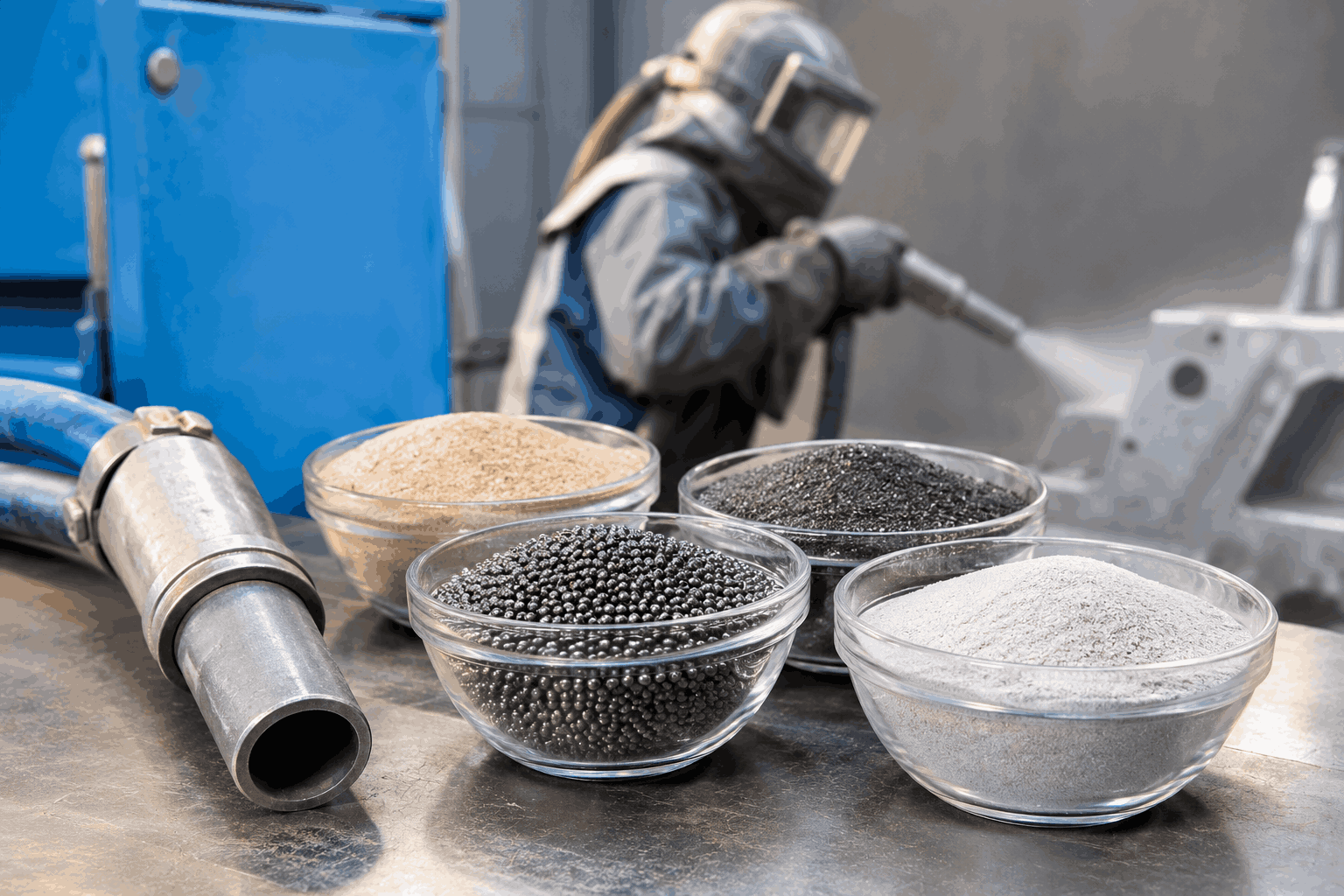
Anyone booking metal sandblasting in Toronto will have the same question, sooner or later. Which abrasive goes in the pot?
Everyone assumes the contracted sandblasting company will pick whichever abrasive is cheapest per bag, but a good contractor will select the media type for both the metal they’re blasting and the profile required by the coating.
Pick the wrong media, and it either fails to clean the metal or (far more common) damages the surface you’re trying to clean!
This guide covers the different sandblasting abrasive types, what they do, and how to match them up to the metal in front of you.
People Also Ask
What is the best sandblasting media for steel?
For rusty structural steel, use a sharp media like garnet, slag, or steel grit. For a smoother blast profile, try glass beads. The coating’s data sheet will specify how rough your steel needs to be.
Is sand still used for sandblasting?
Not often. Silica sand creates a lung hazard and is restricted in Ontario as a designated substance. We tend to avoid it and stick to safer media.
Does the media affect how long paint lasts?
The blasting media defines the coating’s profile. A good profile means the coating will last longer.
Why Media Choice Is a Specification Decision
Every coating data sheet requires a surface profile, the degree of roughness of the steel after blasting. Media determines the profile. A sharp, coarse abrasive creates a deep profile; a rounded, fine media leaves a smooth surface.
That’s why media selection isn’t a cost issue. It depends on three factors: the metal being blasted, the contaminants on the metal, and the next coat. Media is one part of the wider blast specification for industrial coatings, alongside cleanliness grade and surface profile.
Angular Media vs Round Media
Most sandblasting media falls into one of two shapes, and the shape matters more than the brand.
Angular media has sharp edges. It cuts into rust and mill scale and leaves a jagged profile for coatings to grip. Garnet, slag, steel grit, and aluminum oxide all fall in this group.
Round media hits the surface and bounces off. It cleans and smooths without cutting deep. Glass beads and steel shot are round.
Hardness plays a part too. Harder media cuts faster and deeper. Softer media removes coatings while leaving the metal underneath mostly untouched.
What Each Abrasive Is Made For
Industry Painting Ltd. works with black shot, garnet, glass beads, aluminum oxide, walnut shell, and corn. Here’s the wider range you’ll see in proposals.
Coal Slag and Mineral Abrasives
Coal slag and copper slag are hard, sharp, and used once. They’re a common pick for outdoor structural steel. The tradeoff is heavy dust and a lot of spent media to haul away. Some slags contain trace metals, so check the safety data sheet.
Garnet
Garnet is a natural mineral with sharp edges. It cuts quickly through heavy rust and mill scale and throws less dust than many slags. It’s often the first choice for steel sandblasting in Toronto plants.
Steel Grit
Steel grit is angular, tough, and reusable many times over. It’s heavy and costly to lose, so it mostly runs in blast rooms and wheel machines where the media gets swept up and recycled.
Steel Shot
Steel shot is round steel. It cleans and peens the surface instead of cutting it, so the finish stays smooth. It’s common in wheel blasting of fabricated parts.
Aluminum Oxide
Aluminum oxide is one of the hardest common abrasives. It cuts fast and holds its edge. It contains no iron, which makes it a safe pick for stainless steel and aluminum.
Glass Bead
Glass beads leave a clean, bright, satin finish. They suit parts where looks matter or where a deep profile isn’t needed. They’re not the right pick for heavy rust under a thick industrial coating.
Crushed Glass
Crushed glass comes from recycled glass, broken into sharp particles. It cuts like a mineral abrasive and is a popular slag alternative for outdoor steel.
Soda
Baking soda is very soft. It strips paint, grease, and grime without marking the metal underneath, and leaves no profile. Rinse off any soda residue before coating, because it interferes with paint adhesion.
Walnut Shell and Corn Cob
Walnut shell and corn cob are soft, natural, and gentle. They remove coatings and dirt from sensitive parts and thin surfaces without changing the metal underneath.
Matching Media to the Metal
| Metal or surface | Good choices | Avoid |
|---|---|---|
| Heavy structural steel | Garnet, slag, steel grit | Soft media, since it won’t cut mill scale |
| Thin gauge metal and siding | Fine garnet, glass bead at low pressure | Coarse media at full pressure |
| Aluminum and soft metals | Glass bead, aluminum oxide, soft media | Steel grit and steel shot |
| Stainless steel | Aluminum oxide, glass bead | Any steel media |
| Concrete and masonry | Mineral abrasives, chosen for the finish needed | Media too aggressive for the surface |
Heavy Structural Steel
Beams, columns, tanks, and silos with thick rust and mill scale need hard, sharp media. This is where most metal sandblasting services spend their time.
Thin Gauge Metal and Siding
Thin sheet warps under heavy blasting. Crews drop the pressure and switch to finer media.
Example scenario. A crew blasts a run of steel siding with coarse media at full pressure. The panels come out clean but slightly wavy, and the wave shows through the new paint on every sunny afternoon.
Aluminum and Soft Metals
Keep steel media away from aluminum. Tiny bits of steel embed in the soft surface and rust, leaving orange specks on a metal that doesn’t rust on its own.
Stainless Steel
Stainless steel has the same problem. Iron left behind by steel media rusts on the surface. Use aluminum oxide or glass bead, and plan a passivation treatment afterward to restore corrosion resistance.
Concrete and Masonry
Blasting opens up concrete and block so new coatings bond. Pick the media for the finish you want, and plan for fine dust.
Recyclable Media
Steel grit, steel shot, and aluminum oxide hold up well enough to reuse, often many times. Recycling needs recovery equipment, so it pays off mostly in blast rooms and large contained jobs.
Single-use media such as slag costs less up front but leaves more waste behind. The cheapest bag isn’t always the cheapest job.
Dust and Containment
Every media makes dust, but not the same amount. Softer and more friable media, such as slag, breaks apart on impact and throws more of it. Harder media such as garnet hold together better. Heavier dust means stronger containment and more cleanup time.
Media and Waste Disposal
Spent media mixed with old paint is waste. If the old coating contained lead, the whole pile needs testing and proper disposal. Ask who hauls the waste, and include the answer in the quote.
Why Silica Sand Isn’t Used
Blasting silica sand releases fine crystalline silica dust, a known cause of lung disease. Ontario lists respirable crystalline silica as a designated substance under Regulation 490/09, with exposure limits and control requirements. The industry moved to the alternatives above for this reason.
How to Talk About Media With Your Contractor
Ask these five questions before the job starts:
- Which media are you using, and why for this metal?
- What profile will it leave, and does it match the coating data sheet?
- How much dust will it throw, and how will you contain it?
- Is the media single-use or recycled?
- Who removes the spent media and old paint?
A contractor who answers these without hesitating has thought about your job.
Match the Media to the Metal, Not the Price
The right abrasive depends on what you’re blasting, what’s on it, and what goes on next. Sharp media for heavy rust and strong grip. Round media for a smoother finish. Soft media when the metal underneath needs protecting. And steel media never touches aluminum or stainless.
Not sure which media fits your job? Send us photos of the metal and your coating data sheet, and we’ll recommend the right choice. Call (647) 831 6201 or email info@industrypainting.ca.
Frequently Asked Questions
What is the most common sandblasting media for steel?
For structural steel, use sharp media such as garnet or slag. Blast rooms often use steel grit because it gets recycled.
Which media is safe for stainless steel?
Aluminum oxide or glass beads. Avoid steel media, since iron particles left on the surface rust.
Will blasting warp thin metal?
It will if the pressure is too high or the media too coarse. Lower pressure and finer media prevent warping.
Is soda blasting good before painting?
Soda removes coatings well but leaves no profile. Rinse off all residue, and add profile if the coating needs one.
Does Industry Painting Ltd. offer metal sandblasting in Toronto?
Yes. We blast with black shot, garnet, glass beads, aluminum oxide, walnut shell, and corn, matched to your metal and coating.