





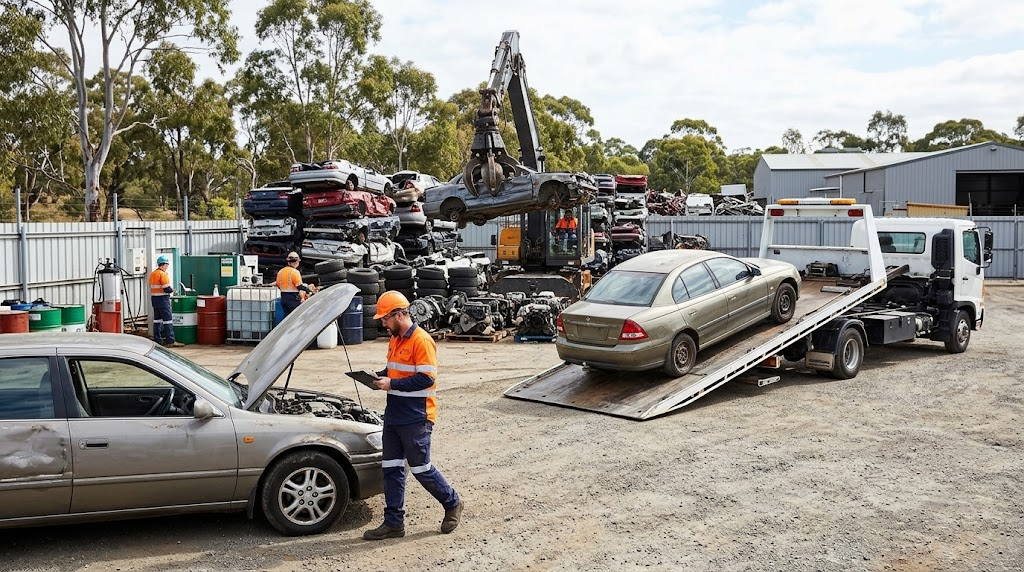
When a car reaches the end of its roadworthy life, trading it in or selling it privately is often out of the question. Between blown head gaskets, rusted chassis rails, or repair bills that exceed the car’s market value, scrapping becomes the most practical path forward.
Yet, many vehicle owners are puzzled when they receive cash offers for an old runabout. Two identical cars can receive vastly different quotes from local wreckers and metal yards. Understanding how auto recyclers assess an end-of-life vehicle (ELV) reveals the clear, data-driven calculation behind the price—rooted in vehicle mass, salvageable components, and volatile commodities trading.
The Core Valuation Triad
Auto recyclers do not pull numbers out of thin air. Instead, their pricing model balances three main pillars:
Total Valuation = Net Metal Weight (Commodity Spot Price)
                + Reusable & Salvageable Parts Margin
                - Processing, Towing & De-pollution Overheads
Every quote you receive is a reflection of this formula. Let’s break down each element to see where the value comes from.
1. Curb Weight vs. Clean Scrap Weight
The foundation of every scrap quote is pure tonnage. Recyclers deal with vehicles as physical bulk material, but raw curb weight is not what the yard can actually turn into revenue.
Curb Weight vs. Deductions
A manufacturer’s listed “curb weight” covers a complete vehicle ready to drive, including oils, coolant, fuel, rubber tyres, safety glass, interior upholstery, plastic trim, and sound-deadening mats.
When an auto wrecker puts a car through an industrial hammer-mill shredder, these non-metallic materials turn into what the industry calls automotive shredder residue (ASR) or “fluff.” Recyclers must pay waste levy fees at municipal transfer stations and landfills to dispose of ASR.
As a rule of thumb, recyclers calculate that:
-
Steel and Cast Iron: Account for roughly 65% to 70% of total vehicle mass.
-
Non-Ferrous Metals (Aluminium, Copper, Brass): Make up approximately 5% to 10%.
-
Fluff/Residue (Plastic, Glass, Textiles, Fluids): Make up the remaining 20% to 25%, representing a processing cost rather than income.
Vehicle Categories and Weight Yields
Because scrap is traded in dollars per metric tonne ($/tonne), heavier vehicles automatically set a higher valuation baseline:
-
Compact Hatchbacks (e.g., Hyundai Getz, Toyota Yaris): ~950 kg – 1,150 kg curb weight. These yield lower metal returns and proportionally higher fluff-to-metal ratios.
-
Family Sedans & Wagons (e.g., Holden Commodore, Ford Falcon): ~1,500 kg – 1,800 kg. These provide a dependable volume of heavy-gauge pressed steel and cast engine blocks.
-
Commercial 4WDs, Utes & Vans (e.g., Toyota Hilux, Ford Ranger, Nissan Patrol): ~2,000 kg – 2,800+ kg. These feature heavy box-section steel ladder frames and robust cast-iron diffs, consistently commanding top scrap valuations.
2. Salvageable Components: Where the Margin Lives
While scrap steel sets the valuation floor, functioning parts determine the ceiling. If a car is merely crushed and melted down, significant value is lost. Automotive recyclers inspect whether components can be tested, catalogued, and resold into the second-hand mechanical market.
Engine and Transmission
If an engine runs without rod knock, smoke, or overheating, its resale value far outstrips its scrap metal weight. A good gearbox or transmission can be sold to mechanics, panel beaters, or DIYers seeking affordable replacements. Conversely, if an engine has seized or thrown a rod, it drops straight to bulk scrap grade (dirty cast aluminium or mixed iron).
Catalytic Converters
The catalytic converter is often the most concentrated single point of value under an exhaust line. Fitted to clean exhaust gases, it houses a honeycomb core lined with precious metals: platinum, palladium, and rhodium.
Recyclers examine converter serial numbers to check whether the unit is an original equipment manufacturer (OEM) part or a low-value aftermarket replacement. Original converters from Japanese, European, and hybrid cars contain higher precious metal densities and significantly lift an offer. If an exhaust system is missing its converter, expect a substantial markdown.
High-Value Metals (Aluminium and Copper)
-
Alloy Wheels: A set of four factory or aftermarket aluminium alloy wheels adds instant value over standard stamped steel wheels.
-
Wiring Harnesses & Alternators: Copper wiring yields premium non-ferrous scrap rates. Alternators and starter motors contain tightly wound copper coils that are stripped or sold as electric motor scrap.
-
Aluminium Radiators & Condensers: Extracted for clean aluminium-copper matrix recycling.
Body Panels and Electronic Modules
Late-model vehicles involved in write-offs often carry undamaged tailgates, bonnet assemblies, quarter panels, and headlamp clusters. Electronic control units (ECUs), infotainment touchscreens, ABS modules, and body control modules also fetch high prices on parts-exchange networks.
3. Domestic and Global Scrap Metal Market Rates
Scrap metal is a globally traded commodity. The price a local car removalist can pay is bound to daily spot price movements on the London Metal Exchange (LME) and international shipping freight conditions.
Global Commodity Spot Prices (LME)
              ↓
Domestic Foundry & Smelter Demand
              ↓
Local Scrap Yard Buy Rates ($/Tonne)
              ↓
Cash Offer for Your Vehicle
When steel mills and foundries increase output for infrastructure and manufacturing, scrap yard buy rates lift. When global manufacturing cools, steel storage piles up, driving per-tonne quotes down.
Fuel prices also play a role. Because car removal relies on flatbed tilt-trays and heavy transport, surging diesel prices raise towing and logistical overheads, which can compress the initial payout to the seller.
For vehicle owners looking to part with broken-down, unregistered, or accident-damaged vehicles across South Australia, working with a specialist like top cash for cars adelaide makes it easy to secure a fair quote that factors in direct metal weights alongside usable auto parts, without losing margin to hidden towing fees.
4. Operational Overheads and Environmental Compliance
Auto recycling is heavily regulated in Australia to prevent environmental harm. The cash paid to you accounts for the operational time and licensing required to dismantle a car responsibly:
-
Depollution: Fluids like motor oil, brake fluid, engine coolant, transmission fluid, and residual petrol must be vacuum-drained and stored in bunded tanks for certified chemical disposal.
-
Refrigerant Recovery: Air conditioning gas (R134a/R1234yf) must be evacuated using specialised recovery stations by ARC-licensed technicians to prevent atmospheric release.
-
Battery Handling: Lead-acid and high-voltage lithium-ion batteries require dedicated recycling chains to avoid thermal runaway and soil contamination.
-
Towing Logistics: Winching an immobile vehicle with seized brakes or missing wheels from a tight suburban driveway demands time and specialised recovery equipment.
How to Maximise Your Vehicle’s Scrap Value
To walk away with the best payout, follow these simple guidelines:
-
Keep the Vehicle Intact: Do not remove the battery, alloy wheels, or catalytic converter unless you have the tools and buyers lined up to sell them separately. Stripped shells fetch minimal returns because they lose their highest-value components.
-
Accurately Describe Condition: State clearly whether the vehicle starts, rolls, steers, or has major panel damage. Transparent descriptions prevent awkward price renegotiations when the driver arrives.
-
Have Paperwork Ready: In Australia, recyclers must verify your identity to combat vehicle theft and ensure compliance with scrap metal industry codes. Have your driver’s licence and proof of ownership ready.
-
Remove Personal Items: Check the glovebox, centre console, boot floor, and under the seats for toll tags, sunglasses, loose change, and documents before the tow truck hooks on.
Frequently Asked Questions
Can I scrap an unregistered vehicle without a roadworthy certificate?
Yes. Auto recyclers do not require a Roadworthy Certificate (RWC), Safety Certificate, or active registration. You only need to verify that you are the lawful owner of the vehicle and supply proof of identity (such as a valid Australian driver’s licence). Remember to remove your registration number plates and hand them into your state transport authority (e.g., Service SA, VicRoads, Service NSW) to claim any pro-rata refund on unused registration.
Why did my neighbor get paid more for a smaller car?
Scrap value is not determined by external dimensions alone. If your neighbour’s car had an intact, high-grade catalytic converter, four alloy wheels, and an engine in high demand for wrecking, it will easily out-price a heavier car that has missing parts, severe fire damage, or a seized motor.
Is it worth stripping parts off my car before selling it for scrap?
Generally, no. Unless you run a mechanical workshop or regularly sell parts online, the time required to dismantle, clean, photograph, pack, and ship individual parts rarely offsets the discount a wrecker applies to a stripped shell. Removing key items like wheels or suspension also makes the vehicle far harder to winch onto a tow truck, which can raise collection costs.
Can recyclers legally pay physical cash for scrap cars in Australia?
In several Australian states (including New South Wales and Victoria), scrap metal industry regulations make it illegal for yards to pay physical cash for scrap metal, requiring payment via direct Electronic Funds Transfer (EFT) or cheque to curb vehicle theft and fraud. In states where cash transactions remain permissible under specific thresholds, licenced car buyers will clearly advise their accepted, compliant payout methods.
Does the distance from the yard affect my quote?
Yes. While most professional car removal services offer complimentary towing within their standard metro service areas, long rural transit times or difficult access (e.g., a car bogged in mud or blocked behind trees) require extra equipment and fuel, which may be factored into the overall valuation.