






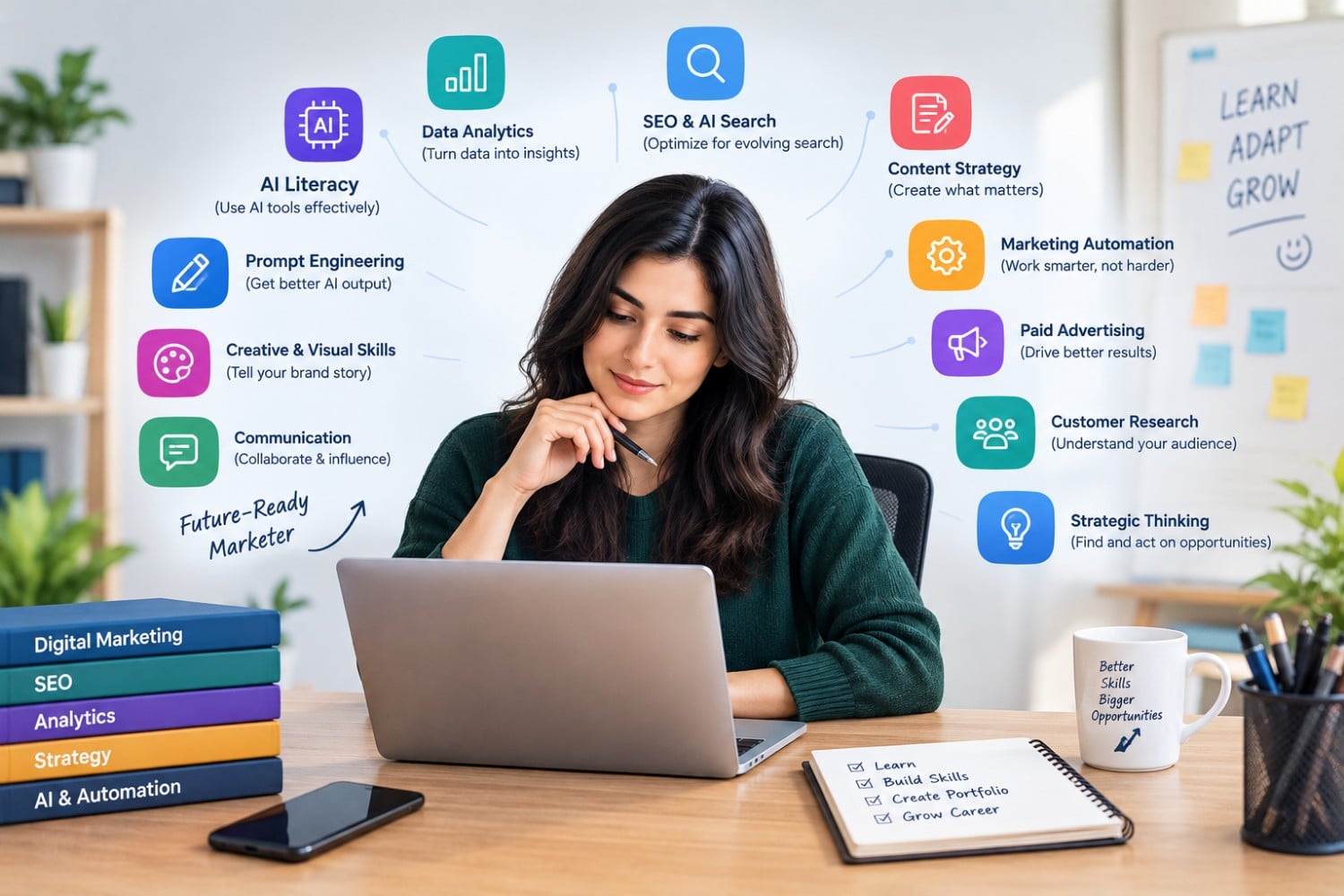
Artificial intelligence is changing digital marketing at an unprecedented pace. Tasks that once required hours of manual research, writing, analysis, and reporting can now be completed with the assistance of AI-powered tools.
For digital marketers, this change can feel both exciting and concerning. If AI can write content, analyze data, generate advertising ideas, assist with SEO, and automate repetitive tasks, what skills should a digital marketer develop to remain valuable? The answer is not to compete with AI by trying to do everything manually.
Instead, digital marketers should develop skills that allow them to use AI effectively while strengthening the areas where human expertise remains essential. The most valuable marketer in the AI era will not necessarily be the person who knows the most AI tools. It will be the person who understands marketing deeply and knows how to use AI to improve their results.
Why Digital Marketers Need to Upgrade Their Skills
Digital marketing in Saudi Arabia has always evolved alongside technology. Search engines changed SEO. Social media created new marketing channels. Analytics transformed how campaigns were measured. Marketing automation changed how businesses communicated with customers. AI is another major transformation. However, AI does not eliminate the need for marketing knowledge. Instead, it changes the skills that marketers need.
A marketer who only knows how to perform repetitive tasks may become easier to replace through automation. A marketer who can develop strategy, interpret data, understand customers, use AI, manage campaigns, and make business decisions becomes much harder to replace. This is why building a strong and diverse skill portfolio is becoming increasingly important.
1- AI Literacy
The first skill every modern digital marketer should develop is AI literacy. AI literacy does not mean becoming an AI engineer or learning how to build artificial intelligence models. It means understanding how AI works at a practical level and knowing how to use AI tools effectively.
A digital marketer should know how to use AI for:
- Research
- Brainstorming
- Content development
- SEO analysis
- Data analysis
- Competitor research
- Campaign planning
- Reporting
- Customer insights
- Marketing automation
More importantly, marketers should understand the limitations of AI. AI can generate incorrect information, misunderstand context, produce generic recommendations, and sometimes make confident but inaccurate claims. A good marketer knows when to trust AI, when to verify it, and when human judgment is required.
2- Prompt Engineering
Prompt engineering has become a useful skill for marketers working with generative AI. A basic prompt might ask: “Write an article about SEO.”
A more effective marketing prompt could specify:
- Target audience
- Search intent
- Business objective
- Brand voice
- Content structure
- Important topics
- Keywords
- Geographic market
- Desired length
- Information that should be included or avoided
The quality of AI output often depends heavily on the quality of the instructions provided. Digital marketers should therefore learn how to communicate clearly with AI systems and develop repeatable prompts and workflows. However, prompt engineering should not become the only AI skill a marketer develops. Understanding marketing is still more important than simply knowing how to write prompts.
3- Data Analytics
Data analytics is becoming one of the most important skills for digital marketers. AI can process large amounts of data, but businesses still need people who understand what the data means.
Marketers should be comfortable working with:
- Google Analytics
- Google Search Console
- Advertising dashboards
- Conversion data
- Traffic data
- Customer data
- Engagement metrics
- Campaign performance
- Excel or spreadsheet tools
- Business intelligence platforms
A marketer should not simply report that website traffic increased by 20%. They should be able to explain why it increased, whether the increase is valuable, what changed, and what the business should do next. AI can help analyze the numbers. The marketer provides the business interpretation.
4- SEO and AI Search Optimization
 SEO remains an important skill, but the search environment is changing. Digital marketers should understand traditional SEO fundamentals while also learning how AI is influencing search and content discovery.
Important areas include:
- Keyword research
- Search intent
- Technical SEO
- On-page SEO
- Internal linking
- Structured data
- Content optimization
- Entity understanding
- Topical authority
- Local SEO
- AI search visibility
- Generative search experiences
The goal should not simply be ranking a webpage for a keyword. Marketers increasingly need to understand how information is discovered and presented across traditional search engines and AI-powered search experiences.
5- Content Strategy
AI has made content production much easier. This means content strategy is becoming more important. When almost anyone can generate an article within minutes, simply producing more articles is unlikely to provide a strong competitive advantage.
Digital marketers should therefore learn how to develop content strategies based on:
- Audience needs
- Search intent
- Business objectives
- Customer journey
- Topic relevance
- Content gaps
- Original research
- Industry expertise
- Conversion goals
A strong marketer should know what content needs to be created, why it needs to be created, and what business objective it should support. AI can assist with production. The marketer should control the strategy.
6- Human-Led Content and Editorial Skills
AI can generate text quickly, but human editorial skills remain extremely valuable.
Digital marketers should be able to identify:
- Generic writing
- Incorrect claims
- Repetitive information
- Weak arguments
- Poor structure
- Unclear messaging
- Missing context
- Unsupported claims
They should also be able to improve AI-generated drafts by adding:
- Original insights
- Expert opinions
- First-hand experience
- Case studies
- Real examples
- Brand perspective
This is especially important for businesses that want content that stands out rather than simply adding another generic article to the internet.
7- Marketing Automation
Automation is another major skill marketers should add to their portfolios. AI and automation can work together to reduce repetitive marketing work.
Marketers can learn how to automate workflows such as:
- Lead management
- Email sequences
- Customer segmentation
- Reporting
- Content distribution
- Social media scheduling
- CRM updates
- Lead notifications
- Data collection
Tools such as marketing automation platforms, CRM systems, workflow automation software, and AI integrations can allow marketers to build efficient systems. A marketer who can design these workflows can provide value beyond individual marketing tasks.
8- Paid Advertising and Performance Marketing
AI is increasingly being integrated into advertising platforms. However, this does not make paid advertising knowledge irrelevant.
Marketers still need to understand:
- Campaign objectives
- Audience targeting
- Budget allocation
- Conversion tracking
- Ad creative
- Landing pages
- Customer acquisition costs
- Return on ad spend
- A/B testing
- Funnel performance
AI can help optimize campaigns, but marketers need to understand the business goals behind the campaigns. A digital marketer should therefore learn how to work with AI-powered advertising systems rather than assuming AI can manage everything automatically.
9- Conversion Rate Optimization
Driving traffic is only one part of digital marketing. Businesses ultimately want visitors to take valuable actions.
These actions could include:
- Purchasing a product
- Submitting a form
- Calling a business
- Booking an appointment
- Requesting a quote
- Signing up for a service
- Downloading a resource
Conversion rate optimization helps marketers understand why visitors do or do not convert.
Marketers should learn about:
- Landing page optimization
- Calls to action
- User experience
- A/B testing
- Conversion funnels
- Form optimization
- User behavior
- Customer objections
This is a valuable skill because it connects marketing activity directly to business results.
10- Customer Research and Consumer Psychology
AI can analyze customer data, but marketers still need to understand the people behind that data.
Understanding customer psychology can help marketers answer questions such as:
- Why does a customer choose one product over another?
- What problem are they trying to solve?
- What prevents them from purchasing?
- What messaging attracts their attention?
- What concerns influence their decision?
- What motivates them to take action?
Customer research, interviews, surveys, reviews, feedback, and behavioral analysis can provide valuable insights. The ability to understand customers remains one of the strongest human advantages in marketing.
11- Brand Strategy
Brand strategy is another area where marketers can differentiate themselves from automation. A brand is more than a logo or color scheme.
Marketers need to understand:
- Brand positioning
- Target audience
- Value proposition
- Brand voice
- Differentiation
- Messaging
- Competitive positioning
- Customer perception
AI can generate marketing messages, but marketers need to determine what the brand should actually communicate. Strong brand strategy requires business understanding and strategic judgment.
12- Social Media Strategy
Knowing how to post on social media is no longer enough. AI can generate captions, content ideas, and posting schedules. Therefore, marketers should develop deeper social media strategy skills.
These include:
- Audience research
- Platform selection
- Content strategy
- Community management
- Social listening
- Influencer marketing
- Performance analysis
- Campaign planning
- Brand reputation management
The objective should be to understand why a brand should publish something, not simply how to publish it.
13- Email Marketing
Email remains an important digital marketing channel. AI can assist marketers with subject lines, email drafts, personalization, segmentation, and campaign ideas.
However, marketers should still understand:
- Email strategy
- Customer segmentation
- Lead nurturing
- Conversion funnels
- Personalization
- Deliverability
- A/B testing
- Customer retention
A marketer who combines email marketing knowledge with AI-powered personalization and automation can create highly efficient campaigns.
14- Video and Visual Content
Digital marketing is becoming increasingly visual. Short-form video, social media graphics, presentations, advertisements, and other visual formats are important parts of modern marketing. AI can help marketers generate images, videos, scripts, storyboards, and creative concepts.
However, marketers should still understand basic principles of:
- Visual communication
- Storytelling
- Video structure
- Creative direction
- Branding
- Audience attention
- Social media formats
Marketers do not necessarily need to become professional designers or filmmakers. They should understand enough to direct and evaluate visual content effectively.
15- Communication and Presentation Skills
Technology cannot replace the importance of communication.
Digital marketers often need to communicate with:
- Clients
- Business owners
- Designers
- Developers
- Sales teams
- Content writers
- Executives
- Customers
Being able to explain marketing concepts clearly is a valuable professional skill. A marketer may have excellent technical knowledge, but if they cannot explain their recommendations or communicate results effectively, their value may be difficult for a business to recognize.
16- Strategic Thinking
Strategic thinking may become one of the most important skills in the AI era. AI can generate dozens of ideas in seconds. The challenge is determining which ideas are actually worth pursuing.
Strategic marketers know how to:
- Set priorities
- Identify opportunities
- Evaluate risks
- Allocate resources
- Understand competition
- Connect marketing activities with business goals
- Measure outcomes
The ability to make good decisions becomes more important when technology makes information and ideas abundant.
17- Critical Thinking and AI Output Evaluation
One of the most overlooked skills in the AI era is the ability to evaluate AI-generated information. AI outputs should not automatically be treated as correct.
Marketers need to ask:
- Is this information accurate?
- Is the source reliable?
- Does this recommendation make sense?
- Is the content relevant to the audience?
- Does this strategy support the business objective?
- What information is missing?
- What assumptions is AI making?
Critical thinking allows marketers to use AI without becoming dependent on it.
18- Portfolio Building
Learning these skills is important, but marketers should also demonstrate them.
A strong portfolio can include:
- SEO case studies
- Content strategy examples
- AI-assisted content workflows
- Analytics reports
- Paid advertising campaigns
- Conversion optimization projects
- Marketing automation workflows
- Social media campaigns
- AI search optimization projects
- Before-and-after campaign results
Instead of simply listing “AI” as a skill on a CV, marketers should demonstrate how they used AI to solve a real marketing problem.
For example:
“Used AI-assisted analysis to identify content gaps and developed a content strategy that increased organic traffic.” This is much stronger than simply writing: “AI tools.”
Which Skills Should a Digital Marketer Prioritize?
Not every marketer needs to master everything. A practical skill portfolio can be divided into several categories.
| Skill Area | Importance in AI Era |
| AI literacy | Very High |
| Data analytics | Very High |
| Marketing strategy | Very High |
| SEO and AI search | Very High |
| Content strategy | Very High |
| Critical thinking | Very High |
| Marketing automation | High |
| Paid advertising | High |
| Conversion optimization | High |
| Customer research | High |
| Brand strategy | High |
| Social media strategy | High |
| Email marketing | High |
| Visual content | Medium to High |
| Prompt engineering | Medium to High |
| Communication | Very High |
Should Digital Marketers Become AI Experts?
Not necessarily. A digital marketer does not need to become a machine learning engineer or AI researcher. The goal is to become an AI-enabled marketer. This means understanding enough about AI to use it effectively in everyday marketing work.
For most marketers, the ideal combination is:
Marketing expertise + AI literacy + data skills + strategic thinking. This combination can be more valuable than becoming highly specialized in AI tools without understanding marketing fundamentals.
The Skills That AI Cannot Easily Replace
Some skills are particularly difficult to automate completely because they depend heavily on human judgment and context.
These include:
- Strategic thinking
- Leadership
- Communication
- Relationship building
- Negotiation
- Creativity
- Business judgment
- Customer empathy
- Brand understanding
- Decision-making
Digital marketers should therefore invest heavily in these areas while also learning how to use AI effectively.
The Future Digital Marketing Skill Set
The digital marketer of the future will probably look different from the traditional digital marketer. Instead of spending most of their time performing repetitive tasks, they may spend more time managing AI-assisted workflows, analyzing results, developing strategies, understanding customers, and making decisions.
The future skill set could look something like this:
Digital Marketing Fundamentals
+
AI and Automation
+
Data Analytics
+
SEO and AI Search
+
Content Strategy
+
Business and Strategic Thinking
+
Human Communication Skills
This combination can make a marketer more adaptable as technology continues to evolve.
Conclusion
AI is not making digital marketing skills irrelevant. It is changing which skills are most valuable. Marketers who rely entirely on repetitive tasks may face greater pressure as AI and automation improve. However, marketers who combine strong marketing knowledge with AI literacy, analytics, strategy, creativity, communication, and business understanding can become significantly more valuable.
The goal should not be to compete with AI. The goal should be to become the marketer who knows how to use AI better than the competition.
- AI can generate information.
- Marketers provide direction.
- AI can analyze data.
- Marketers provide interpretation.
- AI can create content.
- Marketers provide expertise.
- AI can automate tasks.
Marketers decide what should be automated and why. The most future-ready digital marketer is therefore not the one who ignores AI or depends entirely on it. It is the marketer who combines the speed and capabilities of AI with the strategy, judgment, creativity, and human understanding that make marketing effective.