







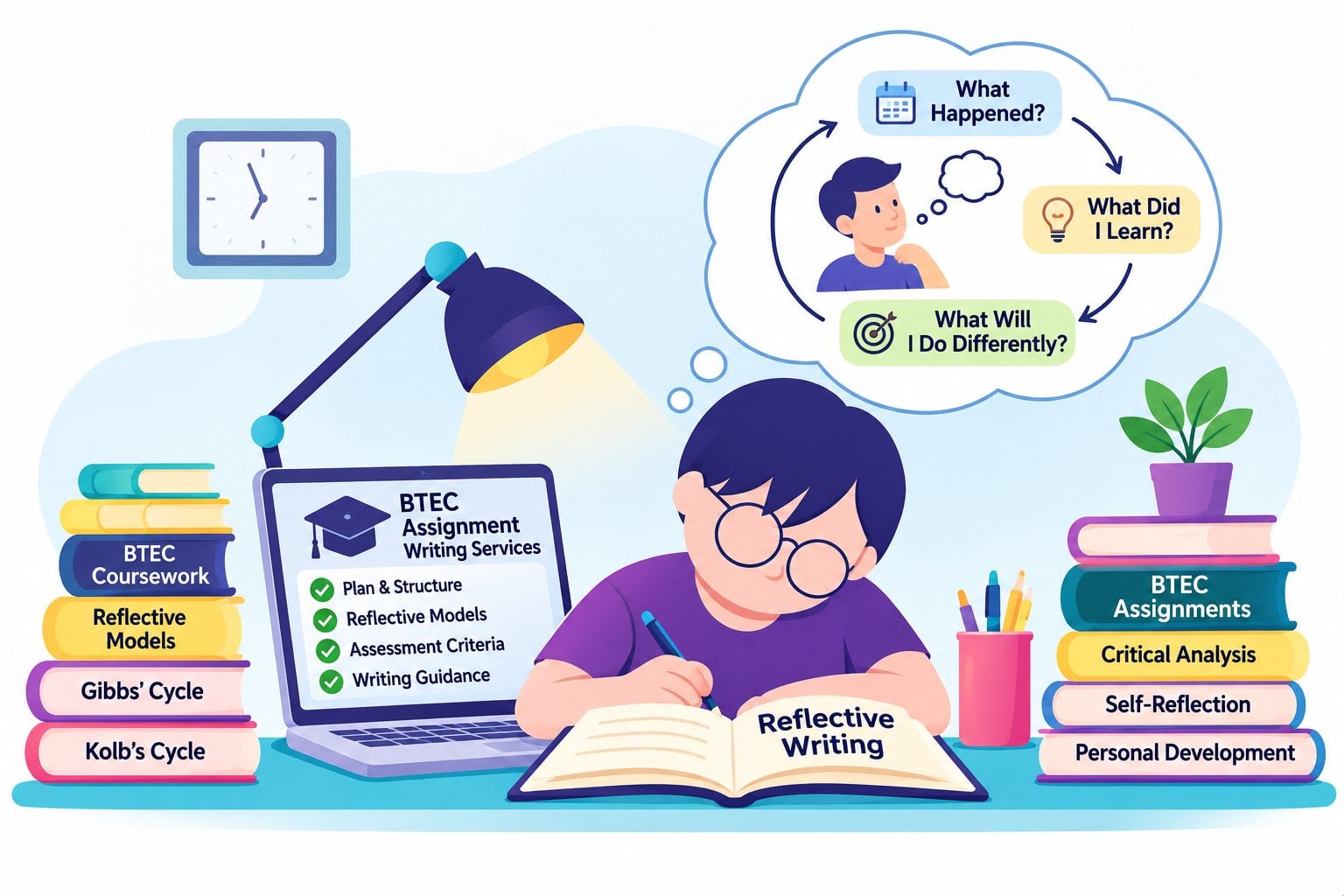
Reflective writing is typically required across all BTEC courses. It focuses on students’ experiences and helps them articulate what they’ve learned and how they can improve. Students often struggle with this task because they find it hard to connect their practical experiences to the course requirements.
BTEC Assignment Writing Services can help. This service focuses on planning, structuring, and reviewing reflective writing tasks. This service helps students capture their ideas and experiences and articulate them clearly and logically.
Reflective Writing in BTEC Assignments
In this type of writing, a person is expected to analyse an experience and articulate what they’ve learned from it. It focuses on the individual’s experiences and how they have supported their academic learning and personal development.
For example, a BTEC Business student may reflect on a group presentation and explain their role, the challenges they faced, and how this helped them identify the communication skills they need to improve.
Reflective writing is intended to answer the following questions:
- What was the experience?
- What did you learn from the experience?
- What will you do differently from now on?
This is what students often struggle to determine when seeking help with BTEC assignments.
Why do BTEC students find reflective writing challenging?
While describing an event may seem like the gist of reflective writing, explaining why it happened and what you learned is also important. Students may find it challenging to delve into these details.
1. Difficulty Organising Thoughts
Students may struggle to generate enough ideas. If they do, they may struggle to organise and communicate them precisely. Consequently, their reflections may become long and confusing, or include repetitive ideas.
2. Lack of Critical Thinking
Students may write only about the facts and miss the opportunity to analyse how their actions contributed to the outcome.
3. Connecting Experience With Theory
Students may find it difficult to recognise their work-related experiences in the theories they learn in the classroom. This is primarily because students lack adequate prior knowledge or relevant work experience.
4. Understanding Assessment Requirements
If students fail to integrate the learning outcomes into their reflections, it may make it difficult for assessors to distinguish their skills and knowledge in the area being reflected on.
How do BTEC Assignment Writing Services Help with Reflective Tasks?
Students can gain a solid understanding of reflective writing through professional academic guidance, without replacing their first-hand experience and independent effort.
Understanding the Assignment Brief
To write an assignment, a student must identify the tutor’s expectations. Writing services can help a student identify the assessment criteria and learning outcomes.
This information helps a student to be specific and eliminate irrelevant details in their reflection.
Developing a Reflective Account
There are several ways in which a student can be assisted in organising their reflection. The organisation may take the form of an introduction, an account of an experience, analysis, learning points, and future improvements.
With BTEC assignment assistance, a student may learn how each part contributes to a reflection.
Building Critical Understanding
Reflective writing requires the student to identify the reasons or the causes for the outcomes and/or actions. For example, rather than writing “The team struggled with communication,” the student may reflect on team members’ actions and explain what caused the communication challenges and how to avoid them in the future.
This example illustrates a deeper, more meaningful understanding.
Using Reflective Models
Students can use reflective models to help order their experiences logically.
There are two main models:
- Gibbs’ Reflective Cycle focuses on experiences by examining the description, feelings, evaluation, analysis, conclusion, and planning what to do next.
- Kolb’s Experiential Learning Cycle focuses on connecting experience, reflection, and conceptual understanding and future practice.
Students will use these models only when assignment requirements call for their use.
Developing Academic Writing Skills
Academic writing uses clear language, appropriate expressions, and logical paragraphs. When searching for BTEC assignment services in the UK, students can find help with grammar, sentence structure, referencing, and proofreading.
However, the reflection must genuinely reflect the student’s ideas, thoughts, and learning.
Concrete Suggestions for Writing Better BTEC Reflections
Reflective assignments can be improved by following a few practical steps. Start with a real experience. Examples include a specific class activity, a work task, or a project.
- Be specific. Use real, specific examples instead of general, vague statements.
- Analyse your decisions. Was something successful or unsuccessful, and why?
- Relate your learning to acting. How will your learning change your behaviour or actions in the future?
- Understand the assessment criteria. Make sure your reflections address the required learning outcomes.
Using these habits should improve your reflective writing and promote independent learning.
How BTEC Assignment Helper UK Can Assist Students
Understanding the purpose and structure of reflective assignments helps students to manage them better. BTEC Assignment Helper UK offers coursework assistance with planning, research, referencing, and writing.
With this support, students can understand different reflective models, organise their ideas, and identify weaknesses in their work. However, students can retain ownership of their work.
This builds students’ confidence and develops a skill they can use throughout their educational career.
Final Thoughts
Reflective writing helps BTEC students review their experiences and gives them the chance to practice skills relevant for other levels of their learning.
The goal of BTEC Assignment Writing Services is the same. This helps students understand the structure and the criteria for other assessments. Reflections are often very subjective; therefore, the goal is to help students be critical of their learning.
Frequently Asked Questions
1. What is the importance of reflective writing in BTEC assignments?
Reflective writing helps students analyse their experiences, identify strengths and weaknesses, and inform future actions.
2. Can BTEC assignment writing services help with reflective assignments?
Yes. They help students with reflective assignments by advising them on structure, reflective models, assessment criteria and requirements, and academic writing.
3. What is the best reflective model for BTEC coursework?
The Gibbs’ Reflective Cycle and Kolb’s Experiential Learning Cycle are two models that students can choose from. The best choice depends on the model used in the assignment.
4. How can students achieve critical reflection?
To achieve critical reflection, students should explain events, consider multiple options, evaluate their actions and decisions, and identify lessons for future situations.
5. Is reflective writing and academic essay writing the same?
No. Reflective writing focuses on the person and their experience, while academic essay writing focuses on research and theory and gives reasons for conclusions drawn.