






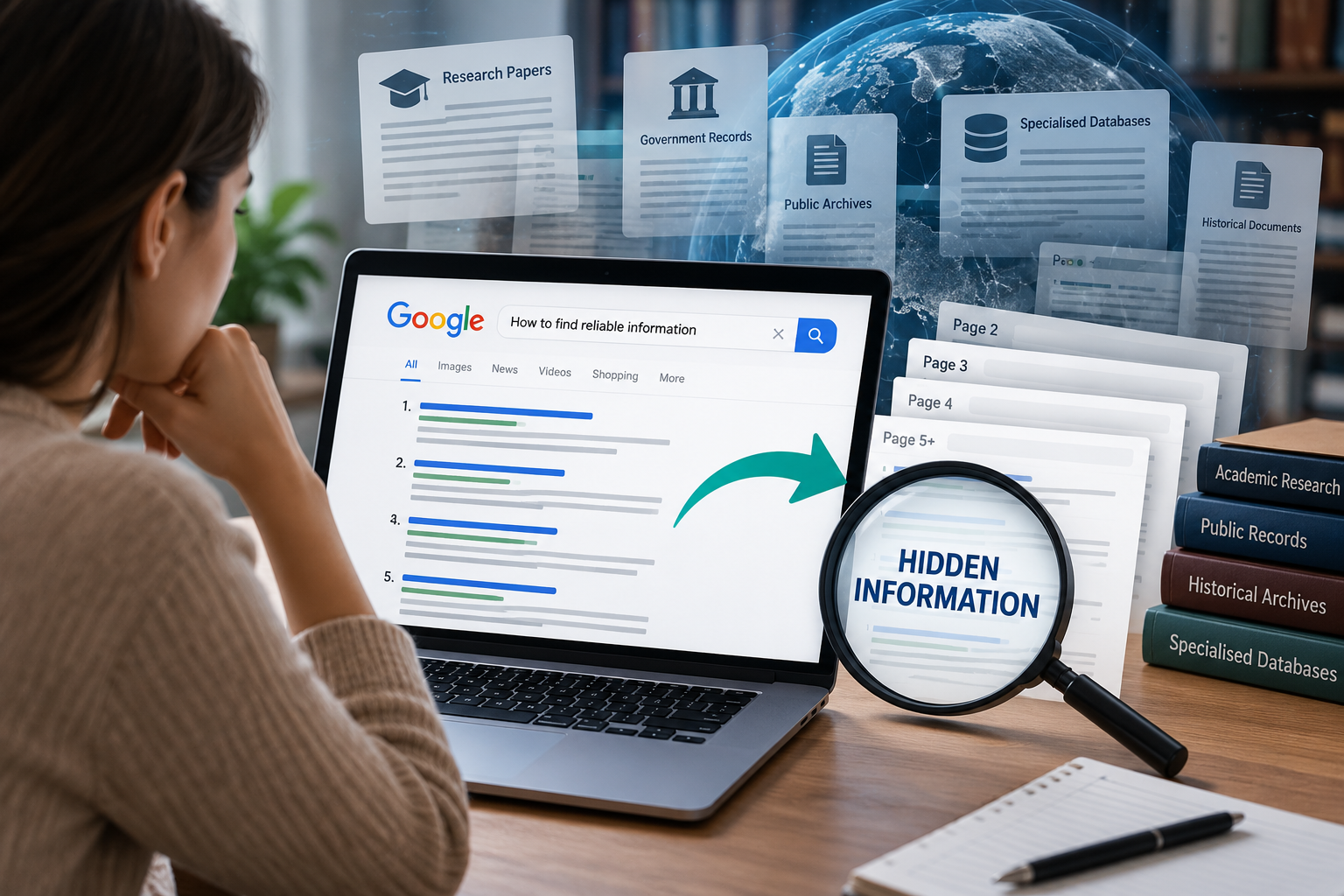
Google makes finding information easier, but the most useful sources do not always appear on the first page of search results. Many valuable research papers, government documents, historical records, and specialised resources remain difficult to discover through ordinary searches. Search rankings depend on several factors, including relevance, content quality, website accessibility, and how well pages match particular queries.
Finding trustworthy information beyond popular search results requires a more thoughtful research approach. By using advanced search techniques, exploring specialised databases, and evaluating sources carefully, researchers can discover useful information that might otherwise remain overlooked.
Why Valuable Information Gets Buried in Search Results
Search engines organise enormous amounts of online content to help users find relevant answers. However, high rankings do not necessarily mean that a source contains the most complete or accurate information. Some authoritative websites receive limited visibility because their content is highly specialised, poorly optimised, or difficult for search engines to index.
Academic institutions, public archives, and smaller research organisations may publish valuable materials without focusing on search engine optimisation. Older documents can also become harder to find when newer articles dominate search results. Understanding these limitations encourages researchers to explore beyond the most visible websites rather than assuming that the first few results contain everything worth knowing.
Use Advanced Google Search Techniques
Advanced search operators can help uncover information that ordinary keyword searches miss. Instead of entering broad questions, researchers can combine specific terms with operators that narrow the results.
For example, the site: operator restricts searches to a particular website or domain, while filetype: can help locate PDFs and other documents. Searching for an exact phrase can identify pages containing particular wording. Excluding irrelevant terms may also improve results when a subject has multiple meanings.
These techniques are especially useful when researching technical subjects, historical events, or industry regulations. Changing search terms and trying related terminology can reveal resources that were previously hidden among less relevant results.
Explore Specialised Databases and Digital Libraries
Not every reliable source is easily discoverable through general search engines. Universities, government departments, professional organisations, and research institutions often maintain their own databases containing detailed information.
Google Scholar can help locate academic publications, while PubMed provides access to biomedical research literature. Government archives, official statistical databases, and university repositories can offer original documents and research materials.
Some databases require subscriptions, but many provide free access to abstracts, reports, or complete publications. Searching these resources directly can produce more focused results than relying exclusively on general web searches.
Investigate Public Records and Archived Information
Public records can provide valuable evidence when researching organisations, businesses, property ownership, or historical activities. Depending on the jurisdiction, official registries may contain company formation details, regulatory filings, court records, and other publicly accessible documents.
People researching their own online presence may also use the phrase deep search your name to explore older profiles, public mentions, archived pages, and information that does not appear in ordinary searches. Such investigations should prioritise legitimate public sources and respect personal privacy.
The Internet Archive and other digital preservation projects can help researchers examine historical versions of websites. However, archived information should be checked against current records because older content may no longer be accurate.
Evaluate the Credibility of Every Source
Finding information beyond the first page is only useful when the material is trustworthy. A website appearing deeper in search results is not automatically more reliable than a highly ranked page.
Begin by examining who published the information and whether the author has relevant expertise. Look for supporting evidence, original documents, publication dates, and transparent references. Official institutions and established research organisations can provide useful starting points, although their claims should still be evaluated.
Be cautious with websites that present strong conclusions without evidence or repeat information from unidentified sources. When possible, trace important claims back to their original publication rather than relying on summaries or copied material.
Compare Information Across Independent Sources
Cross checking is essential when researching subjects involving conflicting opinions, incomplete records, or rapidly changing information. A single article may omit important context, misunderstand a study, or present outdated findings.
Compare information from several independent sources, preferably including original research, official documentation, and relevant expert analysis. If multiple websites repeat identical wording, they may all depend on the same original source rather than providing independent confirmation.
Differences between sources can also be informative. Investigating why figures, dates, or conclusions disagree often reveals methodological differences or missing context. This process helps researchers distinguish well supported findings from assumptions.
Search Using Different Terms and Perspectives
Search results can change considerably depending on how a question is phrased. Broad keywords often return popular explanations, while technical terminology may reveal more specialised materials.
For example, someone researching environmental pollution might find different resources by searching for regulatory assessments, scientific measurements, or local monitoring reports. Including geographical locations, dates, document types, and relevant institutions can improve precision.
Searching alternative terminology is particularly important when researching older subjects because historical documents may use language that differs from modern descriptions. Exploring these variations expands the range of available evidence.
Organise and Verify Your Research Findings
Reliable research requires more than collecting useful links. Information should be organised so that important findings can be checked and referenced later.
Record the source title, author, publication date, relevant evidence, and original URL. When reviewing reports or academic papers, note the specific sections supporting important conclusions.
Research notes should also distinguish verified facts from interpretations and unanswered questions. This prevents uncertain information from gradually being treated as established evidence.
Before using a source, confirm whether a newer publication, corrected document, or updated regulation has replaced it. Maintaining accurate references makes the final research more dependable.
Conclusion
Finding reliable information beyond Google’s first page requires curiosity, careful searching, and strong evaluation skills. Advanced search operators, specialised databases, public records, and digital archives can reveal valuable resources that ordinary searches overlook.
However, discovering less visible information is only the beginning. Researchers must examine source credibility, compare independent evidence, and verify whether findings remain current.
By combining effective search techniques with systematic fact checking, anyone can develop a more complete understanding of complex subjects. The goal is not simply to search deeper but to find information that is accurate, relevant, and supported by credible evidence.