




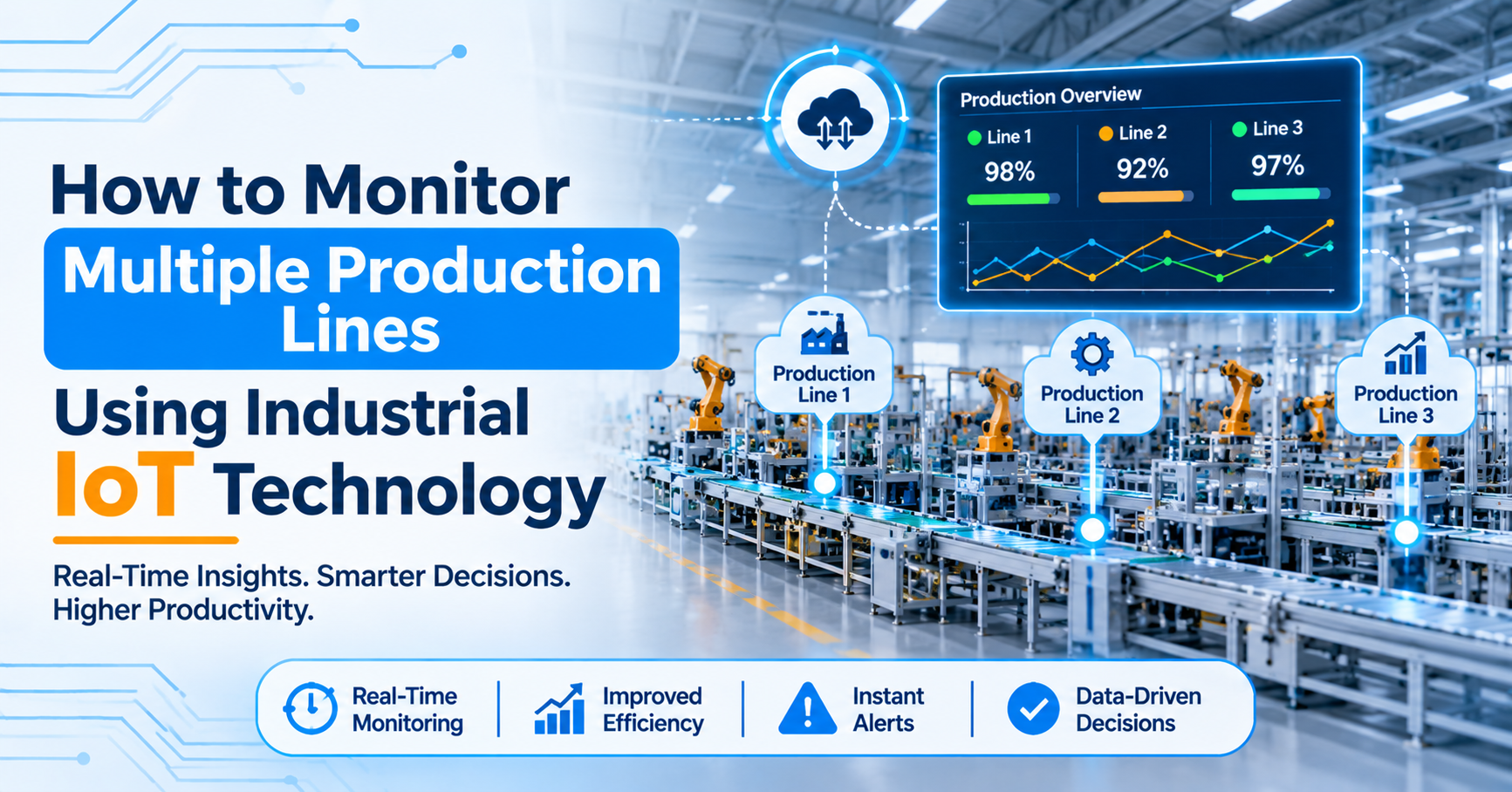
Managing several production lines becomes difficult when machine performance, downtime records, quality measurements, and production output exist in separate systems. Factory managers may struggle to identify bottlenecks, compare line efficiency, or respond to equipment problems before they affect production schedules.
Industrial IoT monitoring addresses this challenge by connecting machines, sensors, industrial controllers, and software platforms to provide a centralized view of factory operations. Instead of depending entirely on manual inspections and periodic reports, manufacturers can access equipment conditions and production data as operations continue.
The growing adoption of connected manufacturing technologies reflects this requirement. Deloitte’s 2025 Smart Manufacturing Survey, based on 600 manufacturing executives, found that 46% of respondents were using Industrial IoT solutions at the facility or network level. The same research reported average improvements of 10–20% in production output among surveyed organizations implementing smart manufacturing initiatives.
For manufacturers operating multiple production lines, the priority is to establish a monitoring architecture that collects reliable data, identifies operational problems, and presents useful information to decision-makers.
Why Multiple Production Lines Need Centralized Monitoring
A manufacturing facility may operate several production lines with different machines, operating speeds, production schedules, and maintenance requirements.
Without centralized visibility, each line may maintain separate records or monitoring interfaces. Supervisors then need to collect information from different systems before understanding overall factory performance.
This creates several operational problems:
- Delayed fault identification: Operators may notice equipment abnormalities only after production quality or output declines.
- Limited production visibility: Management cannot easily compare the performance of different lines.
- Unplanned downtime: Maintenance teams may receive fault information after a machine has already stopped.
- Quality inconsistencies: Defects can remain undetected when inspection results are not connected to production data.
- Inefficient resource allocation: Supervisors may struggle to identify which lines require additional operators, maintenance support, or materials.
A centralized Industrial IoT monitoring system brings these operational indicators together. It helps teams understand individual machine conditions while maintaining visibility across the entire production facility.
1. Build a Data Collection Layer Across Production Lines
The first requirement is collecting information from different machines and production equipment.
Not every machine generates the same type of data. A CNC machine may provide spindle speed, operating status, and cycle time, while a conveyor system may report motor temperature, belt speed, and operating hours.
Manufacturers should identify the most important parameters for each production line before installing monitoring equipment.
Industrial IoT sensors
External sensors can collect information from equipment that lacks built-in monitoring capabilities.
Common examples include:
- Vibration sensors for motors, pumps, and rotating machinery.
- Temperature sensors for bearings, motors, and industrial processes.
- Pressure sensors for hydraulic and pneumatic systems.
- Current sensors for monitoring electrical consumption.
- Proximity sensors for detecting machine position and component movement.
- Optical sensors for counting products moving along conveyor belts.
Sensor selection depends on measurement accuracy, operating environment, installation requirements, and the type of equipment under observation.
For example, a vibration sensor mounted on a motor housing can provide information about changes in mechanical behavior that may indicate imbalance, misalignment, or bearing deterioration.
PLC and machine data integration
Modern production equipment often contains programmable logic controllers (PLCs) that already collect useful operational information.
Rather than installing a separate sensor for every parameter, engineers can retrieve selected data from existing controllers.
Industrial communication technologies such as Modbus TCP, OPC UA, and industrial Ethernet support communication between machines, gateways, and monitoring applications.
For legacy equipment, an industrial gateway can collect available controller data and convert it into a format suitable for centralized processing.
2. Design an Industrial IoT Architecture for Multiple Lines
A monitoring solution should connect production equipment without creating unnecessary complexity or interfering with machine control.
A practical architecture contains four main layers.
Layer 1: Machine and sensor layer
This layer includes production machines, PLCs, industrial sensors, meters, and other connected equipment.
Each device generates operational information according to its function.
Layer 2: Edge gateway layer
Industrial gateways collect information from multiple machines and handle communication with higher-level systems.
They can also perform local filtering, protocol conversion, data buffering, and selected calculations.
For example, a gateway can read machine status through Modbus TCP and forward relevant telemetry through MQTT.
Edge processing becomes particularly useful when a factory has limited network connectivity or needs local monitoring to continue during temporary cloud interruptions.
Layer 3: Data processing and storage
The processing layer receives information from connected gateways and organizes it for analysis.
It may include:
- MQTT brokers for message communication.
- Time-series databases for historical telemetry.
- Stream-processing services for real-time events.
- Rule engines for threshold-based alerts.
- APIs for connecting MES and ERP applications.
Data standardization is important because different machines may report similar measurements using different field names or engineering units.
A consistent data model allows monitoring applications to compare equipment performance without repeatedly interpreting manufacturer-specific formats.
Layer 4: Monitoring and visualization
The application layer presents operational information through dashboards, reports, charts, and alarm interfaces.
Managers can review factory-wide performance, while individual production supervisors can access information relevant to their assigned lines.
This layered approach separates machine communication from data analysis and visualization, making the system easier to expand.
3. Create a Centralized Production Monitoring Dashboard
A centralized dashboard should provide a clear picture of production performance without overwhelming operators with unnecessary information.
The most useful dashboards combine machine-level indicators with production-line and factory-level summaries.
Machine operating status
Display whether each machine is running, idle, stopped, or undergoing maintenance.
This helps supervisors identify unexpected interruptions and compare operating conditions across production lines.
Production output
Track the number of units produced during a selected period.
Compare actual output against production targets to identify lines that consistently fall behind their schedules.
Overall Equipment Effectiveness
Overall Equipment Effectiveness (OEE) is one of the most useful indicators for comparing manufacturing performance.
It combines three factors:
OEE = Availability × Performance × Quality
- Availability measures the proportion of planned production time during which equipment operates.
- Performance compares actual production speed with the expected production speed.
- Quality measures the proportion of produced units that meet quality requirements.
For example, if a production line achieves 90% availability, 95% performance, and 98% quality, its OEE is:
0.90 × 0.95 × 0.98 = 83.79%.
Tracking OEE across multiple lines helps managers identify where production losses occur.
However, comparisons require consistent definitions of planned production time, ideal cycle time, and acceptable output.
Downtime monitoring
Display equipment stoppages with their duration, time of occurrence, and recorded cause.
Organize downtime events into categories such as mechanical failure, material shortage, changeover, quality issue, and operator intervention.
This classification helps maintenance and production teams distinguish recurring equipment problems from process-related interruptions.
Energy monitoring
Track electrical consumption across machines and production lines.
Comparing energy consumption against production output can reveal inefficient operating conditions.
For example, a machine that consumes substantial electricity while producing very few units may require operational investigation.
4. Use Real-Time Alerts to Respond to Equipment Problems
A monitoring dashboard becomes more useful when it can notify employees about conditions requiring attention.
Rule-based alert systems can evaluate incoming telemetry against predefined limits.
Consider a motor operating under normal temperature conditions. If its temperature exceeds the configured threshold, the monitoring system can generate an alert for the maintenance team.
Alerts can also cover:
- Unexpected machine stoppages.
- Excessive vibration.
- Abnormal energy consumption.
- Production output below target.
- Repeated quality failures.
- Communication loss from critical equipment.
Not every abnormal reading should generate an immediate alarm. Engineers should establish suitable thresholds, persistence periods, and alarm priorities to avoid unnecessary notifications.
For example, a temperature reading that briefly crosses a threshold may not require the same response as a sustained increase accompanied by abnormal vibration.
Where monitoring systems support historical trend analysis, maintenance teams can investigate changes before they develop into equipment failures.
5. Connect Production Monitoring with MES and ERP Systems
Industrial IoT monitoring provides machine-level information, but manufacturers often need to combine it with production planning and business data.
Integrating the monitoring platform with a Manufacturing Execution System (MES) helps connect equipment performance with production orders, work-in-progress, and quality records.
ERP integration adds information about inventory, material availability, procurement, and customer orders.
For example, when a production line stops because of material shortages, the monitoring system can provide the equipment event while the MES and ERP systems help identify the related production order and inventory situation.
This broader context helps managers understand whether a production problem originates from machinery, scheduling, materials, or quality processes.
Integration also reduces the need to maintain separate reports across departments.
6. Maintain Reliability, Security, and Data Accuracy
A multi-line monitoring environment depends on reliable communication between machines, gateways, servers, and business applications.
A temporary network interruption should not automatically result in permanent data loss. Edge gateways can buffer selected telemetry locally and forward it when connectivity returns.
Manufacturers should also establish consistent device identification, timestamp synchronization, and measurement units.
Cybersecurity requires particular attention because monitoring infrastructure connects operational technology with information systems.
The NIST Guide to Operational Technology Security, SP 800-82 Rev. 3 recommends security practices that account for the performance, reliability, and safety requirements of industrial control environments.
Practical safeguards include network segmentation, encrypted communication, role-based access, secure remote maintenance, device authentication, and controlled software updates.
Monitoring systems should also operate independently of safety-critical machine controls unless engineers have specifically designed and validated an appropriate safety architecture.
7. Practical Example: Monitoring Three Automotive Production Lines
Consider an automotive components manufacturer operating three production lines.
The first line handles metal cutting, the second performs machining, and the third manages component assembly.
Each line contains several machines, PLCs, motors, conveyors, and inspection stations.
Previously, supervisors collected machine status and production output through separate interfaces and manual reports.
The manufacturer introduces Industrial IoT monitoring across the facility.
External vibration and temperature sensors monitor selected motors, while industrial gateways collect available PLC information through Modbus TCP. Gateways forward standardized telemetry to a central monitoring platform using MQTT.
The dashboard displays:
- Operating status for machines across all three lines.
- Production output against shift targets.
- OEE for each production line.
- Equipment temperature and vibration trends.
- Downtime duration and recorded causes.
- Active maintenance alerts.
The company also connects selected production information with its MES to associate machine stoppages with production orders.
When the machining line experiences repeated motor temperature increases, the maintenance team can review historical measurements and schedule an inspection.
Meanwhile, production supervisors can identify whether the assembly line has sufficient output to meet the planned shift target.
The company gains a shared operational view without requiring employees to access multiple machine-specific applications.
This is an illustrative implementation scenario, not a reported customer deployment.
8. Estimate the ROI of Industrial IoT Monitoring
The financial value of centralized monitoring depends on how effectively it reduces operational losses.
Consider a hypothetical manufacturing facility operating three production lines. Each line experiences 12 hours of unplanned downtime per month.
Total monthly downtime:
3 × 12 = 36 hours.
Suppose an Industrial IoT monitoring initiative helps reduce unplanned downtime by 20%.
Recovered production time:
36 × 20% = 7.2 hours per month.
If each recovered production hour contributes an illustrative $500 in additional production value, the potential monthly value equals:
7.2 × $500 = $3,600.
Annualized potential value:
$3,600 × 12 = $43,200.
This calculation represents potential production value, not guaranteed net profit or cash savings. It excludes implementation costs, maintenance expenses, production constraints, and the possibility that other processes may limit the use of recovered machine capacity.
Manufacturers should compare actual downtime records and production contribution margins before making investment decisions.
Final Thoughts
Monitoring multiple production lines requires more than collecting machine data. Manufacturers need a connected system that turns equipment measurements into useful operational information.
A well-designed Industrial IoT monitoring solution combines sensors, industrial gateways, data processing, centralized dashboards, and enterprise integrations. These components help production and maintenance teams identify equipment problems, compare line performance, and make informed operational decisions.
Manufacturers should begin with critical equipment, establish reliable data collection, and gradually extend monitoring across the facility. This approach creates a practical foundation for better production visibility, reduced downtime, and continuous manufacturing improvement.