



In today’s digital world, children often spend a significant amount of their free time watching videos, playing online games, or using tablets and smartphones. While technology can offer educational benefits, finding a healthy balance between screen time and other activities is important for children’s overall development. Screen-free activities provide opportunities for children to explore their creativity, stay physically active, and enjoy meaningful time with family.
The good news is that keeping children entertained without screens does not require expensive toys or complicated preparations. With a little creativity, parents can turn everyday household items into exciting play opportunities. From indoor adventures to arts and crafts, there are plenty of enjoyable activities that encourage learning while keeping children engaged.
1. Build a Cozy Blanket Fort
Building a blanket fort is one of the most enjoyable indoor activities for children. Parents can use blankets, pillows, cushions, and chairs to help children create their own private hideaway. Once the fort is ready, kids can turn it into a reading corner, imaginary castle, or secret adventure headquarters.
This activity encourages imagination, creativity, and teamwork. For more inspiration, parents can explore these fun fort ideas for kids to discover creative ways to transform ordinary household spaces into exciting play areas.
2. Organize an Indoor Treasure Hunt
A treasure hunt can turn an ordinary afternoon into an exciting adventure. Hide small toys, colorful objects, or child-safe household items around the home and create simple clues to help children find them.
You can make the game more interesting by using riddles, picture clues, or a homemade treasure map. This activity encourages observation, memory, and problem-solving while keeping children physically engaged.
3. Encourage Arts and Crafts
Arts and crafts are excellent ways to keep children entertained while allowing them to express their creativity. Give them paper, crayons, washable paints, glue, and recycled materials to create their own artwork.
Children can make greeting cards, paper animals, handmade decorations, or colorful collages. Parents can also introduce seasonal craft projects to make the activity more exciting.
4. Create a Homemade Obstacle Course
If your children have plenty of energy, an indoor obstacle course can be a great way to keep them active. Use cushions, soft toys, cardboard boxes, and safe household objects to create simple challenges.
Children can crawl through tunnels, step over cushions, or follow a path marked with colorful paper. Always keep the course away from sharp furniture, stairs, and slippery surfaces, and supervise younger children.
5. Have a Family Board Game Night
Board games are a wonderful way to bring family members together without relying on digital entertainment. Games involving matching, memory, strategy, and teamwork can encourage children to think carefully and follow instructions.
Choose games that match your children’s ages and abilities. You can also introduce simple card games, puzzles, and homemade guessing games to keep everyone involved.
6. Start a Storytelling Challenge
Storytelling is an enjoyable way to develop language skills and imagination. Ask children to create their own stories using imaginary characters, animals, or magical places.
For a fun family challenge, one person can begin a story with a sentence, and everyone else adds another sentence to continue the adventure. Children can also draw pictures to illustrate their stories.
7. Try Simple Science Experiments
Children naturally enjoy discovering how things work. Simple science experiments can turn everyday household materials into exciting learning opportunities.
For example, parents can demonstrate how different objects float or sink in water, create colorful patterns using safe art materials, or observe how plants grow over time.
Choose age-appropriate experiments, use non-toxic materials, and supervise children throughout the activity.
8. Organize a Mini Indoor Camping Adventure
Indoor camping is an exciting activity that allows children to experience the fun of camping without leaving home. Set up a small tent or blanket shelter, arrange comfortable pillows, and bring out favorite storybooks.
You can make the experience more memorable by telling stories, playing guessing games, and preparing simple snacks together. Use battery-operated lights instead of candles or open flames.
9. Introduce Gardening Activities
Gardening is a rewarding screen-free activity that teaches children about nature and responsibility. Give them small pots, soil, and easy-to-grow seeds so they can start their own mini garden.
Children can water their plants, observe their growth, and learn about the importance of sunlight and healthy soil. Growing herbs or flowers can also become an enjoyable long-term family project.
10. Make Homemade Musical Instruments
Music provides another creative way to keep children entertained. Parents can help children make simple instruments using safe household materials, such as empty containers, paper tubes, and sealed containers filled with suitable materials.
Once the instruments are ready, organize a mini family music session where children can experiment with different sounds and rhythms.
11. Enjoy a Reading Challenge
Reading is one of the simplest ways to encourage screen-free entertainment. Create a comfortable reading corner with cushions, blankets, and age-appropriate books.
You can introduce a weekly reading challenge where children choose a book, read a few pages each day, and share their favorite characters or moments with the family.
Parents can also read aloud to younger children and encourage them to ask questions about the story.
12. Plan a Pretend Restaurant Game
Children often enjoy copying everyday activities they see adults doing. A pretend restaurant game allows them to become chefs, waiters, or restaurant owners.
Help them create a simple menu, arrange toy dishes, and prepare imaginary orders. This activity encourages communication, creativity, and social interaction.
13. Make a DIY Puzzle
Puzzles are excellent for encouraging patience, concentration, and problem-solving. Parents can create simple puzzles by drawing a picture on cardboard and cutting it into several large pieces.
Children can then try to put the pieces together. Adjust the difficulty according to their age and abilities.
14. Arrange a Family Dance Party
A family dance party is a fun way to combine physical activity with entertainment. Play music through a speaker and encourage everyone to dance, create their own moves, or participate in a freeze-dance challenge.
When the music stops, everyone must freeze in place. This simple game can create plenty of laughter while helping children stay active.
15. Let Children Create Their Own Play Area
Giving children a small space to organize and decorate can encourage independence and creativity. Provide building blocks, soft toys, books, art supplies, and other age-appropriate play materials.
Allow them to arrange their belongings and decide how they want to use the space. They might create a reading corner, an art station, or a pretend play area.
Why Screen-Free Activities Matter for Children
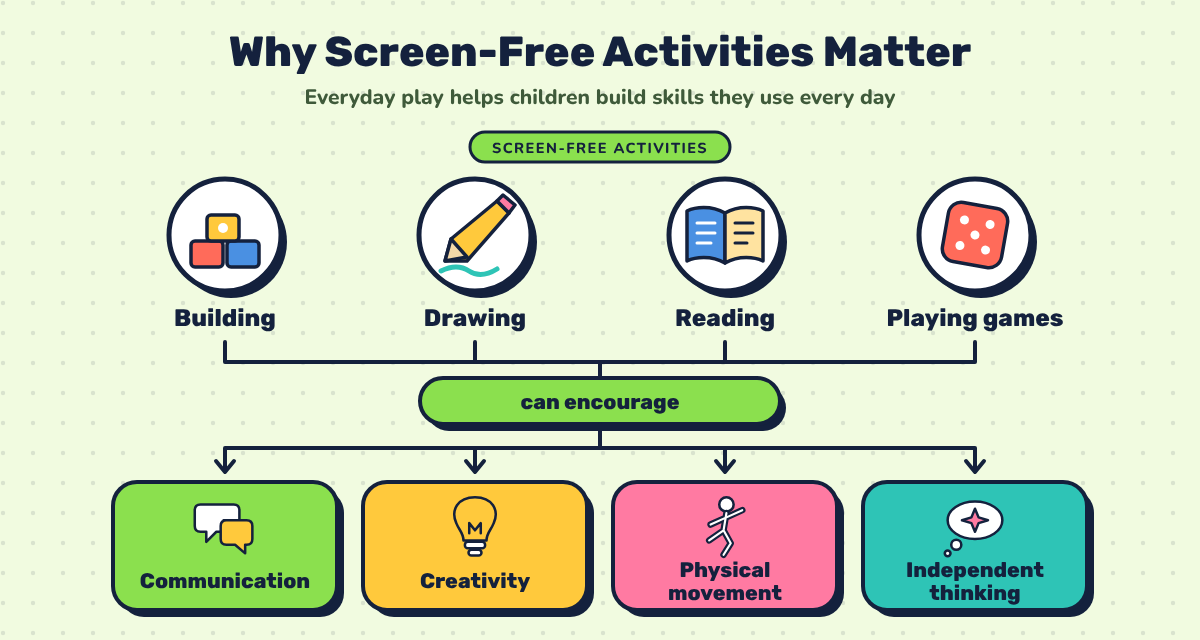
Screen-free play provides children with opportunities to develop skills that are important in everyday life. Activities such as building, drawing, reading, and playing games can encourage communication, creativity, physical movement, and independent thinking.
According to UNICEF’s guide to screen-free activities for children, families can enjoy a variety of activities together, including storytelling, nature walks, scavenger hunts, and creative games.
The American Academy of Pediatrics also highlights how screen-free play can support children’s planning, problem-solving, language, social, and physical development.
Parents can find additional ideas in HealthyChildren.org’s collection of free screen-free activities.
Tips for Making Screen-Free Time More Enjoyable
Introducing screen-free activities can take some adjustment, especially if children are accustomed to using digital devices regularly. Parents can make the transition easier with a few simple strategies:
- Start with activities that match your child’s interests.
- Keep basic craft and play materials easily accessible.
- Create a regular family game or activity time.
- Encourage children to choose and organize their own games.
- Participate in activities instead of expecting children to entertain themselves all the time.
- Offer a variety of indoor and outdoor experiences.
- Be patient when children initially complain about being bored.
Remember that children do not need to be entertained every minute. Unstructured play gives them the freedom to explore their interests and develop their own ideas.
Final Thoughts
Keeping children entertained without screens does not have to be difficult. Simple activities such as building blanket forts, organizing treasure hunts, creating artwork, reading stories, and playing family games can turn ordinary days into memorable experiences.
By introducing a variety of screen-free activities, parents can encourage creativity, independence, physical activity, and stronger family connections. The key is to provide children with opportunities to explore, experiment, and enjoy their free time in meaningful ways.