





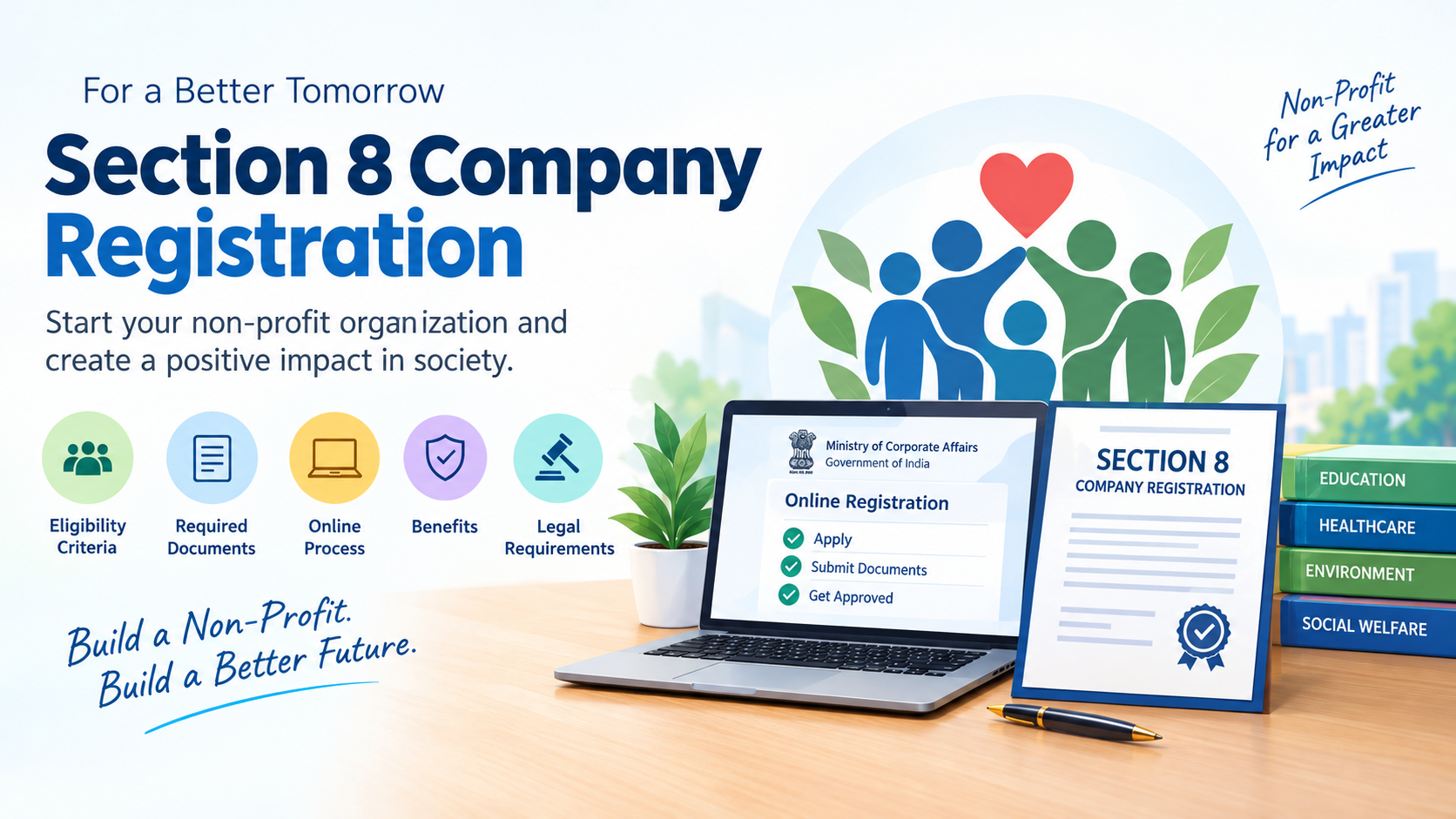
A Section 8 Company is a type of non-profit organisation established under the Companies Act, 2013, to promote charitable, social, educational, cultural, scientific, environmental, religious or other beneficial objectives. Unlike ordinary companies, a Section 8 Company uses its profits and income to achieve its objectives rather than distributing them among its members as dividends.
In India, Section 8 Company Registration is a suitable option for individuals, entrepreneurs, social workers and organisations planning to undertake charitable or non-profit activities through a legally recognised corporate structure. It offers a formal identity, better governance and opportunities to receive eligible grants and donations, subject to applicable laws.
This article explains the eligibility criteria, documents, registration fees and step-by-step process for incorporating a Section 8 Company in India.
What Is a Section 8 Company?
A Section 8 Company is incorporated under Section 8 of the Companies Act, 2013. It is formed to promote activities such as education, art, science, sports, research, social welfare, environmental protection, charity and other similar objectives.
The primary purpose of this organisation must be to serve public or charitable interests. Any income or profit generated through its activities must be used to achieve its stated objectives. Members are not permitted to receive dividends or share profits from the company.
A Section 8 Company can be registered as a company limited by shares or a company limited by guarantee. It enjoys a separate legal identity and must follow the applicable provisions of company law.
Eligibility Criteria for Section 8 Company Registration
Before applying for registration, applicants should understand the eligibility requirements prescribed under the Companies Act, 2013.
1. Charitable or Non-Profit Objectives
The proposed company must have objectives related to promoting commerce, art, science, education, sports, research, social welfare, religion, charity, environmental protection or similar activities.
2. Minimum Number of Directors
The minimum number of directors depends on the type of company:
- Private Section 8 Company: At least two directors.
- Public Section 8 Company: At least three directors.
At least one director must satisfy the applicable residency requirement under the Companies Act.
3. Minimum Number of Members
A private Section 8 Company generally requires at least two members, whereas a public Section 8 Company requires at least seven members.
4. Utilisation of Income
The company must apply its profits and income towards promoting its stated objectives. Distribution of dividends to members is prohibited.
5. No Minimum Capital Requirement
There is no prescribed minimum paid-up share capital requirement for incorporating a Section 8 Company. The organisation can determine its capital structure according to its requirements and proposed activities.
6. Compliance with Legal Requirements
The proposed organisation must comply with the Companies Act, 2013, and other applicable regulations. Its activities and governing documents must reflect its non-profit purpose.
Documents Required for Section 8 Company Registration
Applicants must arrange the necessary documents before submitting the incorporation application. Proper documentation helps avoid unnecessary delays and objections during the registration process.
Documents Required from Directors and Members
- PAN card of Indian directors and members.
- Aadhaar card, passport, voter ID or driving licence as identity proof.
- Recent passport-sized photographs.
- Residential address proof, such as a bank statement or utility bill.
- Email address and mobile number.
- Digital Signature Certificate (DSC) of the proposed directors.
Documents Required for Registered Office
- Proof of ownership or valid rent agreement.
- Recent electricity bill, water bill or other utility bill.
- No Objection Certificate (NOC) from the property owner, where applicable.
- Address details of the proposed registered office.
Other Important Documents
- Proposed name of the company.
- Memorandum of Association (MOA).
- Articles of Association (AOA).
- Details of proposed directors and subscribers.
- Declaration and consent documents, as applicable.
- A brief description of the proposed charitable or non-profit activities.
The exact documentation may vary depending on the company’s structure, proposed objectives and circumstances of the applicants.
Section 8 Company Registration Fees in India
The cost of registering a Section 8 Company depends on several factors, including the authorised capital, state of registration, professional assistance and applicable government charges.
The major cost components generally include:
1. Digital Signature Certificate (DSC): Proposed directors and subscribers who need to sign incorporation documents electronically must obtain valid DSCs.
2. Name Reservation Charges: Applicants may incur applicable fees for reserving the proposed company name, depending on the filing route and service used.
3. Government Filing Fees: Applicable MCA filing and statutory charges may vary according to the company structure, authorised capital and prevailing fee rules.
4. Professional Fees: Applicants may engage a practising Chartered Accountant, Company Secretary or other eligible professional for documentation, incorporation filings and related assistance.
5. Stamp Duty: Stamp duty on incorporation documents may vary from state to state and according to the applicable capital structure.
There is no single fixed registration cost for every Section 8 Company. Applicants should check the latest MCA fee structure and applicable state stamp duty before filing.
Step-by-Step Process for Section 8 Company Registration
The Ministry of Corporate Affairs (MCA) provides an online system for company incorporation. The following steps explain the general procedure for registering a Section 8 Company in India.
Step 1: Obtain Digital Signature Certificates
The proposed directors and subscribers must obtain Digital Signature Certificates to authenticate and sign electronic incorporation documents. DSCs are essential for completing the online registration process.
Step 2: Apply for Director Identification Number
A Director Identification Number (DIN) is required for individuals appointed as directors. For new directors, the DIN can generally be applied for through the integrated incorporation process, subject to applicable rules.
Step 3: Select and Reserve the Company Name
Choose a suitable name for the proposed Section 8 Company. The name should reflect its non-profit objectives and comply with MCA naming guidelines.
Applicants can submit the name reservation request through the applicable MCA incorporation service. The proposed name must not be identical or too similar to an existing company or trademark in a manner prohibited by law.
Step 4: Prepare MOA and AOA
The Memorandum of Association (MOA) and Articles of Association (AOA) are important incorporation documents.
The MOA specifies the company’s objectives, while the AOA describes its internal management rules and governance structure. Both documents must clearly establish the non-profit nature of the organisation and comply with Section 8 requirements.
Step 5: Prepare the Incorporation Application
The applicant must complete the applicable MCA incorporation forms and attach the required supporting documents. These may include director details, subscriber information, registered office proof, declarations and constitutional documents.
The relevant application for a licence under Section 8 must also be completed as part of the prescribed incorporation procedure.
Step 6: Submit the Application to the MCA
After preparing the documents, submit the incorporation application electronically through the MCA portal. The application must contain accurate information and the required declarations and attachments.
Step 7: Review by the Registrar of Companies
The Registrar of Companies (ROC) examines the submitted application and supporting documents. If any clarification or additional information is required, the applicant may receive a resubmission or clarification request.
Applicants should respond within the prescribed period to avoid delays or rejection.
Step 8: Receive the Certificate of Incorporation
Once the application is approved, the ROC issues the Certificate of Incorporation. The company receives its Corporate Identity Number (CIN), and its legal existence begins from the date mentioned in the certificate.
After incorporation, the company should complete applicable post-incorporation formalities, including opening a bank account, maintaining statutory records and meeting relevant compliance requirements.
Benefits of Section 8 Company Registration
Registering a Section 8 Company offers several advantages to non-profit organisations and charitable initiatives.
- Separate Legal Identity: The company has an independent legal identity and can own property, enter into contracts and conduct activities in its own name.
- Limited Liability: Members generally enjoy limited liability according to the company’s legal structure.
- Better Credibility: Registration under the Companies Act provides a recognised legal framework and may improve confidence among donors, institutions and stakeholders.
- No Dividend Distribution: Income is reinvested into the company’s objectives, supporting long-term social and charitable activities.
- Funding Opportunities: A registered Section 8 Company may seek eligible donations, grants and institutional support, subject to applicable conditions.
- Perpetual Succession: The company’s existence is not automatically affected by changes in its membership or directors.
Compliance Requirements After Registration
A Section 8 Company must comply with applicable provisions of the Companies Act, 2013. Important responsibilities generally include:
- Maintaining proper books of accounts and financial records.
- Conducting board meetings and general meetings as required.
- Preparing and filing annual financial statements.
- Filing annual returns with the ROC.
- Conducting statutory audits as applicable.
- Maintaining statutory registers and records.
- Informing the ROC about relevant changes in directors, registered office or company details.
- Using income and funds only for the company’s approved objectives.
A Section 8 Company seeking income-tax exemptions may separately apply for registration under the applicable income-tax provisions. Similarly, eligible organisations seeking to provide tax deductions to donors may need separate approval under the relevant provisions. Foreign contributions are subject to the Foreign Contribution (Regulation) Act, 2010, and applicable permissions.
Conclusion
Section 8 Company Registration is an effective legal structure for individuals and organisations seeking to establish a non-profit entity in India. It provides a formal corporate identity, limited liability and a structured framework for carrying out charitable and social activities.
The registration process involves selecting an appropriate name, obtaining digital signatures, preparing incorporation documents, submitting the prescribed MCA application and receiving approval from the Registrar of Companies. Understanding the eligibility criteria, documents and applicable fees can make the process more organised and efficient.
Corpbiz provides professional assistance for Section 8 Company Registration, including eligibility assessment, name selection, documentation, application filing and incorporation support. With proper guidance, applicants can complete the registration process while focusing on their organisation’s social and charitable objectives.