



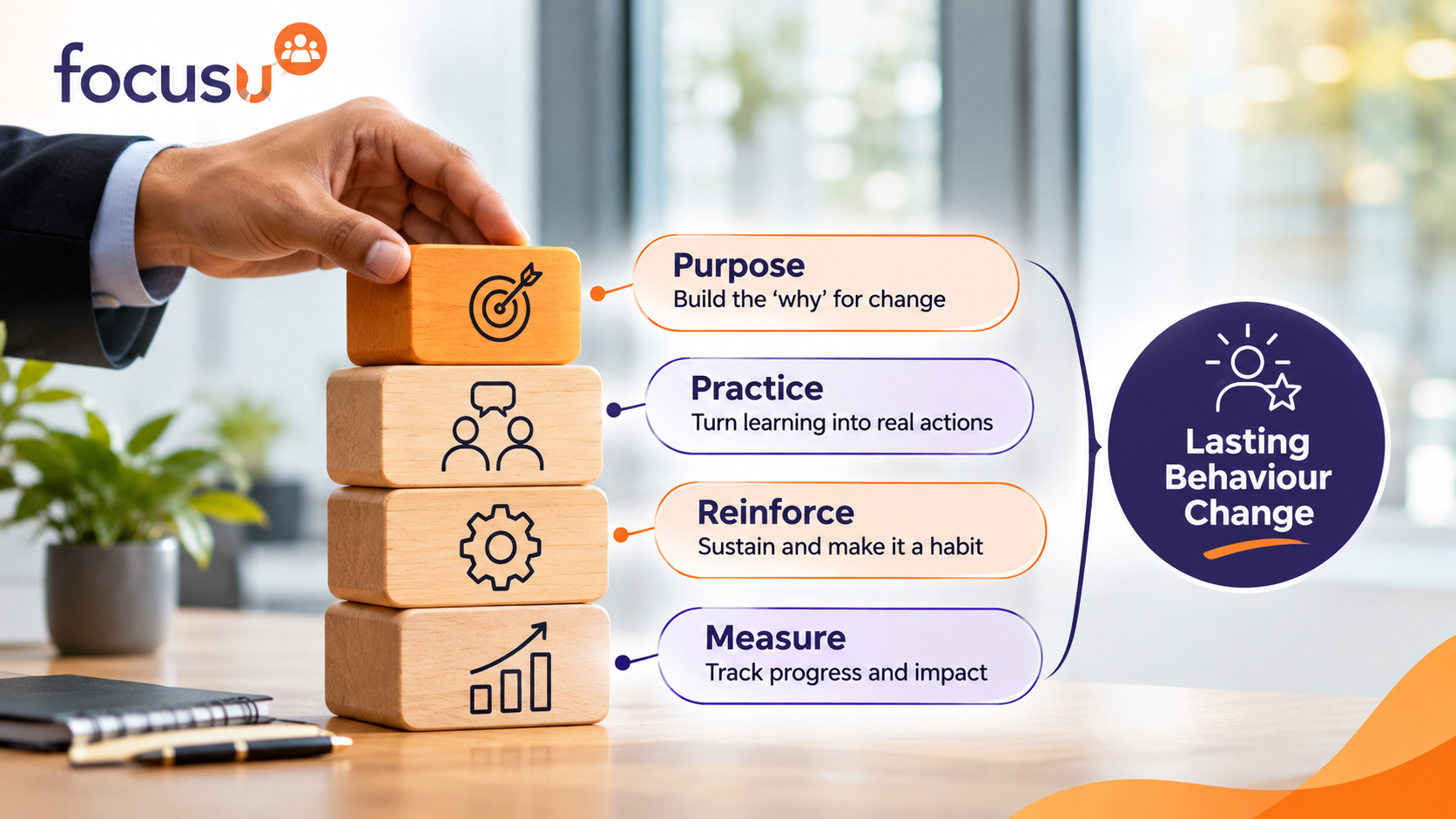
The FocusU Behaviour Stack is a framework showing that lasting behaviour change happens across four nested layers: Individual, Team, Leaders and Culture. When these layers are misaligned, change fades after the training ends. When they are aligned, change compounds. It is the thinking behind every FocusU engagement, and it explains why FocusU designs for the whole system around a person, not just the person in the room.
If you’ve ever wondered why a great workshop didn’t change how a team actually works, the Behaviour Stack offers a practical answer. This guide explains what it is, how each layer works, and how you can use it to diagnose your own organisation.

The Behaviour Stack at a glance

Why does FocusU use a “stack” to explain behaviour change?
FocusU’s starting belief is that training is not transformation, and completion is not capability. A workshop can create energy, insight and intent. But people return to a workplace with its own habits, pressures and expectations, and that environment usually wins.
A “stack” is a useful image because it shows that behaviour is layered. An individual’s behaviour sits inside a team, the team sits under a leader, and all of it sits inside a culture. Change one layer in isolation and the others pull it back. This is why FocusU’s work, described on the Know Us Better page, goes beyond delivering sessions and focuses on shifts people can sustain at work.
The logic nests like this: culture is the container, leaders shape teams, teams shape individuals, and behaviour nests inward.
What are the four layers of the Behaviour Stack?
Layer 1: Individual (how people think, communicate and act)
This is the layer most training programmes target. It covers the skills, mindsets and habits of each person: how they communicate, make decisions, give feedback and manage their own work.
FocusU’s approach at this layer is to build practice-rich experiences and reinforce them after the session, so skills transfer to the job instead of staying in the room. Formats used here include Lego Serious Play, gamified solutions, microlearning and learning through case studies. The related solution area is Better Work, which is about turning intent into consistent execution.
Where it breaks: individuals learn something new, but their team or manager doesn’t support it, so the behaviour never becomes routine.
Layer 2: Team (how people work together)
Behaviour is rarely solo. Most of what people do at work depends on how their team communicates, aligns and resolves friction. This layer covers trust, alignment, working agreements, conflict and decisions, which FocusU calls the team’s operating system.
FocusU works at this layer through interpersonal effectiveness programmes and team bonding workshops, built on the belief that happy employees lead to happy customers. Longer engagements such as learning journeys let a team practise new ways of working together over time.
Where it breaks: a team has strong individuals but unclear agreements, so friction, rework and silent disagreement persist.
Layer 3: Leaders (how leaders model the way)
Leaders are the leverage point in the stack. Teams watch what leaders reward, tolerate and do themselves, and behaviour change rarely outruns the example set above it.
FocusU works with leaders at every level, from first-time managers to senior leadership teams, through manager capability development and its flagship offerings. Its case studies show this in action, such as a 12-month leadership journey at Surya Nepal, a 4-month programme for first-time managers at Providence and a 2-year journey with Hindustan Unilever’s North regional leadership team.
Where it breaks: leaders endorse a change but don’t visibly practise it, so teams quietly conclude it isn’t really expected.
Layer 4: Culture (rituals, structure, language and ways of working)
Culture is the outer layer, the container that decides which behaviours feel normal and which feel unusual. It shows up in rituals, structures, the language people use and the unwritten rules of how work gets done.
FocusU’s role at this layer is to install the rituals and language that make new behaviours normal rather than exceptional. This is the focus of the culture and organisational development solution. Behaviour-led programmes at scale, such as a gamified onboarding journey for a Big Four firm covering 11,000+ new joiners, show how culture-level design can shape the first behaviours people learn.
Where it breaks: the culture rewards the old behaviour (speed over quality, say, or silence over candour), so even well-trained people revert.
How does the Behaviour Stack fit into FocusU’s process?
The Stack is the lens, and FocusU’s learning design process is how it is applied. The process has three steps:
- Understand what needs to change. Map the business outcome, identify the critical behaviours and uncover what’s in the way, checking each layer of the stack for blockers.
- Design what will make it stick. Co-create a learning experience for your context, with reinforcement built in from day one and the right layers involved.
- Make the change visible. Track, sustain and embed behaviour shifts into everyday work so the impact is clear and lasting.
The Stack stops FocusU from solving a team-level or culture-level problem with an individual-level workshop, which is one of the most common reasons training fails to deliver.
How can you use the Behaviour Stack to diagnose your own organisation?
Use these questions as a quick self-check. The layer where you answer “no” is usually where change is getting stuck.

If the answers differ across layers, you’ve found why a programme “worked” in the room but not at work.
What results come from working across the whole stack?
FocusU backs its approach with an unconditional “Happy or Free” promise: if you don’t see the shift you agreed on, it makes it right or you don’t pay. It has worked with 1000+ organisations, reached 40k+ learners in 2025 and holds an average CSAT of 9.2. You can explore the evidence in Our Impact, by industry on the Sectoral Expertise page, and in client testimonials.
Who should use the Behaviour Stack approach?
The framework is most useful for:
- L&D and HR leaders who want training to translate into visible change
- Business leaders who can name the behaviours that would improve a performance outcome
- Organisations in transition, such as a new management layer, rapid hiring, a market shift or a culture reset
- Teams that have already tried one-off workshops and want something that lasts
Frequently asked questions
What is the FocusU Behaviour Stack?
It is FocusU’s framework showing that behaviour change happens across four nested layers (Individual, Team, Leaders and Culture) and sticks only when all four align.
What are the four layers of the Behaviour Stack?
Individual (how people think, communicate and act), Team (how people work together), Leaders (how leaders model the way) and Culture (rituals, structure, language and ways of working).
Why is it called a “stack”?
Because the layers are nested. Culture contains leaders, leaders shape teams, and teams shape individuals, so changing one layer alone is rarely enough.
Why are leaders the leverage point?
Because behaviour change rarely outruns the example set above it. Teams follow what leaders reward, tolerate and model.
How is the Behaviour Stack different from a standard training model?
Standard models often focus on the individual learner and the session. The Stack looks at the whole system around the person, so reinforcement, team agreements, leadership example and culture are designed in.
Does every FocusU engagement cover all four layers?
FocusU starts with diagnosis to understand what needs to change and what’s in the way, then designs for the layers that matter for your outcome.
How does the Behaviour Stack connect to FocusU’s solutions?
The layers map to the solution areas: Better Work, Better Teams, Better Leaders and Better Culture. You can browse them all on the solutions page.
What happens if only one layer is trained?
Change tends to fade. Individuals may learn something new, but an unchanged team, leader or culture pulls behaviour back to the old default.
How do I start applying the Behaviour Stack in my organisation?
Contact FocusU to schedule a call. The first step is a conversation about the business outcome and the behaviours that need to change.
The FocusU Behaviour Stack explains something many L&D teams have felt for years: people don’t change in isolation. Behaviour changes when individuals, teams, leaders and culture all point the same way. By designing across the stack, with diagnosis at the start and visible change at the end, FocusU helps organisations turn learning into results that last. To explore how it could apply to your organisation, start a conversation with FocusU or download the 2026 brochure.