





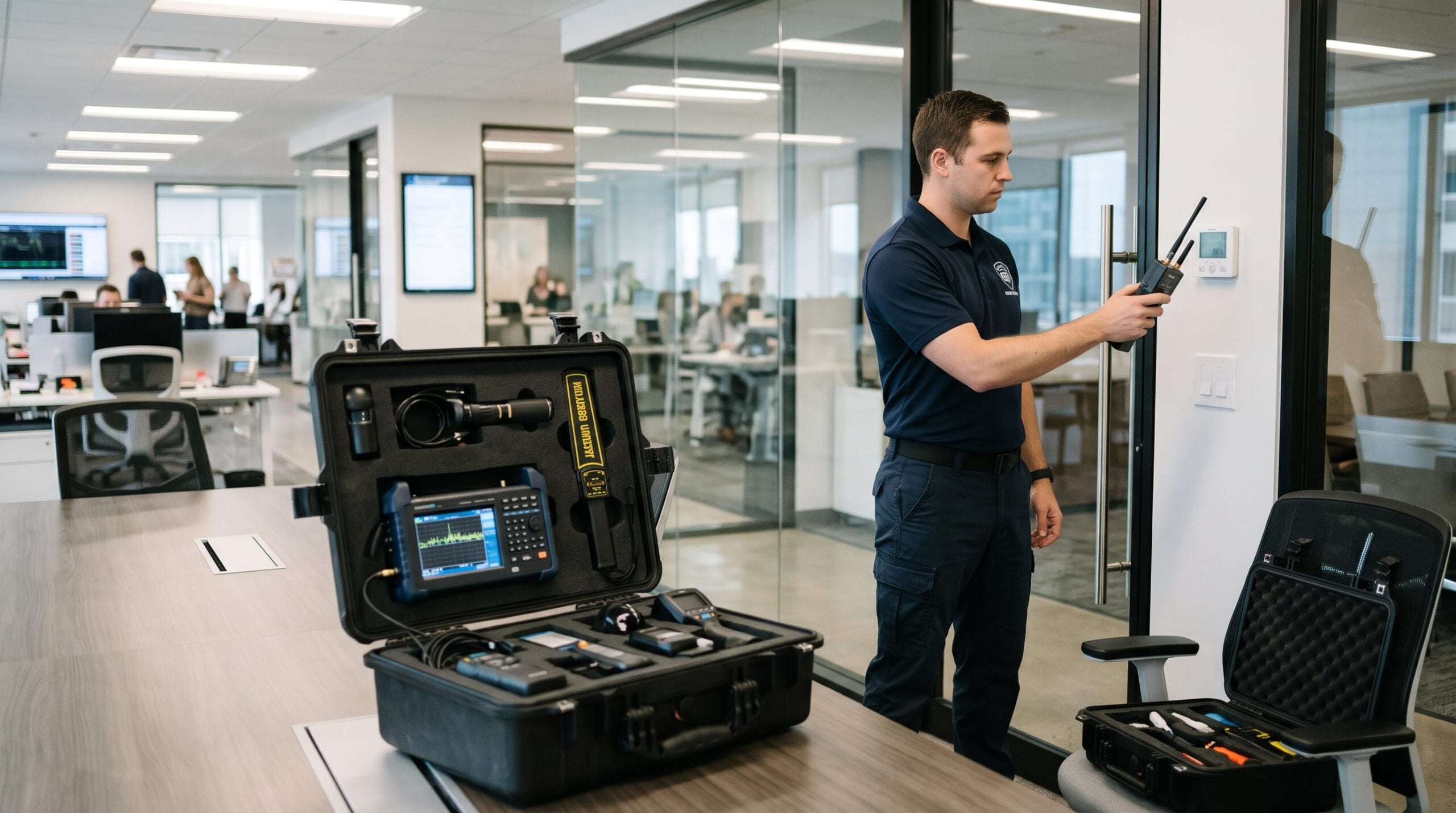
Businesses handle confidential information every day. From private meetings and financial discussions to client negotiations and business strategies, sensitive information must be protected from unauthorized access. However, hidden cameras, listening devices, and other surveillance equipment can create serious security risks without being noticed. A professional commercial bug sweep service helps businesses identify potential surveillance threats and protect their confidential environments.
Corporate espionage and unauthorized monitoring are concerns for organizations of different sizes. Small businesses, corporate offices, law firms, financial institutions, and executive workplaces may all become targets of unwanted surveillance. Even a single compromised meeting room can expose sensitive information and damage business relationships.
Professional Technical Surveillance Countermeasures (TSCM) services are designed to identify these risks through specialized inspections, detection equipment, and security assessments. By taking preventive action, businesses can improve their privacy and reduce the possibility of confidential information being exposed.
Why Is Business Privacy Important in Today’s Corporate Environment?
Business privacy is directly connected to trust, reputation, and long-term success. Companies regularly exchange information that should only be accessible to authorized employees, partners, and stakeholders.
For example, corporate offices may discuss:
-
Financial statements and investment strategies.
-
Upcoming product launches and business developments.
-
Employee information and internal management decisions.
-
Legal matters and confidential client agreements.
-
Mergers, acquisitions, and partnership negotiations.
-
Proprietary business processes and trade secrets.
If such information is captured through unauthorized surveillance, the consequences can extend beyond financial losses. Business relationships may be affected, competitive advantages can disappear, and legal complications may arise.
This is why physical security should not be limited to access control systems, security cameras, and alarm installations. Protecting private conversations and sensitive working environments should also be considered an important part of corporate security.
What Does a Commercial Bug Sweep Service Include?
A professional commercial bug sweep service involves inspecting business premises for unauthorized surveillance equipment and potential security vulnerabilities.
These inspections are commonly performed by trained TSCM professionals using specialized electronic detection equipment and technical investigation methods.
Unlike ordinary security inspections, TSCM assessments focus specifically on identifying devices and technologies that may be used to monitor private conversations or activities.
1. Hidden Camera Detection
Unauthorized cameras can be installed in different areas of a commercial property. Meeting rooms, executive offices, conference spaces, and private work areas may be vulnerable if physical security is not properly maintained.
During an inspection, specialized equipment and visual examination techniques may be used to identify suspicious camera installations.
Potential inspection areas include:
-
Meeting rooms and conference tables.
-
Executive offices and private workspaces.
-
Reception areas and shared facilities.
-
Temporary office spaces and rented meeting rooms.
-
Sensitive storage and document-handling areas.
Identifying unauthorized cameras can help businesses protect private activities and maintain a more secure working environment.
2. Hidden Listening Device Detection
Listening devices can create serious privacy concerns because confidential conversations may be captured without participants knowing about it.
These devices may be designed to transmit audio through wireless signals or store recorded information for later retrieval.
Professional TSCM specialists use appropriate technical methods to investigate suspicious electronic activity and identify potential listening devices.
A thorough assessment may include:
-
Radio frequency (RF) signal analysis.
-
Inspection of suspicious electronic equipment.
-
Examination of accessible communication systems.
-
Identification of unusual transmission activity.
-
Investigation of potential audio surveillance equipment.
Not every unusual electronic signal indicates surveillance. Therefore, findings should be assessed by experienced professionals before conclusions are made.
3. Wireless Signal Analysis
Modern surveillance equipment may use different wireless technologies to transmit information. Some devices can operate intermittently, making them more difficult to identify through basic inspections.
Wireless signal analysis helps specialists examine the radio frequency environment and investigate unusual transmissions.
This process may help identify:
-
Suspicious RF activity.
-
Unauthorized wireless transmitters.
-
Unusual electronic communication patterns.
-
Potential surveillance-related signals.
-
Devices requiring additional technical investigation.
The results are evaluated within the context of the building’s existing wireless equipment and normal electronic activity.
4. Physical Security Inspection
Electronic detection is only one part of a complete TSCM assessment. Physical inspections are also important because suspicious devices may be concealed within everyday objects or building fixtures.
Specialists may examine accessible areas such as furniture, fixtures, electrical installations, and other locations where unauthorized equipment could potentially be placed.
Any suspicious findings should be documented and investigated carefully.
Which Businesses Should Consider Professional TSCM Inspections?
Surveillance risks are not limited to large corporations or government organizations. Any business that handles confidential information may benefit from an appropriate privacy assessment.
A professional inspection may be particularly valuable for the following industries.
Corporate Offices
Corporate environments frequently handle internal strategies, financial information, and confidential discussions. Executive offices and conference rooms may require additional privacy protection.
Law Firms and Legal Practices
Lawyers regularly discuss sensitive client information, legal strategies, and confidential case details. Unauthorized monitoring could create serious professional and legal concerns.
Financial Institutions
Banks, investment firms, accounting companies, and financial consultants manage information that requires strong confidentiality controls.
Protecting private discussions and sensitive working environments can help reduce unnecessary exposure.
Technology and Research Companies
Technology businesses may develop proprietary products, software, research, and intellectual property. Unauthorized surveillance could expose valuable information to competitors.
Healthcare Organizations
Medical facilities manage confidential patient information and internal administrative discussions. Privacy assessments can support broader efforts to protect sensitive business and operational information.
Government Contractors
Organizations working on confidential government projects may operate under strict security requirements. TSCM inspections can form part of a wider physical and information security program where appropriate.
Signs That Your Business May Need a Bug Sweep Inspection
Not every business will experience surveillance threats, and unusual electronic activity does not automatically indicate that a property has been compromised.
However, certain situations may justify a professional security assessment.
Consider arranging an inspection if:
-
Confidential business information has unexpectedly reached competitors.
-
Suspicious electronic equipment has been discovered.
-
Private conversations appear to have been disclosed without authorization.
-
Your office has recently experienced unauthorized access.
-
Your company is preparing for sensitive negotiations.
-
Executive offices or meeting rooms have recently been renovated.
-
Your organization has experienced a potential security breach.
-
You are moving into a previously occupied commercial property.
These situations do not prove that surveillance equipment is present. However, they may justify further investigation by qualified security professionals.
How Does a Professional Commercial Bug Sweep Inspection Work?
A reliable inspection should follow a structured process rather than relying on a quick visual examination.
The exact approach depends on the property’s size, security requirements, and the nature of the suspected threat.
Step 1: Initial Security Consultation
The process usually begins with a discussion about the business environment and its privacy concerns.
The inspection team may review the building layout, sensitive areas, previous security incidents, and specific concerns identified by management.
Step 2: Site Assessment
The property’s relevant areas are assessed to determine where an inspection should be performed.
Priority may be given to executive offices, conference rooms, private meeting spaces, and locations where confidential discussions regularly take place.
Step 3: Technical Detection
Specialized detection equipment is used to examine the environment for potential electronic surveillance threats.
Depending on the scope of work, RF analysis, electronic inspection, and other appropriate TSCM methods may be performed.
Step 4: Physical Examination
Accessible areas and suspicious objects are examined for signs of unauthorized surveillance equipment.
Any unusual findings are investigated using appropriate procedures.
Step 5: Findings and Recommendations
After the assessment, findings should be documented and explained to the client.
If potential threats are identified, appropriate recommendations may be provided to improve physical security, protect sensitive areas, and reduce future risks.
What Should You Look for When Choosing a TSCM Provider?
Selecting an experienced security provider is important because the quality of an inspection depends on technical knowledge, suitable equipment, and professional investigation methods.
Businesses should avoid choosing a provider based solely on price.
Instead, consider the following factors:
Relevant TSCM Experience: Look for professionals with practical experience in technical surveillance countermeasures and commercial security inspections.
Specialized Detection Equipment: Ask whether suitable equipment is used for electronic surveillance detection and RF analysis.
Confidentiality Practices: Business information and inspection findings should be handled through appropriate confidentiality procedures.
Clear Reporting: Findings should be explained in understandable language, supported by relevant observations and recommendations.
Customized Inspection Plans: Different commercial properties have different security requirements. Inspection methods should be selected according to the environment and identified risks.
Professional Communication: A reliable provider should explain the inspection process, its limitations, and the expected deliverables before work begins.
How Regular Security Inspections Support Long-Term Business Protection
A single inspection may help identify existing surveillance concerns, but business security should be treated as an ongoing responsibility.
Office environments change over time. New employees join, contractors access different areas, equipment is replaced, and meeting spaces are renovated. These changes can introduce new physical and electronic security considerations.
Regular TSCM assessments can help organizations maintain better awareness of potential privacy risks.
Businesses may consider arranging inspections:
-
Before important corporate negotiations.
-
After office renovations or major maintenance work.
-
When moving into a new commercial property.
-
Following a suspected security incident.
-
As part of an established corporate security program.
-
When significant changes occur in sensitive working environments.
The inspection schedule should be based on the organization’s risk profile rather than following an arbitrary timetable.
Furthermore, TSCM inspections should be combined with employee awareness, controlled access, secure communication practices, and appropriate cybersecurity measures.
No single inspection can guarantee complete protection against every surveillance threat. However, a structured approach can strengthen an organization’s overall privacy and security arrangements.
Final Thought
Protecting confidential business information requires more than traditional physical security measures. Unauthorized cameras, listening devices, and other surveillance technologies can create risks that may remain unnoticed without proper technical investigation. A professional commercial bug sweep service can help organizations identify potential surveillance threats, assess vulnerable areas, and make informed security improvements. By working with experienced TSCM specialists and maintaining regular privacy assessments, businesses can take practical steps toward protecting confidential conversations, sensitive information, and long-term corporate interests.