






A business can offer excellent products or services and still lose potential customers if its online information is wrong. An outdated phone number, incorrect address, missing business hours, or inconsistent company name can create confusion at the exact moment someone is ready to make contact.
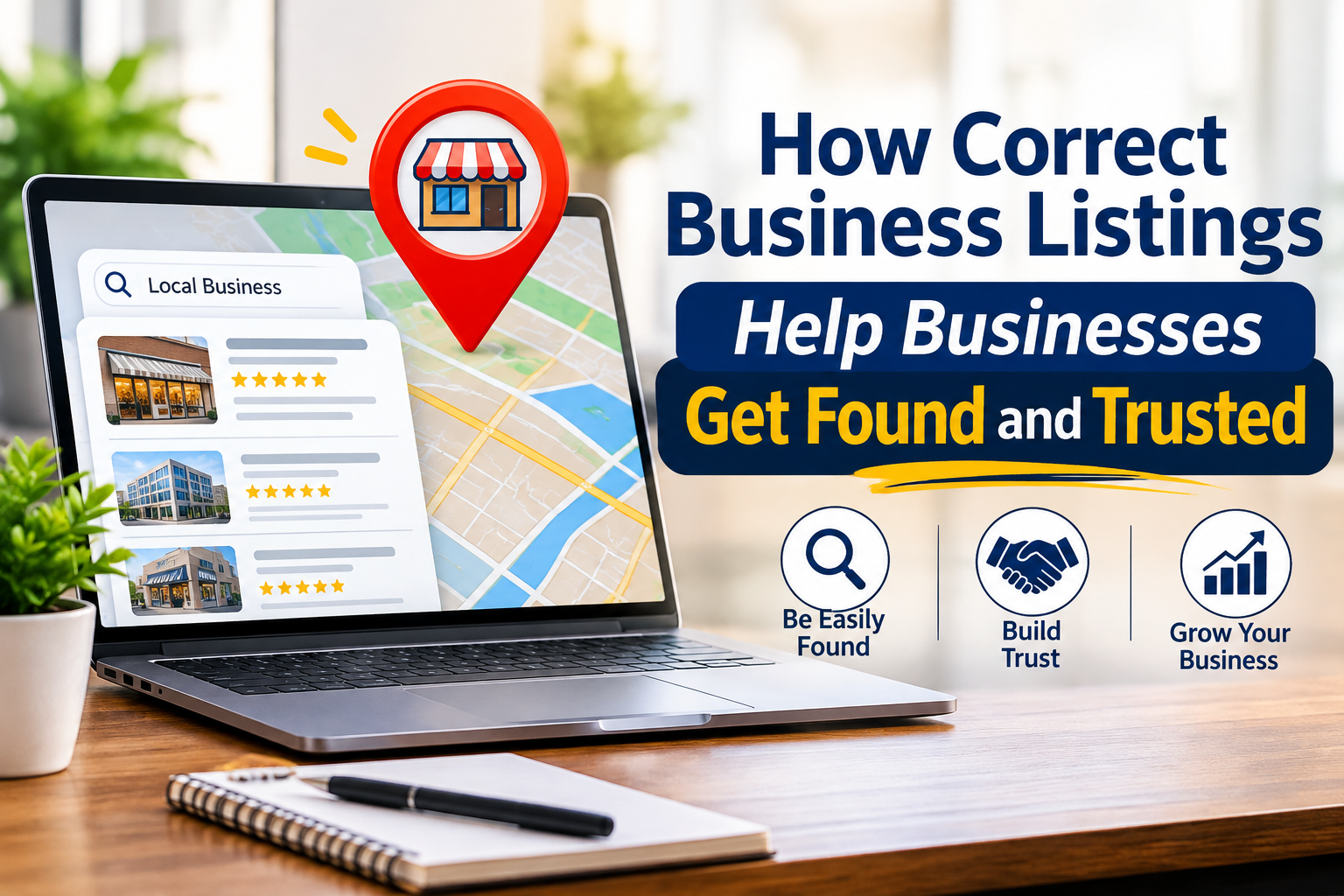
This is why correct business listings matter for businesses of every size. Accurate information across directories, maps, review platforms, social profiles, and local websites makes it easier for customers to discover a business and take the next step.
Accurate listings can also support local search visibility. Google recommends keeping business information complete and up to date because inaccurate information can affect whether a business appears for relevant local searches.
What Are Correct Business Listings?
Correct business listings are online business profiles that contain accurate, consistent, and useful information about a company.
Typical information includes:
- Business name
- Physical address or service area
- Phone number
- Website
- Business category
- Opening hours
- Services or products
- Business description
- Photos
- Customer reviews
- Location details
This information may appear on search engines, online directories, business directories, map services, review platforms, and industry-specific websites.
The goal is simple: customers should receive the same reliable business information wherever they find the company online.
Why Inaccurate Listings Can Cost Customers
Imagine a customer finds a business through a local search. The listing shows an old phone number, but the website has a different number. Another directory shows an outdated address.
The customer now has to decide which information is correct.
Many people will not spend time investigating. They may simply choose another company.
Incorrect listings can create several problems:
- Customers may call the wrong number.
- Visitors may arrive at an outdated location.
- People may believe the business has closed.
- Incorrect hours can lead to missed visits.
- Conflicting information can reduce customer confidence.
- Potential buyers may abandon the search before contacting the business.
Accuracy is therefore not just an SEO concern. It is part of the customer experience.
Consistent Business Information Builds Trust
Consistency helps customers recognize that different online profiles belong to the same business.
For example, a company should avoid using several unrelated versions of its business name across different directories. Its core information should reflect the way the business is actually represented in the real world.
Google specifically advises businesses to represent themselves consistently and accurately, including their real-world business name and precise address or service area.
Consistency can be especially important for local businesses competing for customers in a specific city or service area.
How Correct Listings Support Local SEO
Local SEO helps businesses become more visible when people search for nearby products and services.
Google explains that local results are mainly influenced by relevance, distance, and prominence. Complete and accurate business information can help Google better understand what a business does and match it with relevant searches.
A well-maintained listing can provide useful signals about:
- What the business offers
- Where it operates
- Which category describes it
- How customers can contact it
- When customers can visit
- Which services are available
This does not guarantee a particular ranking. However, accurate information gives both search engines and customers a clearer understanding of the business.
Correct Your Name, Address, and Phone Information
One of the most important steps is checking the basic contact information.
Compare the business name, address, and phone number across major profiles and directories. Look for small differences that could create confusion, such as:
- Different phone numbers
- Missing suite numbers
- Incorrect ZIP or postal codes
- Old business names
- Abbreviated addresses
- Former business locations
- Incorrect service areas
For businesses with physical locations, Google recommends using a precise, real-world address. Businesses that operate as service-area businesses have different requirements and may need to hide their physical address.
Keep Business Hours Updated
Business hours are easy to overlook but highly valuable to customers.
Regularly review:
- Normal opening hours
- Weekend hours
- Holiday schedules
- Seasonal changes
- Temporary closures
- Appointment requirements
A customer who arrives at a closed business because of incorrect online information can quickly lose trust.
Keeping hours updated also makes a listing more useful for people who are ready to visit or call.
Choose the Right Business Category
Business categories help platforms understand what type of company is being listed.
A common mistake is selecting too many unrelated categories simply because they contain desirable keywords. Google recommends choosing the fewest categories necessary to describe the business’s core operation and selecting categories that accurately represent what the business is.
The category should answer a simple question:
What type of business is this?
The answer should be based on the company’s actual primary service rather than a collection of keywords.
Review Your Listings Regularly
Creating a listing once is not enough.
Businesses change over time. They may move locations, change phone numbers, add services, update hours, redesign websites, or change their branding.
A practical listing review can be performed every few months.
Create a simple spreadsheet containing:
| Information | What to Check |
|---|---|
| Business name | Is the name accurate? |
| Address | Is the location current? |
| Phone | Does the number connect correctly? |
| Website | Does the link work? |
| Hours | Are regular and special hours correct? |
| Category | Does it describe the business? |
| Services | Are the current services listed? |
| Photos | Are images current and professional? |
This makes it easier to identify outdated information before customers encounter it.
How Accurate Listings Can Help Generate Business Leads
Accurate online information can make the customer journey easier.
Someone searching for a local service may discover a business through a directory, map result, or search engine. If the listing clearly explains the service and provides a working phone number or website, the customer has an obvious next step.
That can turn online visibility into potential business leads.
The connection is straightforward:
Accurate information → easier discovery → greater trust → easier contact → potential customer
A listing cannot guarantee leads, but removing incorrect information can reduce unnecessary friction between a customer and the business.
Do Not Add Keywords to Your Business Name
Keyword stuffing business names can create another problem.
For example, a real company called “Bright Dental” should not automatically change its business name to something like “Bright Dental Best Dentist Emergency Dental Services” just to target additional searches.
Google’s guidelines state that a Business Profile name should reflect the business’s real-world name, while additional details such as categories, services, address, and hours belong in their appropriate fields.
The better approach is to keep the business name authentic and use relevant information in the correct sections.
Make Listings Useful for Real Customers
SEO should not be the only goal.
A good listing should answer the questions customers actually have:
What does the business do?
Where is it located or where does it provide service?
How can customers contact it?
When is it available?
What makes the service relevant to the customer?
Google also recommends providing complete information so customers can understand what a business does, where it is located, and when they can visit.
When listings are created for people first, they can naturally become more useful for search engines as well.
Final Thoughts
Correct business listings are an important part of a reliable online presence. Accurate names, addresses, phone numbers, categories, hours, websites, and service information make it easier for customers to find and trust a business.
Regular listing audits can also uncover outdated information that may otherwise cost valuable opportunities. For businesses focused on local visibility, accurate profiles provide a stronger foundation for search discovery and customer engagement.
The best approach is not to create hundreds of profiles without maintaining them. Instead, focus on accurate, consistent, useful, and regularly updated business information across the platforms that matter most to the target audience.
When customers can quickly find the right information and take action, online listings become more than directory entries they become useful pathways toward new customers and potential business leads.