





Losing most or all of the teeth in one jaw changes far more than appearance. Eating, speaking, smiling in photographs, and feeling at ease in conversation can all become harder, and many people begin to avoid foods or social situations they once enjoyed. Removable dentures help some people, yet others find that a denture moves during speech, limits food choices, or feels uncomfortable over long periods. For those situations, dentists have developed fixed full-arch approaches that use a small number of implants to support an entire row of replacement teeth. This article explains that concept in general educational terms, including how planning works, what treatment day may involve, how the temporary and final prostheses differ, and how daily care and follow-up are usually organised.
What Full-Arch Tooth Loss Means Day to Day
Tooth loss rarely affects only chewing. When several teeth are missing, the remaining teeth may shift, the bite may change, and the jawbone in areas without tooth roots may gradually lose volume over time. Facial support can also change, because teeth and the surrounding bone help support the lips and cheeks. These changes tend to develop slowly, so people often adapt without noticing each step, until eating a favourite meal or speaking clearly becomes noticeably more difficult.
Eating and Nutrition
Chewing efficiency can decline when teeth are missing or when a removable prosthesis moves. Softer foods may become easier than firmer foods, and some people reduce their intake of raw vegetables, nuts, meat, or crusty bread. Over time, that narrowing of food choices can affect enjoyment of meals and, in some cases, nutritional variety. A fixed full-arch prosthesis is designed to stay stable during chewing, which may allow a wider range of foods, although adaptation still takes time and dietary guidance after surgery often starts with softer foods.
The Fewer-Implant Concept Explained
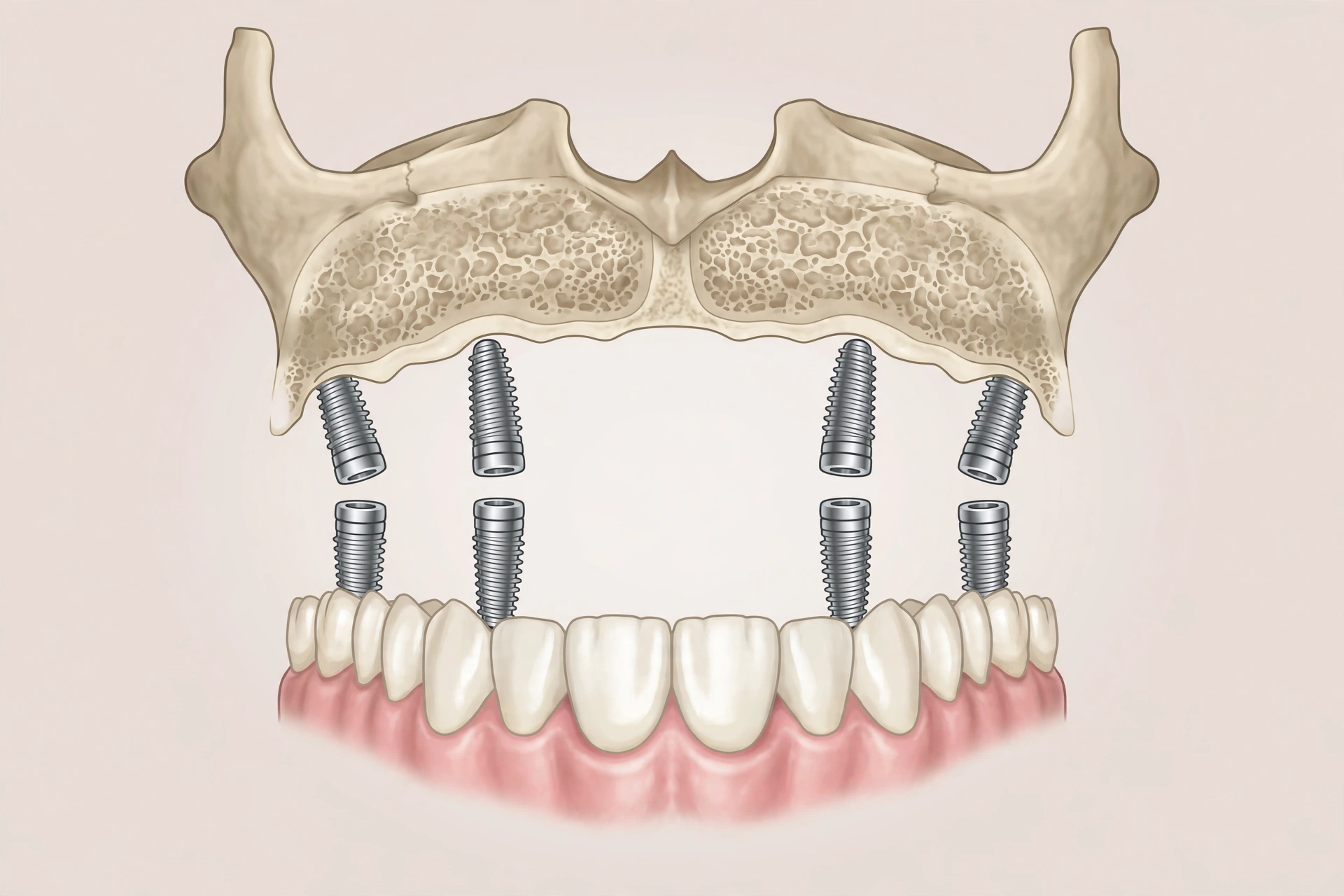
Traditional implant thinking sometimes involved placing one implant for each missing tooth. A full-arch approach uses a different logic. A connected bridge spreads biting forces across several implants, so a smaller number of well-placed implants can support the whole arch. In many plans, four implants are used in one jaw, with two placed toward the front and two placed toward the back. Other plans may use more implants, depending on bone, bite forces, and the prosthesis design.
The front implants are often placed vertically, where bone is commonly available near the front of the jaw. The back implants may be angled to reach bone further forward, avoiding anatomical structures and areas where bone may be thinner. Angling can also allow a longer implant in some cases and can extend the support toward the back of the arch, which may reduce the length of unsupported bridgework extending beyond the last implant. That unsupported extension, sometimes called a cantilever, is kept as short as practical because longer extensions can place extra stress on implants and prosthetic materials.
For readers seeking background on this specific approach, all-on-4 dental implants are described in educational sources as a four-implant strategy for supporting a fixed full arch. The phrase describes a treatment concept, not a single product, and different clinicians may apply the concept with different implant systems, prosthetic materials, and surgical protocols.
Why Fewer Implants May Be Considered
There are several reasons a clinician may discuss a fewer-implant plan:
- It may reduce the need for extensive bone grafting in some cases, because implants are placed where bone is already available.
- It may shorten the overall treatment sequence compared with placing many individual implants and grafts over multiple stages.
- It may lower the complexity of surgery and prosthetic work in selected cases.
- It may make a fixed option accessible to people whose bone volume would not easily support a larger number of implants.
- It may still provide a stable, fixed prosthesis that does not need to be removed at home.
These are possible advantages in suitable cases, not outcomes that can be promised for every person. Bone quality, gum health, medical history, smoking, bite forces, and oral hygiene all influence whether a fewer-implant plan is appropriate.
Angled Implants and How They Work
Angled implants are a central feature of many fewer-implant plans. Instead of placing every implant straight up and down, the back implants are tilted, often by around 30 to 45 degrees, so that their tops emerge further forward in the mouth while their tips reach bone further back. That geometry can help in the upper jaw by avoiding the sinus cavities and in the lower jaw by avoiding the nerve canal. It can also help when bone height toward the back of the jaw is limited.
Planning and Imaging Before Treatment
A full-arch plan usually starts with a detailed examination, a review of medical and dental history, photographs, and impressions or digital scans of the mouth. Gum health is assessed, because active gum disease can affect implant success and needs treatment before or alongside implant planning. Any remaining teeth are evaluated for whether they can be retained or should be removed as part of the restoration.
Three-dimensional cone beam computed tomography, often called CBCT, is commonly used for full-arch planning. It shows bone height, width, and density, the position of nerves and sinuses, and the shape of the jaw in three dimensions. That information allows virtual placement of implants before surgery, so angles, lengths, and positions can be tested on screen. Digital planning may also be combined with a surgical guide, a custom-made template that helps transfer the planned positions into the mouth during surgery.
Factors That Shape the Plan
Planning considers a wide range of factors, and no single factor decides the outcome on its own:
- Amount and quality of remaining bone in each part of the jaw.
- Gum thickness and health, and the amount of attached gum tissue around planned implant sites.
- Bite relationship between the upper and lower jaws, including jaw alignment and chewing patterns.
- Medical conditions, medications, and healing capacity, including conditions that affect bone or immune response.
- Smoking and alcohol use, which can affect healing and long-term implant health.
- Expectations about appearance, speech, food choices, and maintenance effort.
- Budget and the ability to attend follow-up appointments over time.
The Treatment-Day Sequence
Treatment day for a full-arch case is longer than a single implant appointment and is usually planned as a coordinated sequence involving surgery and prosthetics. Sedation options vary by clinic and by patient need, ranging from local anaesthesia alone to conscious sedation or general anaesthesia in appropriate settings. A discussion of anaesthesia, fasting instructions, medications to pause or continue, and transport home is part of preparation, because sedation can affect alertness after the appointment.
A Typical Sequence in Outline
The sequence below is a general outline. Details, order, and timing vary by case and by clinical protocol:
- Final checks, consent discussion, and anaesthesia or sedation are completed.
- Any remaining teeth included in the plan are removed, if that step is part of the same appointment.
- Implant sites are prepared and implants are placed according to the digital plan or surgical guide.
- Stability of each implant is checked, because immediate loading depends on adequate initial stability.
- Abutments are placed and impressions or digital scans are taken for the provisional bridge.
- A provisional fixed bridge is fitted, adjusted for bite, and checked for comfort and speech.
- Aftercare instructions, medications, and follow-up appointments are provided before discharge.
In some protocols, the provisional bridge is fitted on the same day as surgery. That approach is often called immediate loading. It depends on implant stability at placement and on bone quality. If stability is not sufficient, a different plan may be used, such as a removable temporary prosthesis during healing, followed by a fixed bridge later. That change of plan is a safety decision, not a failure of the overall treatment.
Provisional Versus Final Prosthesis
The provisional bridge and the final bridge serve different purposes, even though they may look similar at first glance. The provisional bridge is made quickly after surgery, often from acrylic or a similar material, and is designed to restore appearance and basic function while implants integrate with bone. It may be adjusted several times as swelling resolves and the bite settles. The final prosthesis is made later, after healing, when impressions capture the healed gum shape more accurately.
Comparing Full-Arch Options
|
Option |
How it is held in place |
Removal at home |
Typical material examples |
Maintenance focus |
|---|---|---|---|---|
|
Fixed full-arch bridge on fewer implants |
Screwed to implants |
No, removed only by a professional |
Acrylic with a metal or reinforced framework, or ceramic over a framework |
Cleaning under the bridge, regular professional checks |
|
Fixed full-arch bridge on more implants |
Screwed to implants |
No, removed only by a professional |
Similar framework and tooth materials |
Cleaning under the bridge, regular professional checks |
|
Implant-retained removable denture |
Clips or bars attached to implants |
Yes, removed daily for cleaning |
Acrylic denture base with attachments |
Daily denture cleaning, attachment replacement over time |
|
Conventional removable denture |
Suction and gum support, no implants |
Yes, removed daily for cleaning |
Acrylic base and teeth |
Daily cleaning, relining as bone and gums change |
The final bridge often uses stronger or more refined materials than the provisional bridge and may offer improved durability, stain resistance, and aesthetics. Tooth shape, colour, and gum shading can be refined at the final stage, and the bite can be adjusted with greater precision after healing. Some final bridges include a metal or zirconia framework for strength, while others use layered ceramic for appearance. Material choice involves trade-offs between strength, weight, repairability, and cost, and the best choice depends on bite forces, arch position, and patient priorities.
Eating and Speech Adaptation
Eating adaptation follows a gradual pattern. Soft foods come first, followed by a wider range of textures as healing progresses and the clinician advises. Cutting food into smaller pieces, chewing slowly, and using both sides of the mouth evenly may help distribute forces. Very hard foods, such as ice, hard nuts, or tough crusts, may still need caution even after healing, because excessive force can damage prosthetic teeth or frameworks over time. Individual guidance matters, because bite strength, implant positions, and material choice all affect what is reasonable for a given person.
A Gradual Return to Foods
A staged approach to diet after surgery is commonly described in general terms:
- First days: liquids and very soft foods, with attention to hydration and nutrition.
- Early weeks: soft foods that require little chewing, avoiding the surgical sites as directed.
- Healing months: a gradual return to firmer foods as comfort and clinician guidance allow.
- After the final bridge: a broader diet, with ongoing caution for extremely hard or sticky foods.
Appetite and enjoyment of food often improve as comfort returns, but patience during the soft-food phase helps protect healing. If eating remains painful, if the bridge feels loose, or if biting feels sharply uneven, professional review is warranted rather than pushing through discomfort.
Cleaning Under a Fixed Arch
Daily cleaning is one of the most important long-term factors for implant health. A fixed bridge does not come out at home, so food and plaque can collect under the bridge and around implant abutments. Without regular cleaning, gum inflammation around implants, sometimes called peri-implant mucositis, can develop. If inflammation progresses to bone loss around an implant, the condition is called peri-implantitis, which may threaten implant stability if left unaddressed. Early signs can be subtle, which is why professional monitoring matters alongside home care.
Daily Home-Care Tools and Habits
Home care for a fixed arch often combines several tools, used as directed by a dental professional:
- A soft toothbrush for the outer and inner surfaces of the bridge and any remaining natural teeth.
- Interdental brushes or a water flosser to clean under the bridge and between implant abutments.
- Superfloss or threaders designed to pass beneath a fixed bridge, used gently and as instructed.
- An antimicrobial rinse only if recommended, because routine use is not appropriate for everyone.
- Regular inspection for bleeding, swelling, odour, or loosening, reported promptly if noticed.
Long-Term Monitoring and What Can Change Over Time
Implants and bridges are durable, but they are not maintenance-free. Prosthetic teeth can wear, chip, or stain over years of use. Screws can loosen. Gum tissue and bone can change with age, medical conditions, and oral hygiene. Bite forces can shift if remaining natural teeth change or if a person grinds or clenches their teeth. Night guards may be recommended for people with grinding habits, to protect both implants and prosthetic materials during sleep.
For readers comparing local options for this type of care, all on 4 implants Van Nuys may appear in searches as a location-specific way to find educational information about the same four-implant concept. Location phrases in searches do not change the clinical principles described here, and treatment decisions still rest on examination, imaging, and individual suitability.
Costs and Insurance in General Terms
Cost is a common question, and it varies widely by region, clinic, implant system, prosthetic material, need for extractions or grafting, sedation type, and laboratory work. A full-arch restoration is a major investment compared with a single implant or a conventional denture, because it combines surgery, prosthetics, imaging, laboratory fees, and follow-up care. Some quotes include the provisional and final bridges, follow-up visits, and adjustments, while others itemise those stages separately, so comparing quotes requires checking what each quote includes.
Questions Worth Asking Before Deciding
Preparing questions can help a consultation feel more useful and less rushed. Helpful topics to cover include:
- How many implants are planned for my upper or lower jaw, and why that number was chosen?
- Will any implants be angled, and what structures are being avoided in my case?
- What imaging and planning steps will be used before surgery?
- Will I receive a provisional fixed bridge on the day of surgery, or a different temporary option?
- What materials are proposed for the provisional and final bridges, and what are their trade-offs?
- What is the expected timeline from surgery to final bridge in my situation?
- What daily cleaning routine will I need, and what professional maintenance schedule is expected?
- What are the main risks, possible complications, and alternatives in my case?
- What is included in the quoted cost, and what may incur additional fees?
- What happens if an implant does not integrate, or if a prosthetic component needs repair?
Answers to those questions, combined with a written plan, can help a person compare options and understand the commitment involved.
Red Flags and Safety Notes
Most full-arch implant treatment proceeds without major complications, but it is important to recognise signs that warrant prompt professional evaluation. General safety notes below are educational only and do not diagnose any individual situation.
Signs to Report Promptly
- Persistent or worsening pain, swelling, or bleeding beyond the expected early healing period.
- Fever, increasing redness, warmth, or discharge around a surgical site.
- Numbness, tingling, or altered sensation in the lip, chin, or tongue that does not improve.
- A bridge, tooth, or component that feels loose, cracked, or broken.
- A bite that suddenly feels very uneven, or difficulty opening the mouth that worsens.
- Persistent bad taste, odour, or gum bleeding around implants despite gentle cleaning.
- Difficulty swallowing or breathing, or swelling that affects the airway, which warrants urgent care.
General safety points also include following post-operative instructions about medications, diet, and activity, avoiding smoking during healing if possible, and attending scheduled follow-up appointments even when everything feels comfortable. People taking blood thinners, immune-suppressing medications, or medications for bone conditions should discuss those medicines with both their dental clinician and their medical clinician before surgery, because medication management is individual and should not be changed without professional guidance.
Who May Need Extra Caution
Extra caution or additional planning may be needed for people with uncontrolled diabetes, active gum disease, significant bone loss, a history of radiation to the jaw, certain bone medications, heavy smoking, or conditions that impair healing. Those factors do not automatically prevent treatment, but they may change timing, implant numbers, grafting needs, or monitoring frequency. A candid discussion of medical history helps a clinician plan safely and set realistic expectations about healing and long-term care.
A Balanced View of the Fewer-Implant Approach
A fewer-implant full-arch restoration offers a fixed, stable alternative to a removable denture for many people with extensive tooth loss, and it may avoid extensive grafting in selected cases. Its strengths include a connected, non-removable prosthesis, the use of available bone through angled placement, and a treatment sequence that can be shorter than multi-stage grafting and implant approaches. Its limitations include reliance on a small number of implants, the need for meticulous daily cleaning under a fixed bridge, ongoing professional maintenance, and prosthetic wear or repair over time.
Understanding the concept, the planning behind it, the treatment-day sequence, and the long-term care involved can help readers approach a consultation with clearer questions and more realistic expectations. Full-arch restoration is a long-term partnership between patient and dental team, built on careful planning, honest discussion of risks and alternatives, and consistent care after the final bridge is fitted.
This article is for general educational purposes only and is not medical advice. Experiences and outcomes can vary. Consult a qualified dental professional about your specific situation.