





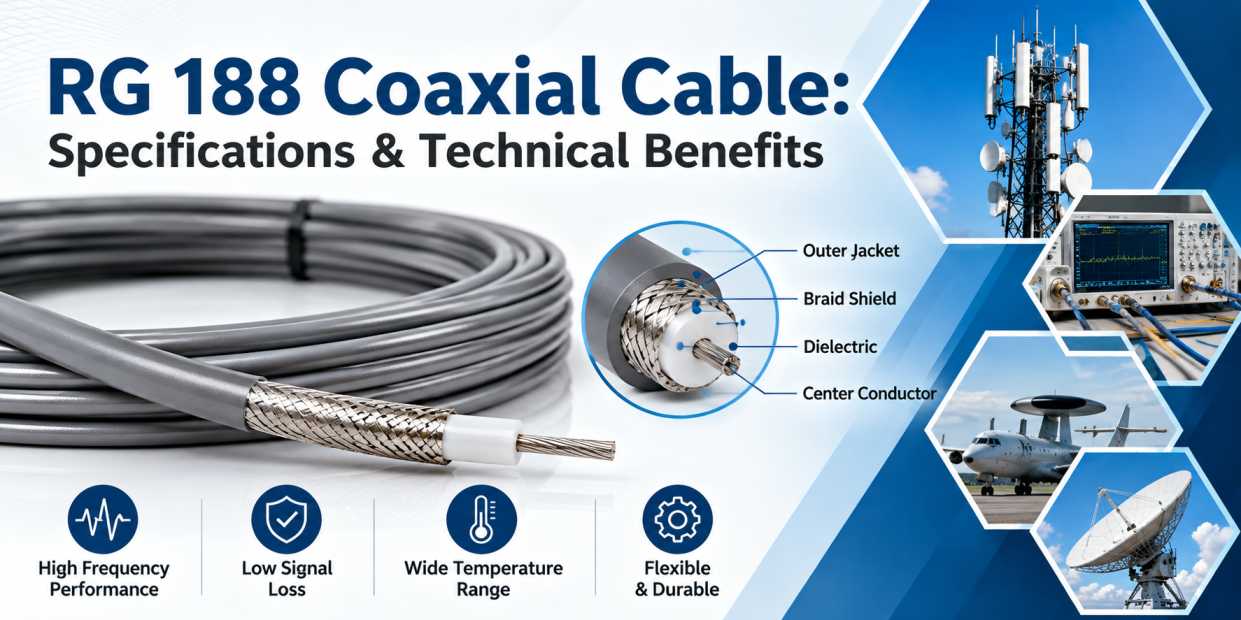
RG 188 Coaxial Cable is a compact, flexible RF cable designed for reliable signal transmission in electronic, communication, instrumentation, and high-frequency applications. Its small diameter and flexible construction make it suitable for systems where space is limited and cable routing requires tight bends.
The RG 188 Cable is commonly used in RF assemblies, wireless communication equipment, test and measurement systems, aerospace and defense electronics, industrial equipment, and other applications requiring a dependable coaxial connection.
What Is RG 188 Coaxial Cable?
RG 188 Coaxial Cable is a small-diameter coaxial transmission cable designed to carry radio-frequency signals while providing shielding against electromagnetic interference. A typical coaxial cable consists of a center conductor, dielectric insulation, shielding layer, and protective outer jacket.
The construction allows the RF signal to travel through the center conductor while the surrounding shield helps reduce unwanted external interference and signal leakage. Its compact construction makes RG 188 particularly useful for equipment where conventional larger RF cables may be difficult to install.
Depending on the manufacturer’s construction, RG 188 Cable may be available with different conductor, dielectric, shielding, jacket, and termination configurations. Therefore, the exact electrical and mechanical specifications should always be verified against the relevant product datasheet.
RG 188 Cable Construction
The performance of an RG 188 Coaxial Cable depends significantly on its internal construction.
Center Conductor
The center conductor carries the RF signal. Depending on the cable design, a plated copper conductor or another suitable conductive material may be used. The conductor construction affects flexibility, conductivity, attenuation, and termination characteristics.
Dielectric
The dielectric material electrically separates the center conductor from the outer shield. It also helps maintain the cable’s impedance and influences signal propagation and frequency performance.
Shielding
The shield surrounds the dielectric and provides protection against electromagnetic and radio-frequency interference. Depending on the specific cable design, the shielding may use a braided, foil, or multiple-shield configuration.
Outer Jacket
The outer jacket protects the internal components from mechanical damage, moisture, abrasion, and environmental exposure. Jacket materials vary according to the intended application.
Read also: Why Mylar Bags Are a Practical Choice for Product Packaging
RG 188 Cable Specifications
The exact specifications of RG 188 Cable can vary according to the manufacturer and construction. Common parameters to evaluate include:
| Parameter | Typical Consideration |
| Cable Type | Flexible RF Coaxial Cable |
| Impedance | Commonly 50 Ohms |
| Cable Size | Compact, small-diameter construction |
| Center Conductor | Plated copper or equivalent conductor |
| Dielectric | RF-grade insulating material |
| Shield | Braided and/or foil shielding depending on design |
| Jacket | Protective polymer jacket |
| Flexibility | Suitable for compact RF routing |
| Applications | RF, microwave, telecom, test & measurement |
| Termination | SMA, BNC, TNC, N-Type and other compatible connectors |
These values should be treated as general design considerations rather than universal specifications. Actual cable diameter, attenuation, operating frequency, temperature range, shielding effectiveness, and voltage rating depend on the particular RG 188 Cable manufacturer and model.
Key Technical Benefits of RG 188 Cable
1. Compact Design
One of the major benefits of RG 188 Coaxial Cable is its compact construction. Its small size makes it easier to install inside equipment, instruments, communication devices, and RF modules where available space is restricted.
2. High Flexibility
RG 188 Cable is designed for flexible routing, making it useful for applications involving movement, tight installation areas, and complex cable paths. Proper bend-radius requirements should always be followed during installation.
3. Reliable RF Signal Transmission
The coaxial construction maintains a controlled signal path between the source and destination. Proper impedance matching, connector selection, and termination can help reduce signal reflections and maintain RF performance.
4. Shielding Against Interference
The shielding layer helps protect the transmitted RF signal from electromagnetic interference. This is particularly valuable in environments containing other electronic equipment, wireless systems, motors, power supplies, and switching devices.
5. Space-Saving Installation
The compact size of RG 188 makes it suitable for densely packed electronic assemblies. Engineers can route the cable through limited spaces without requiring the installation area needed by larger coaxial cables.
6. Wide Application Potential
RG 188 Coaxial Cable can be used across multiple industries, including telecommunications, aerospace, defense, instrumentation, wireless communication, industrial electronics, and RF testing.
RG 188 Cable Applications
Aerospace and Defense
RG 188 Cable can be used in aerospace and defense electronics where compact RF interconnections and dependable signal transmission are required. Applications may include communication equipment, RF modules, instrumentation, and electronic systems.
Telecommunications
The cable can be integrated into communication equipment, RF assemblies, wireless systems, and other telecommunications hardware.
Test and Measurement
RG 188 Coaxial Cable is suitable for connecting RF instruments, measurement equipment, signal sources, test fixtures, and electronic evaluation systems.
Wireless Communication
Wireless equipment often requires compact RF cables between antennas, modules, amplifiers, filters, and other components. RG 188 can be considered when its electrical specifications meet the requirements of the system.
Industrial Electronics
Industrial electronic equipment may require small, flexible RF cables for sensors, communication modules, monitoring equipment, and control systems.
RG 188 Cable Connector Options
The performance of an RF cable assembly depends not only on the cable but also on the connector and termination.
Depending on the cable construction, RG 188 Cable assemblies may be terminated with connectors such as:
- SMA
- BNC
- TNC
- N-Type
- SMB
- SMC
- Other compatible RF connectors
For example, an SMA connector can provide a compact interface for RF equipment. The connector should be specifically selected according to cable diameter, conductor dimensions, dielectric construction, impedance, frequency range, and termination method.
RG 188 Cable and RF Performance
Several parameters should be considered when evaluating RG 188 Cable for a particular RF application.
Impedance
Impedance matching is essential for efficient RF signal transfer. RG 188 is commonly associated with 50-ohm RF systems, but the exact specification should be confirmed before installation.
Insertion Loss
Cable attenuation increases with frequency and cable length. Lower-loss construction can be important in systems where maintaining signal strength is critical.
VSWR and Return Loss
VSWR and return loss indicate how effectively the cable assembly is matched to the RF system. Connector quality, cable construction, and termination accuracy can all influence these parameters.
Frequency Range
The suitable frequency range depends on the cable construction and manufacturer. Always check the manufacturer’s specified maximum operating frequency before selecting RG 188 for high-frequency applications.
How to Select the Right RG 188 Cable
Before purchasing or specifying an RG 188 Coaxial Cable, consider:
- Required operating frequency
- System impedance
- Required cable length
- Maximum acceptable attenuation
- Required flexibility
- Operating temperature
- Shielding requirements
- Connector type
- Installation environment
- Required cable assembly configuration
For demanding RF systems, it is important to evaluate the complete cable assembly rather than selecting the cable alone.
RG 188 Cable vs Larger RF Cables
Compared with larger coaxial cables, RG 188 generally provides an advantage where compact size and flexible routing are important. However, larger cables may provide lower attenuation, greater power-handling capability, or stronger mechanical construction depending on their design.
Therefore, the best cable depends on the application. Engineers should balance cable size, attenuation, frequency, flexibility, power handling, environmental conditions, and connector compatibility.
Installation Considerations
Correct installation is important for maintaining the performance of RG 188 Cable. Avoid excessive bending, crushing, sharp mechanical stress, or pulling directly on the connector.
Connectors should be properly terminated and tightened according to the connector manufacturer’s recommendations. Poor termination can increase insertion loss, VSWR, and signal reflections.
Cable routing should also be planned to minimize unnecessary bends and avoid proximity to strong sources of electromagnetic interference where practical.
Conclusion
RG 188 Coaxial Cable is a compact and flexible RF cable solution designed for applications where reliable signal transmission and space-efficient installation are important. Its coaxial construction combines a center conductor, dielectric, shielding, and protective jacket to support RF signal integrity and mechanical protection.
The RG 188 Cable can be used in telecommunications, wireless communication, aerospace, defense, test and measurement, and industrial electronics. Its compact construction makes it particularly useful for equipment with limited installation space.
When selecting RG 188 Cable, engineers should evaluate impedance, frequency range, attenuation, shielding, flexibility, temperature capability, connector compatibility, and termination requirements. Choosing the correct cable and connector combination helps achieve dependable performance in RF and electronic systems.
FAQs About RG 188 Coaxial Cable
1. What is RG 188 Coaxial Cable?
RG 188 Coaxial Cable is a compact, flexible RF coaxial cable designed for signal transmission in communication, instrumentation, RF, and electronic applications.
2. What impedance is RG 188 Cable?
RG 188 Cable is commonly used in 50-ohm RF systems, but the exact impedance should be confirmed from the manufacturer’s specifications.
3. Where is RG 188 Cable used?
It can be used in telecommunications, wireless communication, aerospace, defense, test and measurement, instrumentation, and industrial electronics.
4. Is RG 188 Cable flexible?
Yes, RG 188 is generally designed as a flexible, small-diameter RF cable, making it suitable for compact and complex cable routing.
5. Can RG 188 Cable be used with SMA connectors?
Yes, compatible SMA connectors can be used for RG 188 cable assemblies when the connector is designed for the cable’s dimensions and construction.
6. What factors affect RG 188 Cable performance?
Frequency, cable length, impedance, attenuation, shielding, connector quality, termination, temperature, and installation conditions can all affect performance.
7. Is RG 188 suitable for high-frequency applications?
It can be used in high-frequency RF applications within the limits specified by the particular cable manufacturer. Always verify the rated frequency range.
8. What are the main advantages of RG 188 Cable?
Its major advantages include compact size, flexibility, reliable RF transmission, shielding, and suitability for space-constrained electronic systems.
9. How should RG 188 Cable be installed?
Avoid excessive bending, crushing, sharp bends, and mechanical stress. Use compatible connectors and follow the recommended termination and bend-radius requirements.
10. How do I choose the right RG 188 Cable?
Consider frequency, impedance, attenuation, length, flexibility, shielding, temperature range, connector type, installation environment, and application requirements.