






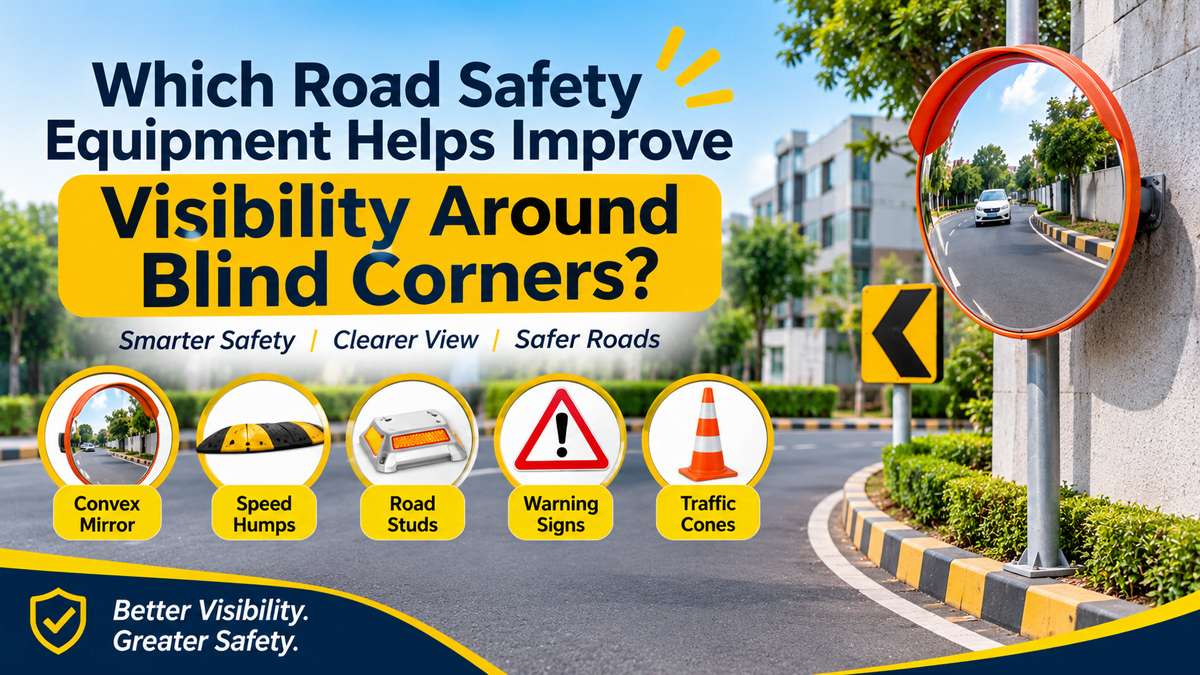
Blind corners create visibility problems for drivers, pedestrians and workers. A vehicle approaching from the other side of a sharp turn may remain hidden behind a wall, building or roadside structure. Drivers often have limited time to react when another vehicle or pedestrian suddenly enters their path.
These situations are common near narrow streets, parking entrances, residential areas, factories, warehouses and commercial buildings. Poor visibility can increase the risk of collisions, particularly where vehicles and pedestrians use the same routes.
The right Road Safety Equipment can help address these problems by improving visibility, guiding vehicle movement and making hidden areas easier to monitor. One useful solution is a Convex Mirror, which provides a wider viewing angle than a standard flat mirror. Other safety products, including road studs, warning signs and speed control devices, can support safer movement around these locations.
Understanding how these products work can help property owners, contractors and road safety planners select suitable equipment for areas with restricted visibility.
Why Are Blind Corners Dangerous for Drivers and Pedestrians?
A blind corner is a location where drivers cannot see approaching traffic or pedestrians because an obstruction blocks their direct line of sight. The obstruction may be a building, boundary wall, parked vehicle, roadside structure or sharp road curve.
These areas require extra attention because drivers may not know whether another vehicle or pedestrian is approaching from the opposite direction.
Some common problems associated with blind corners include:
- Limited viewing distance: Drivers cannot see approaching vehicles until they get closer to the corner.
- Unexpected pedestrian movement: People crossing near buildings or parked vehicles may remain hidden from approaching drivers.
- Restricted vehicle movement: Narrow roads and sharp turns make it difficult for vehicles to pass safely.
- Parking area collisions: Drivers reversing out of parking spaces may not see vehicles or pedestrians approaching from the side.
- Industrial movement risks: Forklifts, trucks and other machinery may enter shared routes from hidden warehouse aisles.
These problems can occur in public and private spaces. Installing suitable safety equipment can provide additional visual guidance and help road users respond more carefully.
How Does a Convex Mirror Improve Visibility Around Blind Corners?
A Convex Mirror has an outward-curved reflective surface that provides a wider field of view than a flat mirror. It allows drivers and pedestrians to see a larger surrounding area, including sections that may be hidden by walls, buildings or other obstructions.
Unlike flat mirrors, convex mirrors show a broader image, although objects appear smaller. This makes them useful at locations where people need to check approaching traffic from different directions.
Providing a Wider View at Sharp Turns
Sharp road turns can prevent drivers from seeing vehicles approaching from the opposite direction. A convex mirror installed at a suitable position can show traffic approaching from around the corner.
Drivers can use this additional view to slow down, wait or proceed when the road is clear.
Helping Drivers Check Hidden Intersections
Intersections near buildings, boundary walls and other structures may have limited visibility. A convex traffic mirror can help drivers check approaching vehicles before entering the intersection.
This is particularly useful on narrow streets where two vehicles may approach the same turn from opposite directions.
Improving Visibility at Parking Entrances and Exits
Drivers leaving underground parking areas, commercial buildings and residential driveways may have difficulty seeing traffic on the main road.
Installing a convex mirror near an exit can provide a wider view of approaching vehicles and pedestrians. It can also help drivers manoeuvre around restricted parking spaces.
Supporting Safety in Factories and Warehouses
Factories and warehouses often have narrow internal routes, storage racks and building structures that obstruct visibility.
Convex mirrors installed at aisle intersections and vehicle access points can help forklift operators and other workers check for approaching movement.
They are useful where vehicles, machinery and pedestrians share internal routes.
What Other Road Safety Equipment Can Help Improve Visibility?
A convex mirror addresses blind spots, but different locations may require additional safety measures. The right combination depends on the road layout, traffic movement, lighting and potential hazards.
Here are some types of Road Safety Equipment that can support better visibility and traffic management.
Road Studs for Clearer Road Guidance
Road studs are raised pavement markers that help drivers identify lane boundaries, road edges and changes in direction. Reflective road studs return light from vehicle headlights, making road guidance easier to see at night.
They are commonly used on highways, intersections, parking areas and other roads where clear lane guidance is required.
Road studs do not provide a wider view around an obstruction. However, they can complement convex mirrors by helping drivers follow the correct road path after checking approaching traffic.
Speed Humps for Vehicle Speed Control
Speed humps are raised road sections that encourage drivers to reduce their speed. They are commonly installed near schools, hospitals, residential streets, parking facilities and commercial buildings.
Near a blind corner, a properly positioned speed hump may encourage drivers to approach the area more slowly. This gives them more time to observe the surroundings and respond to other road users.
However, speed humps should be installed according to applicable road design and traffic regulations.
Warning Signs for Hazard Awareness
Warning signs inform drivers about potential road hazards, sharp turns, restricted visibility and other conditions that require attention.
Placing suitable warning signs before a blind corner can alert drivers to slow down and check their surroundings.
Signs should be visible, correctly positioned and appropriate for the hazard.
Traffic Cones and Barriers for Temporary Guidance
Traffic cones and barriers help direct vehicles and pedestrians around temporary hazards, construction work and restricted areas.
They can be useful when road layouts change or when workers need to separate vehicle movement from pedestrian access.
These products provide temporary guidance rather than a permanent solution to a blind corner.
How to Choose the Right Convex Mirror for Your Location
Selecting a convex mirror requires more than checking its price or appearance. You should consider the size of the hidden area, viewing distance, installation position and outdoor conditions.
Polycrafts offers convex traffic mirrors in three sizes: 18 inches, 24 inches and 32 inches.
Consider the Mirror Size
The viewing distance and size of the blind spot help determine which mirror may be suitable.
- 18-inch mirror: May suit smaller areas with shorter viewing requirements.
- 24-inch mirror: Can be considered for general applications such as driveways, entrances and parking areas.
- 32-inch mirror: May suit larger viewing areas where a broader mirror is required.
These are general selection considerations, not fixed engineering rules. The actual choice should depend on the location and required viewing coverage.
Check Weather Resistance
Outdoor mirrors remain exposed to sunlight, rain, dust and changing temperatures. Their construction should be suitable for the conditions where they will be installed.
Polycrafts describes its convex traffic mirrors as weatherproof and lightweight, making them suitable for various outdoor and commercial applications.
Check the Installation Position
Even a suitable mirror may provide poor visibility if it is installed at the wrong height or angle.
Before installation, consider:
- The direction from which vehicles approach.
- The position of walls, buildings and other obstructions.
- The distance between the mirror and the viewing point.
- Whether pedestrians can also use the reflected view.
- Whether the mirror remains visible under normal lighting conditions.
A properly positioned mirror should show the relevant hidden area without unnecessary obstructions.
Why Should Convex Mirrors Be Part of a Wider Road Safety Plan?
A convex mirror improves the viewing angle, but it cannot address every road hazard. Drivers may still need to slow down, stop or check their surroundings directly before moving.
For this reason, convex mirrors should be considered alongside other suitable Road Safety Equipment.
For example, a commercial property with a narrow entrance may benefit from a convex mirror to show approaching traffic, warning signs to alert drivers about restricted visibility and road markings to guide vehicle movement.
Similarly, a factory may use convex mirrors at internal intersections, speed humps near pedestrian areas and barriers to separate machinery routes from walking paths.
Each product serves a different purpose. Selecting equipment according to the actual problem helps create a more practical safety arrangement.
Why Consider Polycrafts Convex Mirrors for Road Safety Applications?
Polycrafts manufactures rubber products and road safety products for automotive, construction and industrial applications in Pakistan.
Its convex traffic mirrors are designed for locations where drivers and pedestrians need a wider view of their surroundings. The mirrors are available in three sizes:
| Available size | Common application consideration |
| 18 inches | Smaller viewing areas |
| 24 inches | General parking and entrance areas |
| 32 inches | Larger viewing areas |
The mirrors are described as lightweight, weatherproof and easy to install.
They can be used around:
- Sharp road corners and dangerous curves.
- Parking lots and garages.
- Residential driveways.
- Factory and warehouse entrances.
- Commercial and industrial properties.
- Areas with frequent vehicle and pedestrian movement.
Polycrafts also supplies other road safety products, including road studs, rubber speed humps, wheel stoppers and rubber lane dividers.
You can check the product specifications here:
- Polycrafts Convex Mirrors
- Polycrafts Road Safety Products
Frequently Asked Questions
Which equipment is used to improve visibility around blind corners?
Convex traffic mirrors are commonly used to improve visibility around blind corners. Warning signs, road studs and suitable lighting can provide additional guidance depending on the location.
How does a convex mirror help prevent collisions?
A convex mirror provides a wider viewing angle, allowing drivers and pedestrians to see approaching traffic or people hidden behind obstructions. This additional view can help them make safer movement decisions.
Where should convex traffic mirrors be installed?
Convex mirrors can be installed at sharp road corners, blind intersections, parking entrances, building exits, warehouse aisles, factories and narrow driveways where direct visibility is restricted.
What size convex mirror is suitable for a road corner?
The suitable size depends on the viewing distance, size of the blind area and installation position. Polycrafts offers 18-inch, 24-inch and 32-inch convex mirrors for different applications.
Can road studs improve visibility around blind corners?
Road studs improve visibility of road boundaries and lane guidance, particularly at night. However, they do not provide a wider view around physical obstructions. Convex mirrors are more directly suited to blind-corner visibility problems.
Are convex mirrors suitable for outdoor installation?
Yes. Outdoor convex mirrors should have weather-resistant construction and secure mounting. Polycrafts describes its convex mirrors as weatherproof and suitable for different outdoor applications.
Can convex mirrors replace other road safety products?
No. Convex mirrors improve visibility, while other products address different risks. Speed humps encourage lower vehicle speeds, road studs provide road guidance, and warning signs alert drivers to hazards. These products can work together as part of a wider safety plan.
Conclusion
Blind corners require careful attention because drivers, pedestrians and workers may not see approaching movement until they are close to an obstruction. A convex mirror provides a wider viewing angle, helping road users check hidden areas before proceeding.
Other Road Safety Equipment, including road studs, speed humps, warning signs and barriers, can support traffic guidance and vehicle movement in suitable locations.
Polycrafts offers convex traffic mirrors in 18-inch, 24-inch and 32-inch sizes, along with other road safety products for commercial, residential and industrial applications.
Choosing the right equipment, installing it at a suitable position and following safe driving practices can help address visibility problems around blind corners.