







Key Takeaways
- Dubai’s demand is not the problem. The gap between enquiry and confirmed booking is where agencies lose money.
- Slow quotes, stale prices, payment friction and manual reconciliation each quietly cut conversion and margin.
- Measure your leaks first: quote turnaround, conversion rate, payment failures and margin per booking.
- Integrate the costliest bottleneck before replacing every tool. A phased approach improves efficiency and lowers risk.
- Agencies that match OTA-level speed with human expertise stay competitive as online booking keeps growing.
Dubai’s Travel Demand Is Growing. Disconnected Systems Are Costing Agencies Bookings
A family contacts a Dubai agency about a ten-day holiday. The agent checks flights in one supplier portal, hotel rates in another, and builds a quotation by hand. It reaches the customer over WhatsApp two hours later.
By then the fare has moved, one hotel room type has sold out, and the customer is asking for a payment link the agent still has to create. Meanwhile the customer has an OTA tab open, where the same trip takes four minutes.
This is the central argument of this article: most agencies don’t have a demand problem. They have a conversion problem caused by disconnected tools.
The context makes it sharper. Dubai welcomed 19.59 million international overnight visitors in 2025, a 5% rise on 2024, and average hotel occupancy reached 80.7%. Busy markets punish slow responses.
Below, we map where bookings leak, how to put a number on the damage, and what to check before you invest in travel agency software Dubai operators can rely on, or any travel booking system UAE buyers might compare.
Why Disconnected Travel Systems Are a Growing Problem for Dubai Agencies

Flights, hotels and payments rarely operate as one booking journey
A typical agency touches many platforms: a GDS, airline NDC connections, direct supplier APIs, hotel wholesalers or bedbanks, a payment gateway, a CRM and accounting software. To build one itinerary, an agent may switch between five or six of them.
Having many suppliers isn’t the issue. Good agencies need choice. The issue is that these systems don’t share data, so people become the integration layer, retyping passenger names, copying fares and checking payment status across tabs.
Customers expect faster digital experiences than manual processes can deliver
Travellers are used to real-time availability, clear pricing, instant confirmation and mobile payment. OTAs have trained them to expect it.
The shift is measurable. VIDEC research presented at Arabian Travel Market 2026 forecasts UAE online air penetration rising from 42% in 2025 to 46% in 2026, and reaching 52% by 2030. Every point of that growth is a customer comfortable booking without speaking to anyone.
Why the problem is particularly relevant in Dubai
Dubai agencies serve unusually mixed demand: inbound tourists, outbound residents, corporate travellers, visa-linked services and B2B sub-agents. Customers pay in AED and foreign currencies. Peak seasons and events compress decision windows, so a slow confirmation costs more here than in a quieter market.
One caution. Not every delay becomes a lost sale, and assuming so leads to bad investment decisions. The goal is to measure losses, not guess at them.
Seven Ways Separate Flight, Hotel and Payment Systems Cause Booking Losses
1. Slow quotations push customers towards competitors
Picture a Dubai family asking for a multi-destination trip: flights to Europe, two hotels, transfers and a rail pass. The agent collects each price separately, enters them into a template and double-checks the totals.
Each repeated entry adds minutes, and each minute raises the odds the customer asks someone else. It also caps how many enquiries one agent can handle in a day. Itinerary templates, unified supplier search and automated quotations compress this work.
2. Outdated prices and availability undermine customer trust
Cached results, live availability, fare-rule changes and hotel inventory updates don’t always agree. A rate quoted at 10am may not exist at checkout.
The result is awkward re-quotes, refund requests, complaints and sometimes the agency absorbing the difference. Reliable systems revalidate price and availability before payment and put a clear expiry on every quote.
3. Payment friction causes customers to abandon ready-to-buy bookings
A customer who says “yes” is the most expensive person to lose. Yet agencies often send bank details, chase transfer slips or offer one card option that fails on the first try.
Baymard Institute’s analysis of dozens of studies puts average online cart abandonment near 70%. Travel isn’t retail, but the lesson holds: friction at checkout is expensive. Cards, wallets, payment links, deposits and, for eligible purchases, instalments give buyers options. Evaluate any gateway on supported currencies, fees, settlement time, refund workflow and fraud controls.
Quick Question: “Is BNPL essential for a Dubai travel agency?”— No. It’s an option worth testing on higher-value, eligible bookings such as family packages. Check provider eligibility, fees and refund handling before you commit.
4. Disconnected CRM and booking records weaken follow-ups
Enquiry notes sit in email. Preferences live in WhatsApp. Payment status is in a spreadsheet. Documents are in a supplier portal.
When data is scattered, follow-ups get missed, customers are duplicated and repeat business is harder to win. A travel agency CRM UAE teams can trust should connect to the booking workflow, so every quote, payment and traveller preference sits on one record.
5. Manual booking errors create avoidable cancellations and rework
Wrong passport spellings, mismatched dates, duplicate reservations and misread fare rules all cost money to fix. Validation rules, structured data exchange and automated checks catch many of them before ticketing.
Automation reduces mistakes. It doesn’t remove them, and agents still need to handle exceptions.
6. Manual reconciliation hides lost margins
Matching customer receipts against supplier invoices, commissions, markups and refunds is slow work. Add AED invoicing, multicurrency transactions and VAT records, and mistakes creep in.
An agency can win the sale and still lose profit through unrecorded costs or a markup applied incorrectly. Without clean data, nobody notices until month-end.
7. Customers defect to OTAs when the agency experience feels complicated
OTAs win on familiarity, clear pricing, fast confirmation and easy payment. Competing on price alone is a losing game against their scale.
Agencies win elsewhere: personalised itineraries, human support, corporate relationships and specialist packages. But those strengths only land if the digital basics don’t get in the way.
How These Booking Problems Affect Revenue, Profitability and Customer Lifetime Value
Separate lost bookings from lost margin
An enquiry lost before confirmation is a different problem from a confirmed booking with a wrong markup. Track four outcomes: lost conversions, lower average margin, higher administrative cost and fewer repeat bookings.
Build a simple revenue-leakage calculation
Here’s a hypothetical example, not a client result. An agency receives 500 qualified enquiries a month and lifts conversion from 20% to 23%.
- Extra bookings: 500 × 3% = 15 per month
- Illustrative average booking value: AED 4,000
- Additional gross booking value: 15 × AED 4,000 = AED 60,000 per month
Gross booking value is not revenue, and revenue is not profit. Supplier costs, commissions and refunds come off first. If the agency’s net contribution were 8% (an assumption), the monthly gain would be closer to AED 4,800.
Measure the operational indicators that matter
- Quote turnaround time
- Enquiry-to-booking conversion rate
- Payment success and abandonment rates
- Rebooking and refund frequency
- Gross margin per booking
- Staff hours spent on manual processing
What an Integrated Travel Booking System Should Include
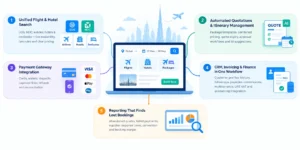
Unified flight and hotel search with reliable supplier connectivity
The platform should connect the GDS, NDC, airline, hotel and bedbank sources you actually use, show live availability and fare rules, validate prices before booking and handle supplier errors clearly. This is what flight and hotel booking software is meant to deliver: one search, one itinerary, one price.
Automated quotations, itinerary management and booking confirmation
Reusable package templates, combined pricing, quote expiry and approval workflows remove repeated entry. Newer AI tour operator software Dubai providers are also adding itinerary suggestions and draft quotations, which can speed up first responses. Agents should still review exceptions and sign off on anything unusual.
Payment gateway integration and flexible collection workflows
Look for card payments, supported wallets, deposits, payment links, refunds and reconciliation. Providers such as Network International and Noon Payments are worth evaluating against your needs. The right choice depends on merchant eligibility, supported methods, fees, technical fit and settlement terms.
CRM, invoicing and finance in one connected workflow
Customer profiles, booking history, automated follow-ups, supplier payables, commissions and refunds should sit in one chain. Multicurrency support and UAE VAT-ready invoicing matter, as do accounting integration and audit trails as volume grows.
Reporting that identifies where bookings are being lost
Dashboards should show abandoned quotes, failed payments, supplier response times, conversion and booking-level margin. Use them to find the biggest bottleneck before buying more features.
Dubai-Specific Requirements Agencies Should Not Overlook
AED pricing, multicurrency transactions and UAE VAT workflows
Agencies serving international customers need consistent conversion, visible exchange rates and accurate supplier-cost tracking. VAT treatment depends on the transaction. International passenger transport, for example, is generally treated differently from local services, so don’t assume every travel product follows one rule. Confirm with the Federal Tax Authority’s guidance or your tax adviser.
Payment methods that match customer expectations
Cards, wallets and payment links are the baseline. BNPL providers such as Tabby or Tamara, plus Aani and Amazon Pay, may suit certain use cases, depending on your merchant setup. Assess eligibility, fees, settlement, refunds and integration effort first.
Different agency models need different workflows
- Leisure agencies: package quotations, flight-and-hotel combinations, deposits and follow-ups.
- Destination management companies: inbound itineraries, transfers, activities and hotel inventory.
- Corporate agencies: approval limits, negotiated rates, traveller profiles and consolidated billing.
- B2B consolidators and sub-agents: agent-specific pricing, credit limits and commissions.
- Umrah and specialist operators: group reservations, document collection and payment schedules.
The best integrated system fits your operating model, not the other way around.
Quick Question: “Do small agencies need an integrated system?”— Often yes, but at a smaller scale. If your agents retype data between tools every day, a simple integration may pay back faster than a full platform.
Ready-Made Travel Software vs Custom Travel Software Development
When a ready-made travel booking platform makes sense
Established platforms offer quicker deployment, predictable subscriptions and existing supplier connections. Limits include restricted workflows, per-booking fees and dependence on the vendor’s roadmap. If standard features cover most of what you do, start here.
When custom travel software development is worth considering
Complex B2B pricing, proprietary supplier agreements, multiple brands, corporate approval flows or unusual finance rules can outgrow packaged tools. In those cases, custom software development in Dubai gives control over workflows and data. It also demands discovery, integration testing, maintenance, security management and a realistic budget. It is not automatically cheaper.
Consider a hybrid approach before replacing everything
Many agencies keep proven supplier systems and connect them through APIs, a central CRM, payment services and finance software. Fix the biggest revenue leak first, measure, then expand.
| Factor | Ready-made | Custom | Hybrid |
|---|---|---|---|
| Implementation time | Fastest | Longest | Moderate |
| Flexibility | Limited | Highest | High |
| Integration cost | Low to moderate | Highest | Moderate |
| Maintenance | Vendor-managed | Your responsibility | Shared |
| Scalability | Vendor-dependent | Designed for you | Good |
| Ownership | Licence only | Full | Partial |
How to Choose Travel Agency Software in Dubai
Questions to ask before selecting a vendor
- Can it connect our current flight and hotel suppliers?
- Does it revalidate prices and availability before booking?
- Which payment methods, currencies and refund processes does it support?
- Can it connect our CRM, accounting and invoicing tools?
- Does it handle B2B agent pricing, permissions and credit limits?
- What are the implementation, transaction, integration and maintenance costs?
- Who manages API changes, downtime, security and support?
Check integration quality instead of counting features
A long feature list says little about data reliability. Ask for a live demo of a real enquiry-to-confirmation journey, including a failed payment and a supplier availability change. For multi-system projects, experienced system integrators in Dubai can map data flows and test failure points before you commit. Request a clear scope, implementation plan, service-level expectations and ownership terms.
Start with the workflow causing the greatest loss
Review response times, quote conversion, payment failures and reconciliation effort. Fixing one high-impact bottleneck often delivers more than replacing every system at once.
How to Estimate the ROI of an Integrated Travel Booking System
Calculate recovered bookings and administrative savings
Set a baseline: qualified enquiries, conversion rate, average contribution per booking, staff processing hours and payment failures. Estimate the extra contribution from recovered bookings, not the full booking value. Calculate labour savings using actual hourly costs and realistic time reductions.
Compare the expected benefit with the total cost of ownership
Include subscriptions or development, supplier API charges, payment fees, implementation, training and ongoing support. Compare annual benefit against first-year and recurring cost, then track results over an agreed period. No honest vendor can promise a guaranteed return.
How SISGAIN Technologies Can Help Dubai Travel Agencies Connect Disconnected Systems
Connect booking workflows through software integration and APIs
SISGAIN Technologies is an IT software development company founded in 2009. For travel businesses, it can help assess disconnected workflows and plan software integration, software development and SaaS development work. Among the API development company Dubai travel firms can shortlist, SISGAIN’s API development and end-to-end product engineering teams can connect suitable supplier systems with CRM, payment workflows and reporting, subject to supplier API availability.
The approach starts with discovery, technical feasibility, security, data consistency and measurable business goals, before any build begins.
Request a travel booking workflow assessment
Tell us how your enquiries move today, which suppliers you use, where payments fail and what you want to fix first. We’ll help identify the most commercially important bottlenecks.
Request a Travel Booking Workflow Assessment
Conclusion: Stop Losing Bookings Between Enquiry and Confirmation
Disconnected systems create friction at every stage: quoting, availability checks, payment and reconciliation. You don’t need to replace every tool. You need a connected workflow that improves speed, accuracy, customer visibility and margin control.
Start by measuring what you’re losing today. Then assess your booking process and pick the integration that recovers the most.
Frequently Asked Questions About Travel Agency Software in Dubai
What is travel agency software, and how does it work?
It connects bookings, supplier data, quotations, payments, customer records and reporting in one workflow, so agents stop re-entering the same information across tools.
How much does travel agency software cost in the UAE?
It depends on the route: a ready-made subscription, a hybrid integration or custom development, plus supplier APIs, payment fees and maintenance. Request itemised quotes.
Can a travel booking system integrate flights, hotels and payments?
Yes, where supplier APIs, payment-provider services, commercial agreements and technical requirements allow it.
How can travel agencies reduce abandoned bookings?
Send faster quotations, revalidate prices, offer clear payment options, cut manual steps and follow up on time.
Should a Dubai travel agency choose custom or ready-made software?
It depends on workflow complexity, existing systems, supplier relationships, budget and long-term ownership needs.