



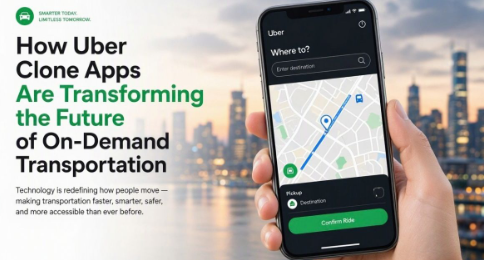
Transportation has advanced massively with the beginning of smartphones and digital technologies. With mobile applications, riders can be able to plan their trips, track their drivers, get trip details, and make payments without using the old means of booking. Also, transportation providers can be able to coordinate with the drivers, vehicles, customers, and payments using the digital technology system.
In such an environment, there appears another opportunity for businesses to utilize Uber-like app solutions. Companies can change features, vehicles used in a service, pricing, service area, and operational rules as required. Apart from being useful for ride booking, they are important for connecting passengers, drivers, and mobility services digitally.
Uber Clone App – What Does It Mean?
An Uber clone application is a ready-to-use software application that is based on key features and functions needed by the transport platform. It generally comes equipped with separate interfaces for passengers, drivers, and admin. Passengers can sign up to the site, input details about the pickup point and destination point, select a mode of transportation, schedule their rides, pay, get fare estimates, and rate the driver.
The Driver Interface will be able to address the problems related to availability, booking rides, reaching the destination, and viewing ride and earnings information. On the other hand, the Admin Dashboard will be useful in managing the users, drivers, transactions, service zones, and settings of the application platform. Hence, an Uber Clone App is more than a clone of a famous ride-hailing application interface; rather, it is a complete custom platform.
From Traditional Dispatch Systems to Digital Transportation Networks
The traditional systems of transportation include phone bookings, dispatchers, taxi ranks, or direct communication between the passenger and the driver. However, digital platforms have brought about a system that facilitates the process of creating, assigning, confirming, tracking, and recording ride requests digitally. With such a system, there will be no need for manual coordination, and the operator can implement an automatic process to facilitate booking and availability of transportation services. It is especially applicable in situations where demand for transportation varies at different times during the day. Unlike the elimination of traditional transportation, digital systems are simply adding the digital component to the system.
Technology Used in an Uber Clone App
The efficiency of a ride-hailing app requires many technologies to work together.
- GPS and Mapping Technologies: Location technologies can help find the locations of pick-up points, vehicles, route calculation and navigation. Mapping technology will help calculate the distance of the journey as well as the time.
- Cloud Infrastructure: Cloud infrastructure can handle massive amounts of booking information, account information, journey data, among others. Cloud infrastructure will help manage services according to changes in the user base and transactions.
- Application Programming Interfaces: Through the APIs, the transport system can interface with other systems. This means that features like mapping, payments, messaging, authentication and others can all be integrated without developing everything from scratch.
- Payment Technology: The payment technology allows the application to integrate with various financial institutions. This will depend on the markets, as some platforms will use card payments, wallet systems, bank transfers, cash payments and others.
- Push Notifications: Notifications allow applications to notify users of various events, including booking confirmation, driver arrival, journey information, payments and others.
Effect of Artificial Intelligence in Transportation Systems
The influence of artificial intelligence on the transportation industry is realised in its ability to process a considerable amount of data from operations and automate certain processes. Artificial intelligence may be employed to perform such activities as demand forecasting, driver and passenger matching, routing, fraud detection, customer service, anomaly detection, and recommendations. However, it should be noted that any automation in terms of price setting, security concerns, driver dispatching, or logging into the account should be taken into account. Proper testing and monitoring can turn AI into a great support in decision-making.
Growing Importance of Scheduled Transportation
Transportation on demand is not all there is in the current transportation system because individuals have to plan for their transport services before travelling for work or other purposes. This has allowed the development of services like Uber to include both scheduled and on-demand systems. The pre-booked airport transfer service is an excellent illustration of scheduled transportation that enables passengers to book their transportation before even leaving home.
Scheduled Airport Transfer can be regarded as the series of processes that include pickup time, flight information, driver, different types of cars, instructions for picking up, notification service, and pre-payment. However, this service requires special organisation because operators should take into account such factors as delays, waiting time, airport requirements, pick-up places, and availability of cars. Thus, airport transportation needs a particular workflow.
From Ride-Hailing to Mobility as a Service
An additional significant trend is the emergence of Mobility as a Service (MaaS). The idea behind MaaS is not just to provide taxis, public transport, car rental, car sharing, airport transfer, and micromobility separately but to integrate all these transport modes into one ecosystem. Thus, customers may get a chance to have access to multiple transport options via a single digital platform.
For instance, one may choose to use public transport combined with ride-hailing services to complete his or her journey, while the other one may go for car hire for his journey that involves many stops along the way. Over time, the more these services integrate, the more the role of mobility applications is going to change from merely ride booking applications to coordination applications.
Challenges of Uber Clone App Development
The presence of software templates does not make the practical problems of running the business disappear.
- Different Regulations: Software designed for one country may need to undergo substantial modification before it is launched somewhere else since the regulations governing transportation differ.
- Driver Availability: For a taxi-hailing application to function, there should be enough supply of transport. If there are not enough drivers in a certain area, customers’ requests will not turn into journeys.
-
- Operational Costs: Businesses must consider software, payment processing, customer service, insurance, costs related to drivers, marketing, and any fleet management costs if necessary.
- Data Security: Since transportation applications process location and payment information, security is not a nice-to-have but rather a mandatory component.
- Customer Retention: Customers have alternatives to choose from. Consistent performance is essential for providing reliable services rather than just functionality of the application.
- Limitations in Infrastructure: The network range, map precision, charging stations, payments, and vehicles can affect the performance of a digital transportation system.
The Future of Uber Clone Applications in a Digital Mobility Ecosystem
The future of the Uber clone app may be characterised by more integration between the elements of digital technology, cars, and transportation systems as a whole. Predictive analysis and artificial intelligence can help with demand planning and managing fleets, and electric and connected vehicles can add some new features to the process of mobility management. Also, these platforms can enter the pre-book airport transfer market, providing scheduled trips and airport transportation.
The integration with the car rental market can help in adding short- and long-term vehicle rental opportunities to ride-hailing services. Multimodal platforms can integrate such components as public transport, rentals, airport transfers, and shared mobility in order to create connected travel. Autonomous vehicles can impact the operation of these companies even further. The research carried out by Pristine Market Insights also shows the direction in which the transportation industry is developing. In general, Uber clone applications are becoming more complex than simply trip booking platforms and are being transformed into digital mobility infrastructure.
Author Bio
Teja Kurane is a research analyst at Pristine Market Insights specializing in ICT, industrial automation, and emerging digital technologies. With a focus on technology-driven business transformation, Teja explores how mobile applications, digital platforms, and innovative software solutions are reshaping industries, improving operational efficiency, and enhancing customer experiences in the evolving digital economy.