






Shipping delays push your household goods’ arrival date back, and they can raise costs, strain customs deadlines and leave you without belongings for weeks. You can’t remove the risk, but you can plan around it: start earlier than the carrier’s quoted transit time suggests, send essentials separately by air or baggage, keep a temporary-living plan, store goods if your destination isn’t ready, and confirm in writing what happens to your quote if schedules or rates change. In 2026, disruption around the Gulf has made this planning more important for anyone shipping from or to the UAE.
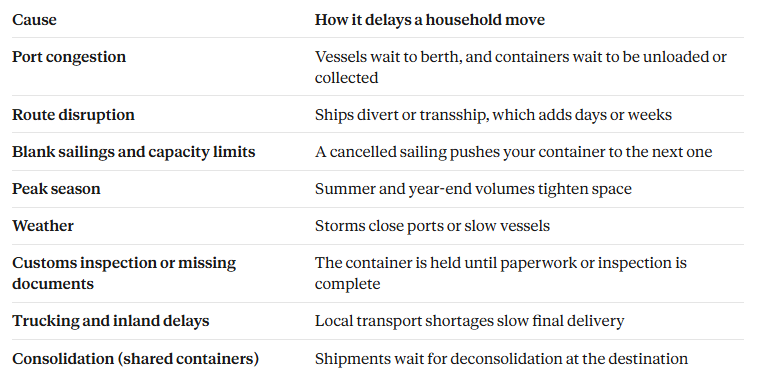
What causes shipping delays?
What is happening in the Gulf in 2026?
If you’re shipping from or to the UAE, current conditions matter. According to third-party tracking and industry sources:
- The Strait of Hormuz has been effectively closed to most commercial shipping since 28 February 2026, according to the tracker Straits Live (updated 21 November 2026), which reported about 2 vessels a day on 15 November against a normal range of around 85.
- Freightos (April 2026, updated May) reported cargo being transshipped at Indian west-coast ports, moved by feeder to accessible ports in Oman and the UAE and trucked onward, and waits of 7–10 days at some UAE ports.
- A forwarder’s rate guide (August 2026) reported war-risk surcharges of $500–1,500 per container, emergency conflict surcharges of $200–500, and transshipment via Khor Fakkan or Salalah adding 7–14 days. It also reported Shenzhen to Jebel Ali rates around $8,250–9,500 per 40-foot container, up sharply from early July. That page is a forwarder’s marketing guide and says its data is for reference only.
- Maersk was reported to charge $1,000 per container for any vessel crossing the strait.
These are third-party reports, not ISS’s own data, and conditions may have changed since they were published. Ask your mover how your specific route is being handled today.
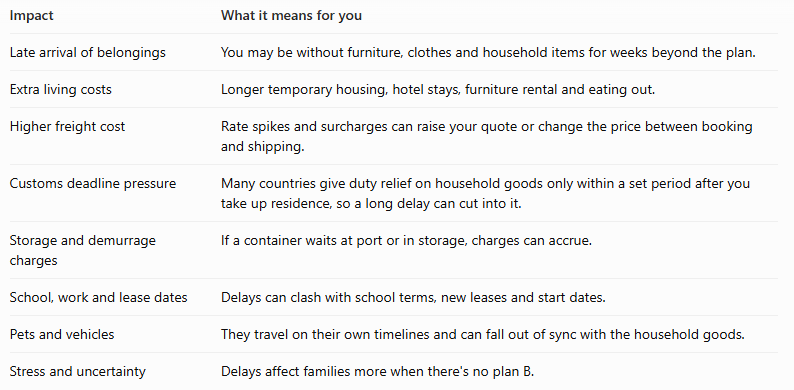
How do delays affect a household move?
What does a real example look like?
An ISS client had to vacate their home within 24 hours. Sea freight rates were rising from about $2,000–2,500 to $14,000–15,000 per container. Instead of shipping at once, ISS stored the belongings in air-conditioned, barcode-tracked storage from March through April, then shipped in September and October once lanes normalised. The shipment arrived with, according to ISS, 100% inventory accuracy and zero damage. The lesson: when rates and routing are volatile, moving fast out of your home and shipping later can save money and stress. Read other customer reviews for more experiences.
How do you plan around shipping delays?
1. Start earlier and add a buffer
ISS’s international relocation page gives a typical sea delivery time of 4–7 weeks, air freight of roughly 5–10 days, and advises starting larger household moves at least 4–8 weeks ahead, with international moves typically taking 4–12 weeks overall. ISS’s GCC Relocation Index gives benchmarks such as about 30–40 days door-to-door from Dubai to the UK and 28–42 days by sea to Canada. These are planning benchmarks, and disruption can extend them. Add a buffer of several weeks to any sea freight estimate, and longer during disruption.
2. Split your shipment
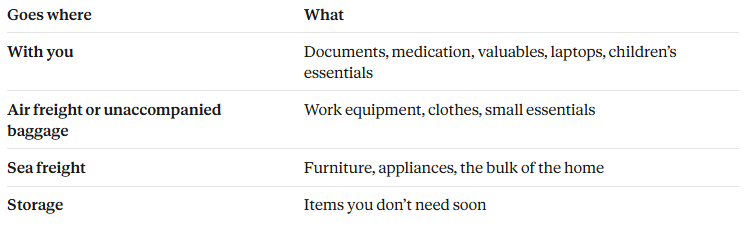
See ISS’s baggage services for unaccompanied and excess baggage, and freight forwarding for comparing sea and air.
3. Use storage as a buffer
If your destination home isn’t ready, or sea freight is unfavourable, storage services can hold your goods until shipping makes sense. ISS describes climate-controlled facilities with 24/7 security and barcode tracking. Ask about storage pricing and terms, and check any customs deadline in your destination before storing for long.
4. Plan your first weeks without your belongings
- Pack an “arrival kit” with bedding, basic cookware, toiletries, chargers and children’s items.
- Book temporary housing for longer than you think you need.
- Consider furniture rental or a furnished lease for the first weeks.
- Keep irreplaceable items with you.
5. Prepare customs documents early
Missing paperwork is a delay you control. Keep a detailed inventory, proof of your residence in the origin country, and your destination residence documents ready. ISS’s customs clearance team can advise on what your destination requires. Check the deadline for duty relief at your destination, and confirm how a delayed arrival affects it.
6. Understand your quote and your contract
Ask, and get answers in writing:
- Are transit times estimates or commitments?
- What happens if the carrier changes routing or blanks a sailing?
- Can freight surcharges or rate changes be added after booking?
- Who pays for extra storage or port charges caused by delays?
- How will I be updated, and by whom?
7. Protect the shipment
Ask about transit insurance, including what it covers, what the excess is, and whether it covers goods held in storage or delayed in port.
8. Align pets and vehicles
Pet paperwork has fixed timing, so use the Pet Relocation Checker and read about pet relocation. For a car, ask about automobile shipping, and don’t let it arrive long before you can register it.
Should you ship now or wait?
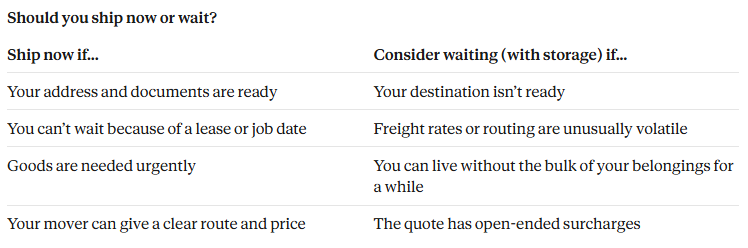
Ask your mover for both options with prices, so you can compare the cost of waiting with the cost of shipping now.
What mistakes make delays worse?
- Planning to the day using the quoted transit time.
- Packing everything in one shipment, with no essentials sent separately.
- Not booking temporary housing for a long enough period.
- Ignoring the customs deadline for duty relief.
- Leaving paperwork until the vessel is on the way.
- Accepting a quote without asking about surcharges.
- Not checking insurance for delay and storage.
- Letting your car or pet arrive out of sync.
- Assuming delays only happen in peak season.
For general preparation, see our Moving Guide and Moving Tips.
FAQs
How do shipping delays affect a household move? They push back the arrival of your belongings, can raise costs through surcharges, storage or temporary housing, and can strain customs deadlines.
How long can a sea freight delay last? It depends on the cause. Third-party reports in 2026 describe port waits of 7–10 days and rerouting that adds 7–14 days or more. Ask your mover for a current estimate on your route.
Will shipping delays increase the cost of my move? They can, through surcharges, rate changes and storage or port charges. Ask what’s fixed in your quote and what can change.
What should I do if my shipment is delayed? Ask your mover for an updated schedule, check your insurance and customs deadline, and extend temporary housing if needed.
Can I send some belongings ahead by air? Yes. Air freight and unaccompanied baggage suit urgent items. See ISS’s baggage services.
Should I store my goods instead of shipping during disruption? It can be worth it when routing or rates are volatile or your destination isn’t ready. ISS offers storage services.
Does a delay affect duty relief on household goods? It can, because many countries set time limits after you take up residence. Confirm your destination’s deadline with customs specialists.
Is my shipment insured against delay? Not necessarily. Ask what transit insurance covers, and whether it covers delay or stored goods.
How do I get an up-to-date estimate for my route? Request a quote or call +971 4 234 8100, and ask for the current routing and timing.
About ISS Relocations
ISS Relocations is a Dubai-headquartered international moving company with FIDI FAIM accreditation and ISO 9001:2015 and ISO 14001:2015 certification. Explore all services, read about ISS, or contact us. Planning a move? Request a quote.