






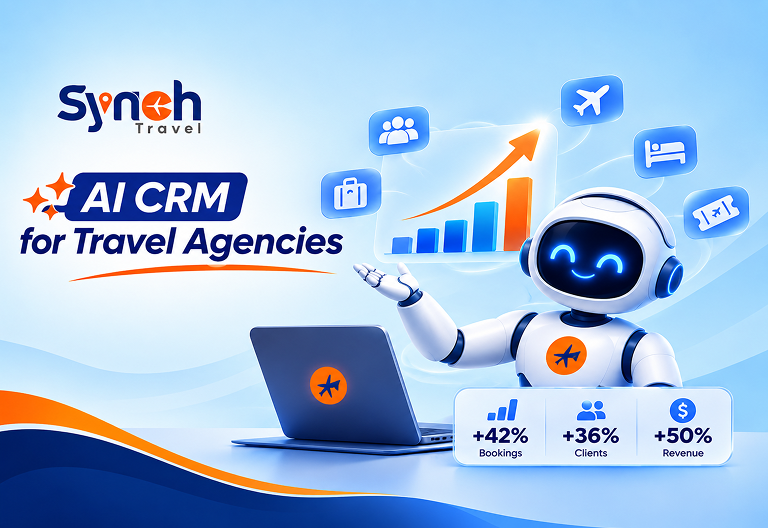
1. Why Travel Agencies Need a Smarter Way to Manage Daily Work
Running a travel agency involves much more than booking flights and hotels. Teams must respond to enquiries, prepare quotations, follow up with potential customers, check booking details, manage changes, and keep travellers informed. When these responsibilities pile up, important tasks can be delayed, and staff may spend more time on administration than customer service.
An AI workforce for travel agencies offers a practical way to manage repetitive activities without removing the human element from travel planning. AI-powered assistants can support different parts of the customer journey, from the first enquiry to post-booking communication.
Instead of treating artificial intelligence as a single chatbot, agencies can use specialised AI tools for lead management, quotation preparation, customer support, and marketing activities. Each tool handles a defined responsibility while employees supervise important decisions and resolve complex requests.
The goal is not to replace experienced travel professionals. It is to help them work more efficiently, respond consistently, and focus on customers who need personal assistance.
2. What an AI Workforce Means for a Travel Agency
An AI workforce is a collection of AI-powered assistants and automated workflows designed to complete specific business tasks. These digital assistants operate through configured instructions, approved information, and connections to relevant business systems.
For example, an agency might use one assistant to respond to common WhatsApp enquiries, another to organise incoming leads, and another to help prepare travel quotations. A connected workflow can then pass relevant information between these functions, reducing the need for staff to enter the same details repeatedly.
AI assistants versus traditional automation
Traditional automation usually follows fixed rules. For instance, a system might send a confirmation email whenever a customer completes a booking.
AI can handle more flexible tasks, such as understanding a customer’s message, identifying the requested destination, summarising travel requirements, or drafting a suitable response.
However, AI should not automatically be trusted to make every decision. Pricing, availability, ticket issuance, refunds, and booking changes may require verified system data, business rules, or employee approval.
A well-designed AI workforce combines automation for predictable processes with AI assistance for tasks involving language and information processing.
3. How AI Can Automate Travel Agency Operations
The most useful applications are those that address recurring tasks and clear operational bottlenecks.
Lead management and enquiry qualification
Travel enquiries arrive through websites, phone calls, social media, and messaging channels. Manually organising every enquiry can become difficult when several employees handle different customers.
AI can extract relevant details from customer messages, including destinations, travel dates, passenger numbers, hotel preferences, and approximate budgets. It can organise this information in a travel CRM so the sales team can review each enquiry with the necessary context.
For example, when a customer asks about a family holiday, an AI assistant could identify the destination, preferred departure date, number of travellers, and accommodation requirements. Staff can then prepare a more relevant response rather than starting the conversation from scratch.
Travel quotations and itinerary preparation
Preparing quotations often requires gathering customer requirements, checking available options, and arranging information in a clear format.
AI quotation software can help organise these details and draft customer-ready proposals using approved prices, supplier information, and agency templates. Employees can review the result before sending it.
The system should distinguish between confirmed prices and estimates. It should never invent flight availability, hotel rates, inclusions, or cancellation conditions to complete a quotation.
Customer support and follow-ups
AI assistants can answer routine questions about documentation requirements, office procedures, payment instructions, and booking processes when the agency has provided reliable information.
They can also draft follow-up messages for customers who have received quotations but have not responded. More complex requests, complaints, urgent itinerary changes, and uncertain cases should be transferred to a human employee.
4. Choosing an AI Workforce for Travel Agencies
Selecting the right solution requires more than comparing the number of available features. Agencies should first identify which tasks consume the most staff time and which processes cause missed enquiries or unnecessary delays.
A practical starting point is to evaluate an AI workforce for travel agencies based on its ability to support real travel operations, integrate with existing systems, and maintain appropriate human oversight.
Consider these essential capabilities:
- Task-specific assistants: Tools designed for lead qualification, customer communication, quotations, or marketing.
- Reliable information access: The ability to use approved business information and current booking data where integrations are available.
- Workflow integration: Connections with the agency’s CRM, booking platform, website, or messaging channels.
- Human approval: Controls for sensitive actions, financial decisions, and customer commitments.
- Performance tracking: Reporting that shows response times, enquiry handling, workflow completion, and errors.
Agencies should also check data access permissions, customer privacy controls, audit records, and the process for correcting inaccurate AI responses.
A smaller solution that handles two important workflows reliably may be more useful than a complicated system with numerous features that employees rarely use.
5. Connecting AI With Booking and Reservation Systems
AI becomes more useful when it works alongside the systems that manage actual travel inventory and reservations.
A travel booking platform may contain flight options, hotel availability, supplier rates, customer records, and booking statuses. Connecting an AI assistant to relevant systems allows it to retrieve information rather than relying entirely on general language knowledge.
For agencies serving other travel businesses, a b2b travel booking system can form part of the operational setup by supporting booking activities between travel suppliers, agencies, and authorised business users.
Why integration matters
Without integration, employees may need to copy information between spreadsheets, messaging tools, customer databases, and booking systems. This creates extra work and increases the possibility of mistakes.
With suitable integrations, an AI workflow might collect a customer’s requirements, create or update a CRM record, retrieve permitted booking information, and prepare a response for employee approval.
The exact capabilities depend on the available APIs, system permissions, and the functionality exposed by each platform.
Protecting booking accuracy
Travel transactions require particular care because a small mistake can affect a customer’s journey or create financial problems.
Before an AI assistant confirms a reservation or changes an itinerary, the workflow should verify the relevant booking details and enforce the agency’s approval rules. If current inventory or supplier information cannot be retrieved, the assistant should explain that verification is required instead of presenting an assumption as fact.
6. Using AI for Customer Communication and Marketing
Customer communication is another area where AI can reduce repetitive work. Travel agencies frequently answer similar questions about destinations, package inclusions, travel dates, hotel categories, and payment procedures.
A WhatsApp chatbot for travel agencies can collect initial requirements, answer approved frequently asked questions, and direct customers to the appropriate team. A voice assistant may help handle basic incoming calls or collect enquiry details when configured for that purpose.
AI marketing tools can also assist with drafting destination descriptions, promotional emails, social media posts, and customer follow-up messages. These drafts should be reviewed for factual accuracy, brand consistency, and relevance before publication.
Personalising communication responsibly
An assistant can use customer-provided preferences to make communication more relevant. Someone asking about a short family break may need different information from a customer planning a multi-city business trip.
However, personalisation should use only appropriate information that the agency is authorised to process. Businesses should establish clear rules for customer consent, data retention, access permissions, and the use of personal information.
Automation should make conversations more helpful, not turn every interaction into an impersonal sequence of promotional messages.
7. Building an AI Workflow Around Your Existing Team
An effective implementation begins with the agency’s current operating process rather than with the technology itself.
A travel business should map how enquiries arrive, who qualifies them, how quotations are prepared, how bookings are confirmed, and how customers receive updates. This reveals where AI assistance can remove unnecessary steps without disrupting established responsibilities.
For agencies reviewing their wider technology setup, Synch Travel provides a starting point for exploring travel technology solutions alongside an AI-supported operational approach.
A practical implementation plan
Step 1: Identify one repetitive task.
Choose a process with clear inputs and outputs, such as collecting enquiry details or drafting quotation follow-ups. Avoid automating several sensitive workflows at once.
Step 2: Define the rules.
Specify the information the assistant can use, the actions it can perform, and the situations that require employee intervention.
Step 3: Connect the necessary systems.
Integrate only the CRM, communication channel, or booking data required for the selected workflow. Confirm that permissions and data handling practices are appropriate.
Step 4: Test real-world scenarios.
Evaluate normal enquiries as well as incomplete requests, unusual travel dates, conflicting details, and questions the system cannot answer. Check whether it recognises uncertainty and escalates appropriately.
Step 5: Review performance and improve.
Monitor response accuracy, employee workload, customer feedback, escalation rates, and workflow failures. Use these findings to refine instructions and business rules before expanding automation.
8. Measuring the Value of AI Automation
Travel agencies should evaluate AI based on operational improvements rather than the number of tasks labelled as automated.
Useful measures include average enquiry response time, time spent preparing quotations, the percentage of enquiries receiving appropriate follow-up, the frequency of manual data entry, and the rate of corrections required after AI-assisted work.
Customer experience also matters. Faster replies are not beneficial if the information is inaccurate or customers struggle to reach a person when they need help.
Calculate the real operational benefit
Agencies can compare the time and cost required to complete a process before and after automation. The calculation should include software subscriptions, integration expenses, staff training, ongoing supervision, and the time spent correcting mistakes.
For example, if an AI assistant drafts routine replies but employees must substantially rewrite most of them, the apparent time saving may be smaller than expected. If it consistently prepares accurate drafts that require only minor review, the workflow may deliver more meaningful value.
The best results come from measuring actual performance, identifying weak points, and improving the process gradually.
9. Common Mistakes to Avoid When Adopting AI
Travel agencies can reduce implementation problems by avoiding a few common mistakes.
First, do not automate a process that is already poorly organised. Clarify responsibilities and standardise the workflow before introducing AI.
Second, avoid relying on outdated or unverified information. Package prices, hotel availability, airline rules, and travel requirements can change. Systems must retrieve current information where necessary or clearly communicate their limitations.
Third, do not remove human review from high-impact decisions before the workflow has been thoroughly tested. Financial transactions, refunds, ticket issuance, and booking modifications require appropriate controls.
Finally, do not overlook employee training. Staff need to understand what the assistant can do, how to check its output, and when to take over a conversation.
Conclusion
An AI workforce can help travel agencies manage enquiries, organise leads, prepare quotations, support customer communication, and reduce repetitive administrative work. Its effectiveness depends on selecting suitable tasks, connecting reliable data sources, establishing clear approval rules, and measuring actual outcomes.
The most practical approach is to begin with one well-defined workflow, test it with real operational scenarios, and expand only when the results justify doing so. By combining AI assistance with experienced travel professionals, agencies can improve consistency and efficiency while keeping customer service and booking accuracy at the centre of their operations.