






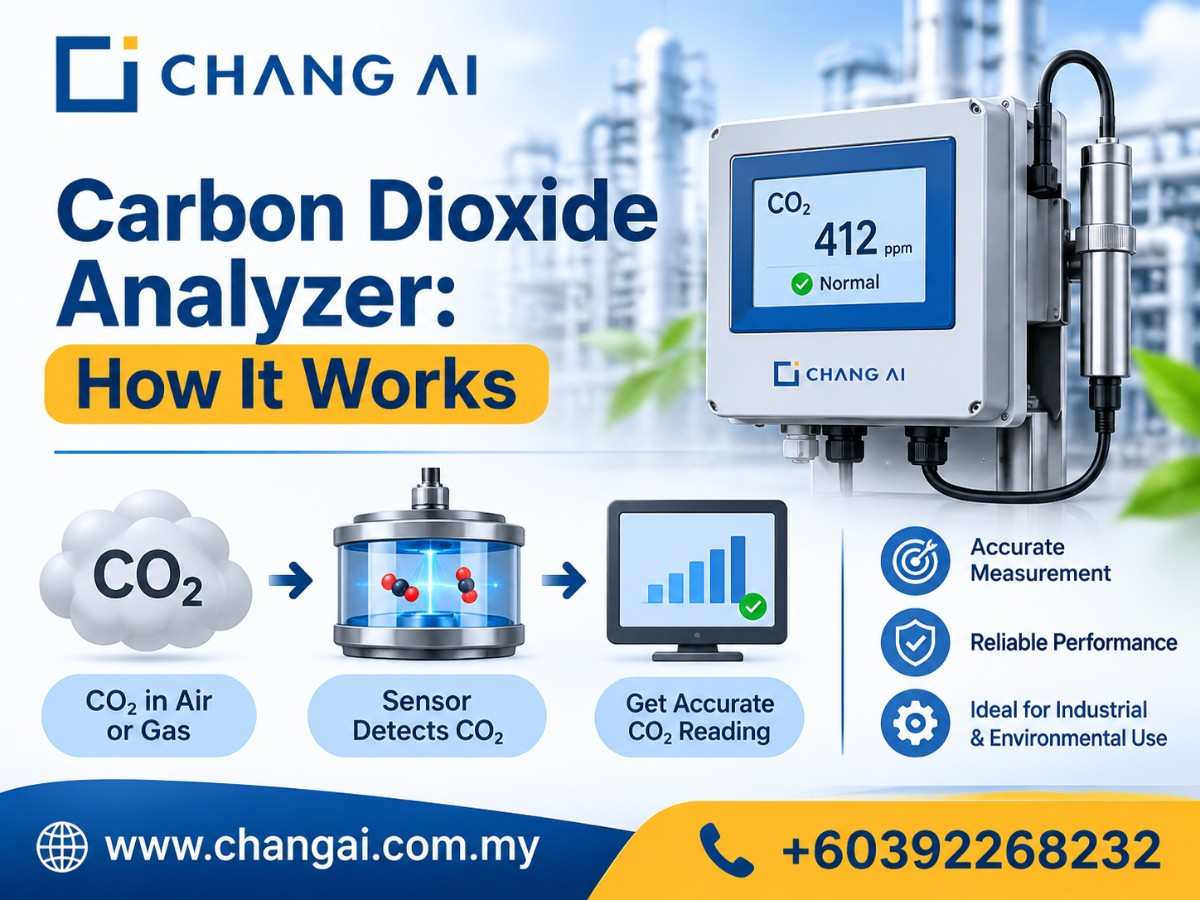
A carbon dioxide analyzer is an instrument that measures the concentration of CO2 in a gas sample or ambient environment. It works by detecting how CO2 molecules absorb infrared light at a specific wavelength. The reading is expressed in parts per million (ppm) or percentage volume, enabling precise monitoring for safety, process control, and environmental compliance.
Industries that depend on accurate gas analysis — from food processing to power generation — rely on a carbon dioxide analyzer to protect workers, optimise combustion efficiency, and meet regulatory thresholds. But understanding how these instruments function, what components drive their accuracy, and which technology suits your application is essential before making any procurement decision.
How Does a Carbon Dioxide Analyzer Work?
The working principle of most CO2 analyzers is based on Non-Dispersive Infrared (NDIR) technology. CO2 molecules absorb infrared radiation at a wavelength of approximately 4.26 micrometres. The analyzer passes an infrared beam through a sample cell containing the gas. A detector on the other side measures how much light was absorbed. The greater the absorption, the higher the CO2 concentration.
Here is a simplified breakdown of the CO2 analyzer working principle:
- Gas sampling — The gas sample is drawn into the measurement cell, either by a pump (extractive method) or by direct in-situ exposure.
- Infrared emission — An infrared light source emits radiation through the sample cell.
- Absorption detection — CO2 molecules absorb radiation at their characteristic wavelength.
- Signal processing — The detector converts the attenuated light signal into an electrical output.
- Concentration display — Onboard electronics calculate and display the CO2 concentration in real time.
Some advanced units incorporate dual-beam or dual-wavelength technology to compensate for source degradation and improve long-term stability — a critical factor in continuous emissions monitoring systems (CEMS).
Key Components of a CO2 Gas Analysis Instrument
Understanding the internal architecture of a carbon dioxide measurement device helps technical buyers evaluate instrument quality and long-term maintenance requirements.
Infrared Source
The source emits broadband infrared radiation. Its stability directly influences measurement accuracy. High-quality sources use thermally stable materials that maintain consistent output over thousands of operating hours.
Sample Cell
The sample cell is where gas-light interaction occurs. Cell path length affects sensitivity — longer paths increase the detectable signal at lower concentrations, making them suitable for trace-level CO2 measurement.
Optical Filter
A narrowband optical filter isolates the specific infrared wavelength CO2 absorbs. This prevents interference from water vapour, hydrocarbons, and other gases present in industrial flue stacks or process streams.
Detector
The detector — typically a thermopile, pyroelectric, or photoconductive type — converts infrared radiation into an electrical signal. Detector choice affects response time, temperature sensitivity, and detection range.
Signal Conditioning and Output
Onboard electronics amplify and linearise the raw signal. Most industrial-grade units provide analogue outputs (4–20 mA), digital outputs (RS-232, Modbus), and alarm relays for DCS or SCADA integration.
Extractive vs. In-Situ CO2 Analyzers
Choosing the right sampling configuration is as important as the detection technology itself.
| Feature | Extractive Analyzer | In-Situ Analyzer
|
|---|---|---|
| Sampling Method | Gas drawn to remote analyser | Sensor installed directly in process |
| Response Time | Slower (transport delay) | Faster (real-time) |
| Maintenance | Higher (sample conditioning) | Lower (fewer components) |
| Best For | Wet, dirty, or high-pressure gas | Clean, accessible gas streams |
| Cost | Higher initial investment | Lower upfront cost |
Extractive systems are common in Malaysian palm oil mills and petrochemical plants where gas conditioning is needed before measurement. In-situ analysers are popular for HVAC monitoring and controlled manufacturing environments.
Where Are Carbon Dioxide Analyzers Used?
CO2 analyzer applications span a broad range of industries. Each use case has specific concentration ranges and accuracy requirements.
- Combustion and emissions monitoring — Measuring flue gas CO2 in boilers, furnaces, and generators to optimise fuel efficiency and comply with Malaysia’s Environmental Quality Act 1974 and its subsidiary regulations on air emissions.
- Food and beverage processing — Monitoring CO2 levels during carbonation, fermentation, and modified atmosphere packaging to ensure product consistency and worker safety.
- Pharmaceutical manufacturing — Verifying inert atmosphere conditions in cleanrooms and storage areas where CO2 displacement of oxygen poses a safety risk.
- HVAC and indoor air quality — Demand-controlled ventilation in commercial buildings relies on CO2 sensors to balance air quality with energy efficiency.
- Greenhouse gas and environmental reporting — Facilities covered under Malaysia’s carbon reporting frameworks use CO2 analysers as part of their measurement, reporting, and verification (MRV) protocols.
- Semiconductor and electronics — Process chambers require precise atmospheric control, and even minor CO2 fluctuations can impact yield.
Why Measurement Accuracy Matters
A poorly calibrated or low-quality CO2 analyzer does not just produce bad data — it creates operational and compliance risk. In combustion applications, a 1% measurement error in flue gas CO2 can translate to significant fuel waste over a year of continuous operation. For facilities under emissions reporting obligations, inaccurate data can trigger regulatory penalties.
The Department of Environment (DOE) Malaysia enforces stack emission standards under the Environmental Quality (Clean Air) Regulations 2014. Facilities operating boilers, incinerators, or gas turbines must use instruments that meet defined accuracy and traceability requirements. Calibration against certified reference gases is mandatory for compliance-grade measurement.
According to industry practice benchmarks, CO2 analyzers used in continuous emissions monitoring should maintain measurement uncertainty within ±2% of the certified reference value across the full operating range.
How to Select the Right CO2 Analyzer for Your Application
There is no universal answer. The right instrument depends on several application-specific parameters.
Concentration Range
Ambient air monitoring operates in the 400–5,000 ppm range. Industrial combustion analysis often requires 0–20% CO2. Confirm the expected range before specifying an instrument to avoid under-range or over-range errors.
Process Conditions
High moisture, particulate loading, and elevated temperatures require extractive systems with proper sample conditioning. In-situ probes are better suited for clean, dry, and accessible gas streams.
Output and Integration Requirements
Plant engineers integrating CO2 measurement into an existing DCS should confirm communication protocols — whether Modbus RTU, HART, or 4–20 mA analogue — before ordering.
Calibration and Maintenance
Zero and span calibration should be easy to perform on-site. Instruments with automatic calibration routines reduce downtime and human error — a meaningful advantage in continuous process environments.
Maintaining Analyzer Performance Over Time
Even the best CO2 analyzer drifts over time without proper maintenance. For industrial users, the following practices protect measurement integrity:
- Perform zero and span calibration at regular intervals using traceable reference gases.
- Inspect and replace sample filters, dryers, and pumps on the manufacturer’s recommended schedule.
- Check optical components for contamination, particularly in dusty or corrosive environments.
- Maintain calibration records to support regulatory audits and DOE compliance documentation.
Preventive maintenance contracts offered by reputable gas analyser suppliers in Malaysia typically include scheduled site visits, calibration verification, and parts replacement — reducing the risk of unplanned downtime and audit non-conformances.
For industrial engineers and plant managers evaluating CO2 gas analysis solutions, Changai provides a range of instruments suited to demanding process environments across Malaysia. Their technical team supports instrument selection, commissioning, and ongoing calibration services — making them a practical partner for facilities that cannot afford measurement uncertainty.
Frequently Asked Questions
What is the difference between a CO2 sensor and a CO2 analyzer?
A CO2 sensor detects concentration and outputs a basic signal, typically used in HVAC or safety applications. A CO2 analyzer is a more sophisticated instrument that includes sample conditioning, signal processing, and calibration capabilities, making it suitable for industrial process control and regulatory compliance measurement.
What measurement range should a CO2 analyzer cover for combustion monitoring?
For combustion and flue gas monitoring, a CO2 analyzer should cover a range of 0–20% by volume. This range captures the typical CO2 concentrations found in boiler and furnace exhaust under both normal and upset operating conditions.
How often should a CO2 analyzer be calibrated?
Calibration frequency depends on the application and regulatory requirements. For continuous emissions monitoring under Malaysia’s DOE regulations, calibration checks using certified reference gases are typically performed monthly, with full verification audits conducted annually or as specified in the facility’s approval conditions.
Can a CO2 analyzer measure other gases at the same time?
Most dedicated CO2 analyzers measure CO2 only. However, multi-gas analysers using NDIR or paramagnetic technology can simultaneously measure CO2 alongside CO, O2, NOx, and SO2 — common in flue gas analysers used for full combustion efficiency and emissions profiling.
What causes drift in CO2 analyzer readings?
Drift is commonly caused by infrared source degradation, detector ageing, optical contamination, and changes in sample conditioning components such as filters or dryers. Regular calibration against traceable reference gases and scheduled preventive maintenance are the most effective ways to control measurement drift.
Is NDIR the only technology used in CO2 analyzers?
NDIR is the dominant technology due to its accuracy, stability, and cross-sensitivity management. Other methods include photoacoustic spectroscopy, electrochemical sensing, and tunable diode laser absorption spectroscopy (TDLAS), each offering specific advantages in sensitivity, response time, or suitability for extreme process conditions.