





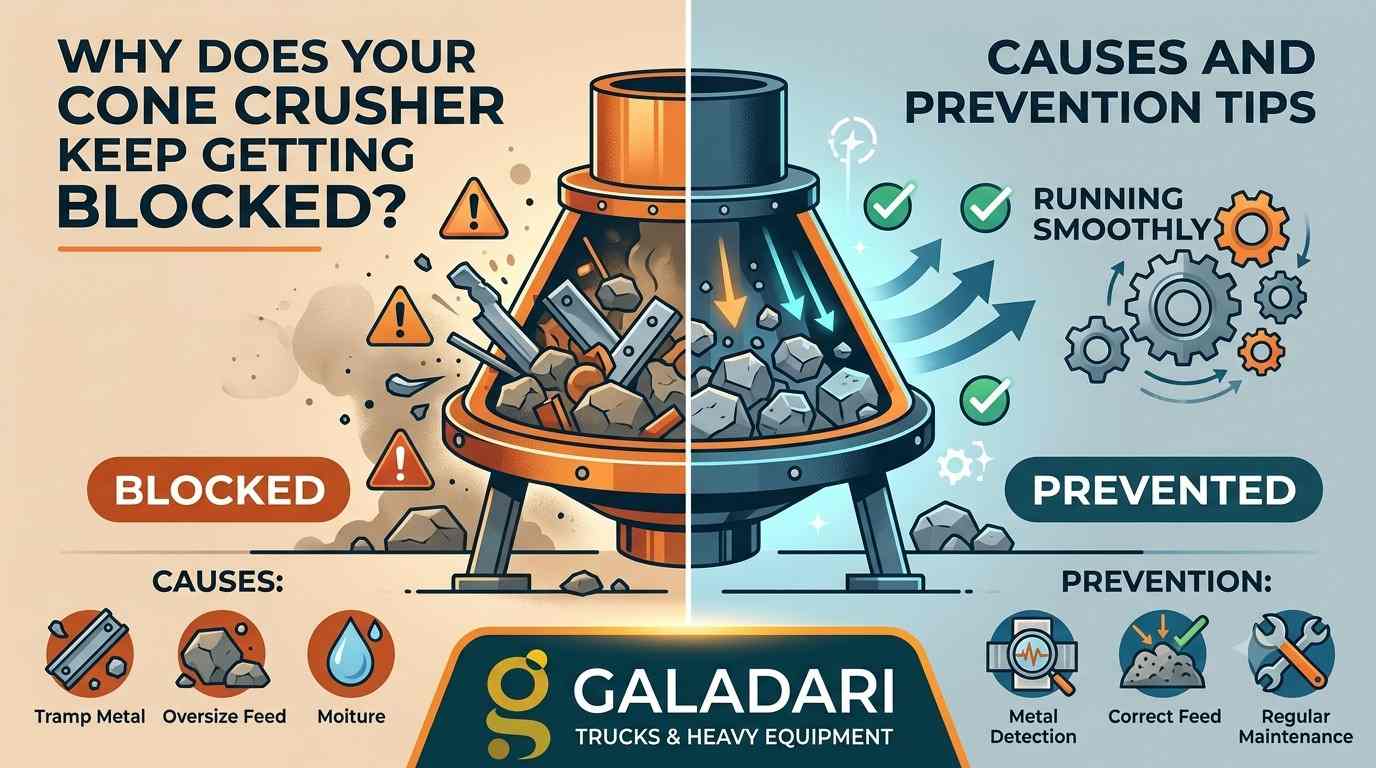
A cone crusher that’s blocked is a crushing operation that isn’t profitable. Downtime costs money — both in lost production and emergency repairs. Whether you’re operating cone crushers on an aggregate site or investing in cone crushers for sale in UAE, understanding what causes blockages is the first step toward running a smoother, more reliable operation.
Blockages in cone crushers are frustratingly common. But they’re not inevitable. Most blockages result from predictable causes — and most are preventable with proper operating practices, correct settings, and smart material management. This guide walks through the main culprits and shows you how to keep material flowing and your equipment working.
What Causes Cone Crusher Blockages?
Blockages don’t happen by accident. They’re the result of feed material, crusher geometry, and operating parameters interacting in ways that create stagnation. Understanding the causes helps you address them before they shut down production.
📏
Oversized Feed
Material larger than the crusher’s designed inlet. Wedges into the chamber and stops material flow entirely.
💧
Unsuitable Feed Moisture
Too-wet material clumps and sticks to surfaces. Too-dry material generates dust and can create bridges.
🪨
Material Buildup
Fine material and sticky residue accumulate on crusher surfaces, reducing flow and creating dead zones.
⚙️
Incorrect Settings
Cavity setting too tight, or gap configuration wrong for the material type being crushed.
Oversized Feed: The Most Common Culprit
The most straightforward cause of blockages is material that’s simply too large. A piece of rock larger than your crusher’s designed inlet will wedge into the chamber, stop the mantle from operating, and halt production immediately.
This is why proper screening and pre-crushing are non-negotiable in any professional crushing operation. Before material reaches your cone crusher, it should be scalped or pre-screened to remove anything oversized. Many operators who invest in quality cone crushers supplier in UAE networks also purchase compatible scalping screens and primary crushers to protect their secondary and tertiary equipment.
Prevention is simple: Know your crusher’s maximum input size and enforce it. Install a grizzly screen or undersize feeder upstream. Better a few minutes of setup than hours of downtime clearing blockages.
Unsuitable Feed Conditions: Moisture and Cleanliness
Feed moisture is a silent blockage trigger. Wet material (especially clay-rich or fine aggregate) clumps together, sticks to internal surfaces, and creates friction that stops material from flowing through the cavity. Dry, fine material can do the opposite — creating suspended dust and bridging across the chamber opening.
The ideal feed moisture depends on the material type:
| Granite/Hard Rock | 1–3% moisture (naturally dry) |
| Limestone | 2–5% moisture (slightly damp acceptable) |
| Recycled Concrete | 3–7% moisture (dust control needed) |
| Sand & Gravel Mix | 3–6% moisture (depends on clay content) |
If your feed is too wet, consider:
1. Allowing stockpiles to drain before feeding (especially after rain)
2. Installing a scalping screen to remove fines and excess moisture
3. Covering outdoor material stockpiles to control moisture ingress
Operator Tip
Sticky material from clay or fine dust is one of the biggest blockage triggers. If you’re seeing frequent buildup on the crusher bowl or mantle, your feed is too moist or too fine. Address the source — not just the symptom.
Material Buildup: The Silent Friction Builder
Even when feed is appropriate, buildup happens. Fine material and dust accumulate on the internal surfaces of the crusher — particularly the mantle, concave, and around the main shaft. This buildup acts like friction, slowing material flow and eventually creating dead zones where material stalls.
Buildup is especially problematic when:
Crushing recycled material — old concrete often contains dust and fine particles that stick to crusher surfaces.
Seasonal weather changes — humidity spikes cause adhesion; temperature swings crack accumulated layers.
Running high throughput — pushing a crusher beyond its design capacity overloads the system and accelerates buildup.
Prevention involves scheduled cleaning and operator diligence:
1. Stop the crusher and blow out with compressed air every 2–4 hours of operation
2. Inspect the bowl and mantle visually during routine maintenance
3. Clean the feed hopper and chute to prevent material from sitting and hardening
4. Replace mantle and concave as they wear — worn surfaces are more prone to sticking
Incorrect Crusher Settings: The Forgotten Adjustment
Many blockages are actually caused by operating the crusher at settings designed for a different material. Cavity setting (the gap between mantle and concave) should match both the material hardness and the desired output size. A setting that works perfectly for granite may jam repeatedly when you switch to limestone or recycled concrete.
Key settings to monitor:
Cavity Gap: Too tight, and you’re forcing material through a space too small for its nature. Limestone is softer and can jam if the gap is too tight; granite flows better at tight settings.
Feed Rate: Overfeeding backs up material in the chamber. An ideal feed rate leaves the cavity continuously full but not jammed.
Speed: Most cone crushers operate at 1,000–2,000 RPM. Running below designed speed reduces crushing force and can cause stalling. Running above designed speed can cause spillage and wear.
Get the settings right for your material type and stick to them. Keep detailed records of what works — when you move to a different material, you have a baseline to adjust from rather than guessing.
Operating Best Practices: Keeping Material Flowing
Beyond the mechanical causes, operator behavior prevents most blockages:
Monitor feed consistency: Don’t feed the crusher sporadically. Steady, continuous feed is better than bursts followed by gaps — bursts cause surge and stalling.
Watch for early warning signs: If the crusher starts making unusual noises, vibrating more than normal, or grinding without moving material, stop and inspect before it fully blocks.
Maintain clean surroundings: Spillage around the crusher creates piles that can be refed accidentally. Keep the work area organized.
Record blockage patterns: Track when and why blockages happen. If they spike after certain weather or material sources, you’ve found your problem.
Professional cone crushers supplier in UAE operations train their operators on these practices. If you’re running your own equipment, invest in proper operator training — it pays for itself in uptime alone.
Frequently Asked Questions
How do I know if my cone crusher cavity setting is too tight? What are the warning signs?
Several signs indicate a cavity that’s too tight. First, listen for grinding sounds — the crusher should sound like material is being crushed, not like metal scraping on metal. Second, watch the discharge: if product is coming out very fine but the crusher is running hot and consuming excessive power, the cavity is likely too tight. Third, check for blockages: if you’re having to clear jams frequently and the material is appropriate size, the gap is probably constraining flow. Finally, feel the vibration: a crusher running at a cavity that’s too tight vibrates more than normal. Easiest check? Measure the actual gap with feeler gauges (stop the crusher first) and compare to the manufacturer’s recommendation for your material type.
Can I prevent blockages by using a vibrating feeder instead of a regular hopper?
Absolutely, yes. A vibrating feeder controls the feed rate and prevents surges, which are a major blockage trigger. It also helps break up clumped material before it enters the crusher. If you’re dealing with frequent blockages and haven’t upgraded to a vibrating feeder, it’s one of the best preventive investments you can make. The downside is cost and maintenance — vibrating feeders have bearings and moving parts that need attention. But the uptime you gain (and the reduced stress on your cone crusher) usually justifies it within a year or two. If you’re buying new cone crushers, including a proper vibrating feeder in the package is standard practice for a reason.
My cone crusher blocks every time I switch from crushing granite to recycled concrete. Why?
Recycled concrete is fundamentally different from granite — it’s more brittle, softer, dustier, and often has a higher fine content. Granite needs a tight cavity to crush properly and flows well because it’s hard and angular. Recycled concrete needs a looser cavity because it fractures more easily, and the dust and fines want to stick together. When you switch materials without adjusting your settings, you’re essentially choking the crusher for recycled material. Solution: Open your cavity gap by 2–4mm for recycled material versus granite. You may also want to reduce feed rate slightly. And crucially — pre-screen recycled material to remove fines before they enter the crusher. A 10mm undersize screen removes the dust that causes sticking. Once you get the settings right for each material, keep records. Don’t guess each time you switch.
Is there a way to predict blockages before they happen, or do I just have to wait for them to occur?
You can predict them. Modern cone crushers have pressure sensors and vibration monitoring built in — if you’re using them, pay attention to the data. A sudden spike in crusher pressure or vibration before blockage is your early warning system. Older crushers without sensors? Train your operator to listen and feel. The crusher’s sound changes subtly before it jams — it goes from a rhythmic crushing sound to a slightly higher-pitched grinding. Also track how long between blockages. If it’s happening every 2 hours, you have a feed issue (moisture, size, or fines). If it’s random, it’s probably operator-related (feeding too fast or inconsistently). Once you identify a pattern, you can address it. Many operators wait for a full blockage before they act — by then you’ve lost hours. Early detection systems or operator training pays back quickly in uptime.