







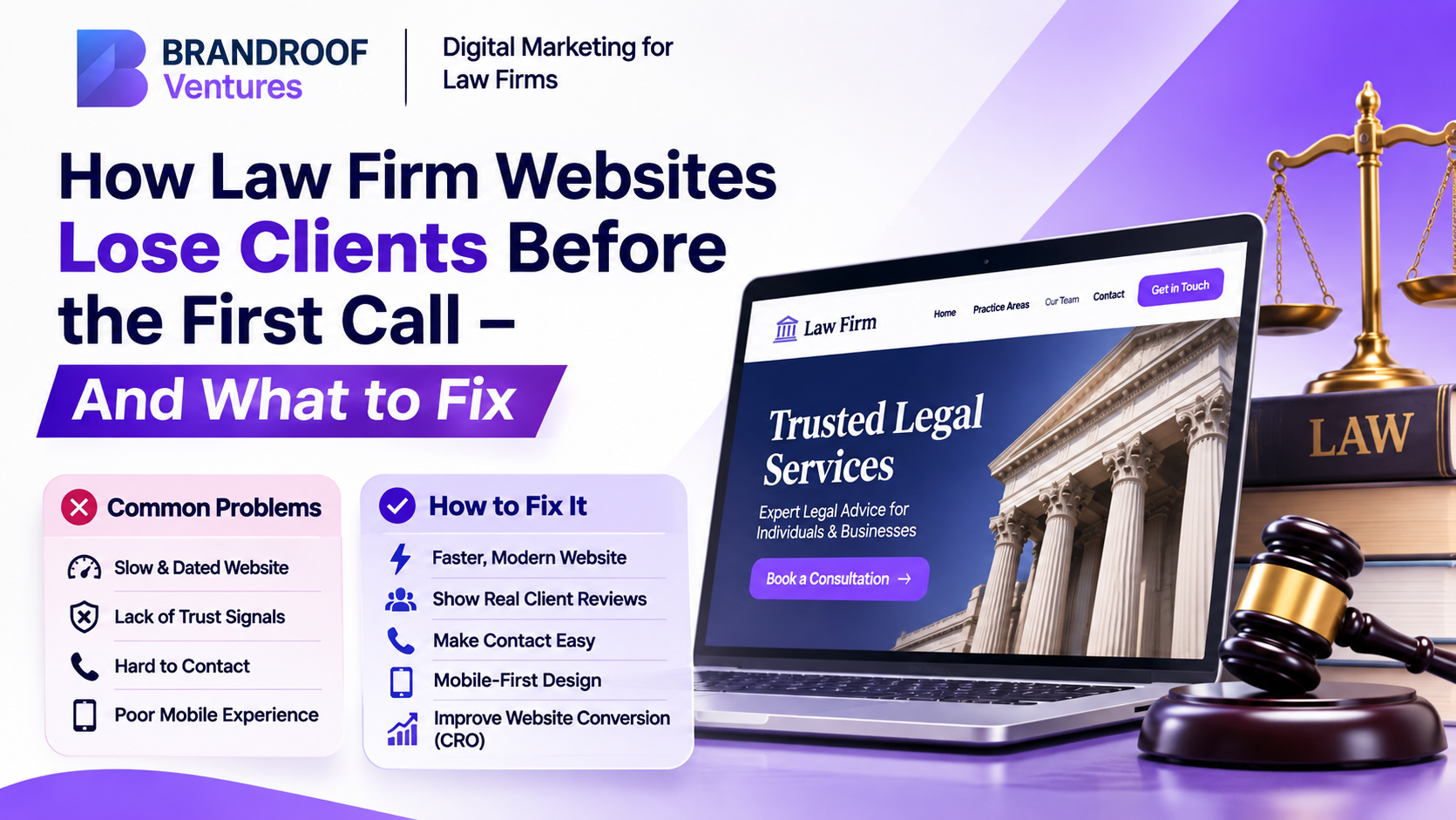
Most law firms that invest in digital marketing focus on getting more people to their website. They run Google Ads, build backlinks, improve their search rankings, and measure success by the number of visitors arriving each month. What they measure less often is what happens after those visitors arrive — and for a significant proportion of law firm websites, what happens is that potential clients leave without making contact.
This is a law firm website conversion problem, and it is more common than most firms realise. Traffic without conversion is simply an expensive way to demonstrate that visitors found your website unpersuasive. Understanding why law firm websites lose clients before the first call is essential to building a stronger online presence. The good news is that the failures causing these lost opportunities are identifiable and fixable, and the improvements required are less complex than most firms assume.
The First Impression Problem: Slow, Dated, and Unclear
A prospective client visiting a law firm website for the first time makes a judgement within seconds. That judgement is not primarily about your qualifications or your case outcomes — it is about whether the website signals that you are a credible, competent, and trustworthy practice. A website that loads slowly, looks dated, or fails to communicate your area of practice clearly in its opening lines will lose visitors before they have absorbed a single fact about your firm.
Page speed is a concrete, measurable problem that affects both search rankings and user behaviour. Google’s Core Web Vitals measure how quickly a page loads and becomes interactive, and a law firm website that scores poorly on these metrics loses visitors and ranks lower in search results. For a sector where the average cost per click on paid search is high and every visitor represents real acquisition cost, a page that loads in four seconds instead of two is not a minor inconvenience — it is a meaningful proportion of leads gone before the relationship began.
The fix starts with a technical audit: page speed scores, mobile rendering, and the clarity of the headline on the homepage. Effective law firm website design 2026 should prioritise speed, usability, mobile responsiveness, and clear messaging. The homepage headline should tell a prospective client what type of law you practise, who you serve, and where you operate — in one sentence if possible. “Expert personal injury solicitors serving clients across the North West” communicates far more useful information than “Welcome to [Firm Name],” and it does so in the time a visitor is willing to give before deciding whether to read further.
The Trust Deficit: Qualifications Without Proof
Legal services are a high-stakes purchase. A client instructing a solicitor is placing significant trust in a professional they may never have met, on a matter that may have serious financial or personal consequences. The information that builds that trust — reviews from previous clients, verifiable accreditations, clear and humanising profiles of the lawyers they will be dealing with — is the information that most law firm websites bury, omit, or present in a way that feels formal and impersonal.
Reviews displayed directly on service pages, not just linked through to Google or Trustpilot, perform significantly better as conversion tools than off-site review platforms alone. A prospective client reading about your conveyancing service who sees three specific, recent testimonials from clients describing their experience with your firm does not need to navigate away to be reassured. The social proof is right there, at the moment it is most needed. Law firms that surface their best reviews on the pages most relevant to each practice area consistently see higher enquiry rates from those pages.
Lawyer profiles are similarly underused as conversion tools. A brief, well-written biography that explains a solicitor’s experience, their approach to client communication, and the kinds of cases they handle most often gives prospective clients something to connect with before they pick up the phone. It reduces the anxiety of cold contact and increases the likelihood that the person who does call feels they already have some sense of who they will be speaking to.
The Contact Friction Problem: Making It Hard to Reach You
The moment a prospective client decides to make contact is the most fragile point in the entire conversion journey. Any friction at this stage — a phone number that is difficult to find, a contact form that asks for too much information, a booking system that requires account creation — risks losing someone who was ready to instruct.
Law firm websites frequently make contact harder than it needs to be. A phone number buried in the footer rather than displayed prominently at the top of every page. A single generic contact form for all enquiries, rather than practice-area-specific forms that signal the firm has understood what the client needs. No indication of response time, so the prospective client submitting an enquiry has no idea whether they will hear back in an hour or three days. Each of these is a point of friction that adds doubt and reduces the proportion of visitors who follow through.
The fix is to audit the contact pathway from the perspective of a prospective client who has never visited your site before. Can they find a phone number within two seconds of landing on any page? Is there an online enquiry option that takes fewer than two minutes to complete? Is there a clear statement of what happens next — “We will call you back within one working hour” or “A solicitor will review your enquiry and respond by end of day”? These are practical ways to understand how to improve law firm website enquiries and reduce friction throughout the conversion journey.
The Mobile Failure: Ignoring Where Most Searches Happen
A significant and growing proportion of legal searches happen on mobile devices. Someone involved in an accident, dealing with an employment dispute, or seeking urgent immigration advice is often searching on their phone rather than at a desktop. A law firm website that has been optimised for desktop presentation but renders poorly on mobile is effectively invisible to this audience — not because it cannot be found, but because the experience of trying to use it on a phone is discouraging enough to send visitors straight to a competitor.
Mobile optimisation for a law firm website means more than a responsive layout. It means ensuring that phone numbers are clickable links that dial immediately on tap, that contact forms are short enough to complete comfortably on a small screen, that text is readable without zooming, and that the most important information — practice areas, contact options, and social proof — is accessible without excessive scrolling. Google also uses mobile performance as a ranking signal, which means a poorly performing mobile site is not just losing conversions; it is also losing the search visibility that delivers traffic in the first place.
What a High-Converting Law Firm Website Actually Does
The law firm websites that convert the highest proportion of visitors into enquiries share a common set of characteristics. They load quickly and render well on every device. They communicate the firm’s practice areas and geographic coverage immediately and clearly. They display specific, recent client reviews on every relevant service page. They present genuine, humanising profiles of the solicitors clients will work with. They make contact frictionless, with visible phone numbers, short enquiry forms, and clear statements of what happens after contact is made.
These improvements form the foundation of effective legal website CRO (Conversion Rate Optimisation). Rather than focusing exclusively on attracting more traffic, firms should continuously evaluate visitor behaviour, identify pages with high exit rates, test calls to action, and improve enquiry forms.
None of these elements require an expensive rebuild. Many of the highest-impact improvements can be made incrementally, starting with the pages that receive the most traffic and addressing the specific friction points that data reveals are causing visitors to leave. A conversion rate improvement of even two or three percentage points on an existing traffic level can represent a substantial increase in monthly enquiries without any increase in marketing spend.
Law Firm Marketing That Converts Traffic Into Clients
BrandRoof Ventures works with law firms as a specialist growth partner, combining SEO, Google Ads, and conversion rate optimisation to build a digital presence that attracts the right visitors and converts them into enquiries. All engagements use transparent, month-to-month pricing with no long-term contracts.
By focusing on law firm website conversion, website performance, and legal website CRO, BrandRoof Ventures helps law firms turn existing website traffic into more meaningful client enquiries.
Law firms looking to understand how to improve law firm website enquiries and get more from their existing digital presence can find full details at our website.