








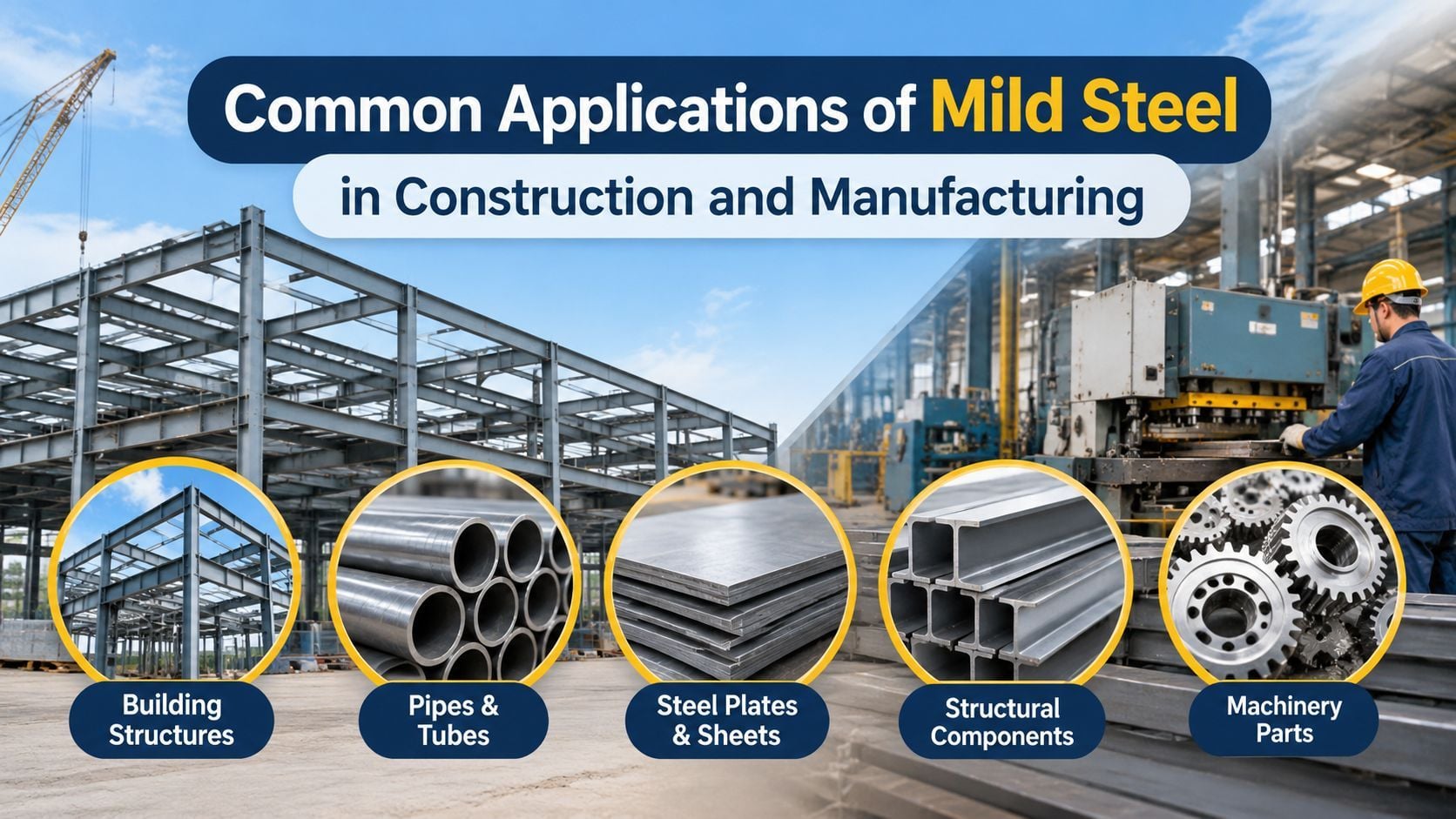
Mild steel applications span structural frameworks, machinery components, pipelines, automotive parts, and fabricated products across nearly every industry. Its low carbon content typically between 0.05% and 0.25% makes it easy to weld, cut, and form without sacrificing structural integrity. Cost-effective and widely available, mild steel remains the most commonly used steel grade in both construction and manufacturing.
If you work in construction, engineering, or fabrication, understanding where and why mild steel applications make the most sense can directly influence your material choices, project costs, and build quality.
What Makes Mild Steel the Default Choice?
Before diving into specific uses, it helps to understand why mild steel gets specified so often. With a tensile strength typically ranging from 400 to 550 MPa, it handles significant structural loads without being excessively hard or brittle. That balance strength without rigidity is exactly what fabricators and construction teams need when working across diverse project types.
It’s also forgiving in fabrication. It bends, drills, and welds cleanly, which reduces processing time and waste on the shop floor.
Mild Steel Applications in Construction
Structural Steel Frameworks
In construction steel work, mild steel is the backbone of most structural frameworks. Columns, beams, and joists built from mild steel sections support everything from warehouses and commercial buildings to bridges and elevated roadways.
In the United States, structural steel accounts for roughly 25% of the steel market by volume, with mild and low carbon grades making up the majority of that demand. Projects requiring standardized sections — I-beams, H-columns, angle iron — almost always default to mild steel due to its predictable performance and ease of connection.
Reinforcement Bars (Rebar)
Rebar is one of the most direct low carbon steel applications in civil construction. Embedded in concrete foundations, slabs, walls, and columns, mild steel rebar adds tensile strength to a material that handles compression well but fails under tension.
Grade 40 and Grade 60 rebar commonly specified in US construction projects are predominantly mild steel products that meet ASTM A615 standards. Infrastructure projects across highways, bridges, and residential foundations rely on this combination daily.
Roofing, Cladding, and Decking
Mild steel sheet, often galvanized or coated for corrosion resistance, is extensively used in roofing systems, wall cladding, and metal decking for composite floors. Its ability to be cold-rolled into thin profiles without cracking makes it ideal for these applications.
Metal roofing built from mild steel can last 40–70 years with proper coating systems, making it a long-term investment for commercial and industrial facilities.
Mild Steel Uses in Manufacturing
Machinery and Equipment Frames
Manufacturing facilities depend on mild steel for press frames, conveyor systems, machine bases, and enclosures. The material’s machinability allows engineers to drill, tap, and weld components precisely critical when tolerances matter on production equipment.
Unlike high-carbon steel, mild steel won’t harden unpredictably during welding. This consistency is a significant advantage when fabricating large machine frames where multiple weld passes are required.
Automotive and Transportation Components
The automotive industry uses mild steel for body panels, chassis components, brackets, and structural reinforcements. Advanced high-strength variants of mild steel are now common in vehicle manufacturing, where engineers balance weight reduction against crash performance.
According to the American Iron and Steel Institute (AISI), steel predominantly low carbon and high-strength low-alloy grades — makes up approximately 54% of the average vehicle’s weight. Mild steel remains core to this, particularly in non-critical structural panels and under-body components.
Pipelines and Storage Tanks
Mild steel pipes and tanks are foundational to oil and gas, chemical processing, and water treatment industries. Carbon steel pipe manufactured to ASTM A53 or A106 specifications both mild steel grades handles pressurized fluid transport across industrial and municipal systems.
Storage tanks for water, fuel, and industrial liquids are frequently fabricated from mild steel plate, with internal linings or external coatings applied depending on the substance being stored. The material’s weldability allows large-diameter tanks to be built on-site, reducing transport constraints.
Fabrication Industries That Rely on Mild Steel Products
Beyond construction and heavy manufacturing, several fabrication sectors depend heavily on mild steel products as their primary raw material.
- Structural fabrication shops: cutting and welding steel sections into frames, staircases, mezzanine floors, and support structures
- Sheet metal fabrication: producing enclosures, panels, brackets, and custom parts for OEM manufacturers
- Agricultural equipment: tractor implements, storage bins, and irrigation structures built from mild steel plate and tube
- Furniture and fixtures: commercial shelving, workbenches, racking systems, and retail display units
- Shipbuilding: hull plating, bulkheads, and deck structures where weldability and toughness matter more than extreme hardness
Each of these sectors values mild steel for the same core reasons: it’s predictable, available in standard sizes, and responds consistently to heat and mechanical processing.
Mild Steel vs. Other Steel Grades: Where Does It Win?
| Application Type | Mild Steel | High Carbon Steel | Stainless Steel
|
|---|---|---|---|
| Structural frameworks | ✔ Preferred | ✘ Too brittle | ✘ Cost-prohibitive |
| Welded fabrication | ✔ Excellent | ✘ Difficult to weld | ⚠ Specialist process |
| Corrosive environments | ⚠ Needs coating | ⚠ Needs coating | ✔ Preferred |
| High-wear tooling | ✘ Too soft | ✔ Preferred | ⚠ Situational |
| General manufacturing | ✔ Preferred | ✘ Overkill | ✘ Cost-prohibitive |
The table makes the case clearly. Mild steel isn’t the best material for every situation, but for the broadest range of structural and manufacturing applications, it consistently outperforms alternatives on value, workability, and availability.
Protective Coatings and Surface Treatments
One limitation worth acknowledging: mild steel corrodes without protection. In construction and outdoor applications, this is managed through galvanizing, epoxy coating, priming, or paint systems. Hot-dip galvanizing per ASTM A123 is a standard specification for structural mild steel used in exposed environments.
When engineers factor coating systems into the project specification early, mild steel performs exceptionally well even in demanding environments. The key is matching the right surface treatment to the exposure conditions — not avoiding mild steel altogether.
Why Specifying the Right Mild Steel Product Matters
Not all mild steel is equivalent. Grade selection, dimensional tolerances, surface condition, and certification all affect performance. For structural applications, specifying material that meets ASTM A36 (structural shapes) or A572 Grade 50 (higher yield applications) ensures the design load assumptions hold up in the field.
Fabricators and engineers who work with a reliable steel supplier get consistent certifications, accurate mill test reports, and material that performs exactly as the specification requires no surprises mid-project.
For construction companies, manufacturers, and fabrication shops looking for a dependable source of mild steel products in standard and custom forms, CL Metal offers a broad product range backed by technical knowledge and reliable supply.
Frequently Asked Questions
What are the most common mild steel applications in construction?
Mild steel is used in structural beams, columns, rebar, roofing, metal decking, and cladding. Its weldability and consistent mechanical properties make it the default material for load-bearing frameworks and reinforced concrete systems across residential, commercial, and infrastructure projects.
Why is mild steel preferred over other steel grades for fabrication?
Mild steel welds cleanly, machines easily, and bends without cracking — properties that high-carbon steel lacks. For fabricators producing frames, enclosures, and structural components in volume, mild steel’s workability reduces processing time and lowers the risk of weld defects.
What industries use mild steel the most?
Construction, automotive manufacturing, oil and gas, agricultural equipment, and general fabrication are the heaviest users. Each industry values mild steel for its balance of tensile strength, machinability, and cost-effectiveness compared to specialty alloys or stainless grades.
Does mild steel rust easily?
Yes, mild steel corrodes without surface protection. Galvanizing, epoxy primer, or paint systems are applied depending on the exposure environment. Hot-dip galvanizing per ASTM A123 is the standard method for structural mild steel used in outdoor or high-humidity applications.
What is the difference between mild steel and low carbon steel?
They refer to the same material. Low carbon steel describes the metallurgical composition — typically 0.05% to 0.25% carbon — while mild steel is the trade and construction term. Both terms describe a highly weldable, ductile steel suited to structural and manufacturing applications.
How do I choose the right mild steel grade for a structural project?
Match the grade to your load and fabrication requirements. ASTM A36 suits general structural shapes, while A572 Grade 50 offers higher yield strength for demanding applications. Always request mill test reports from your supplier to confirm the material meets the specified mechanical properties.