






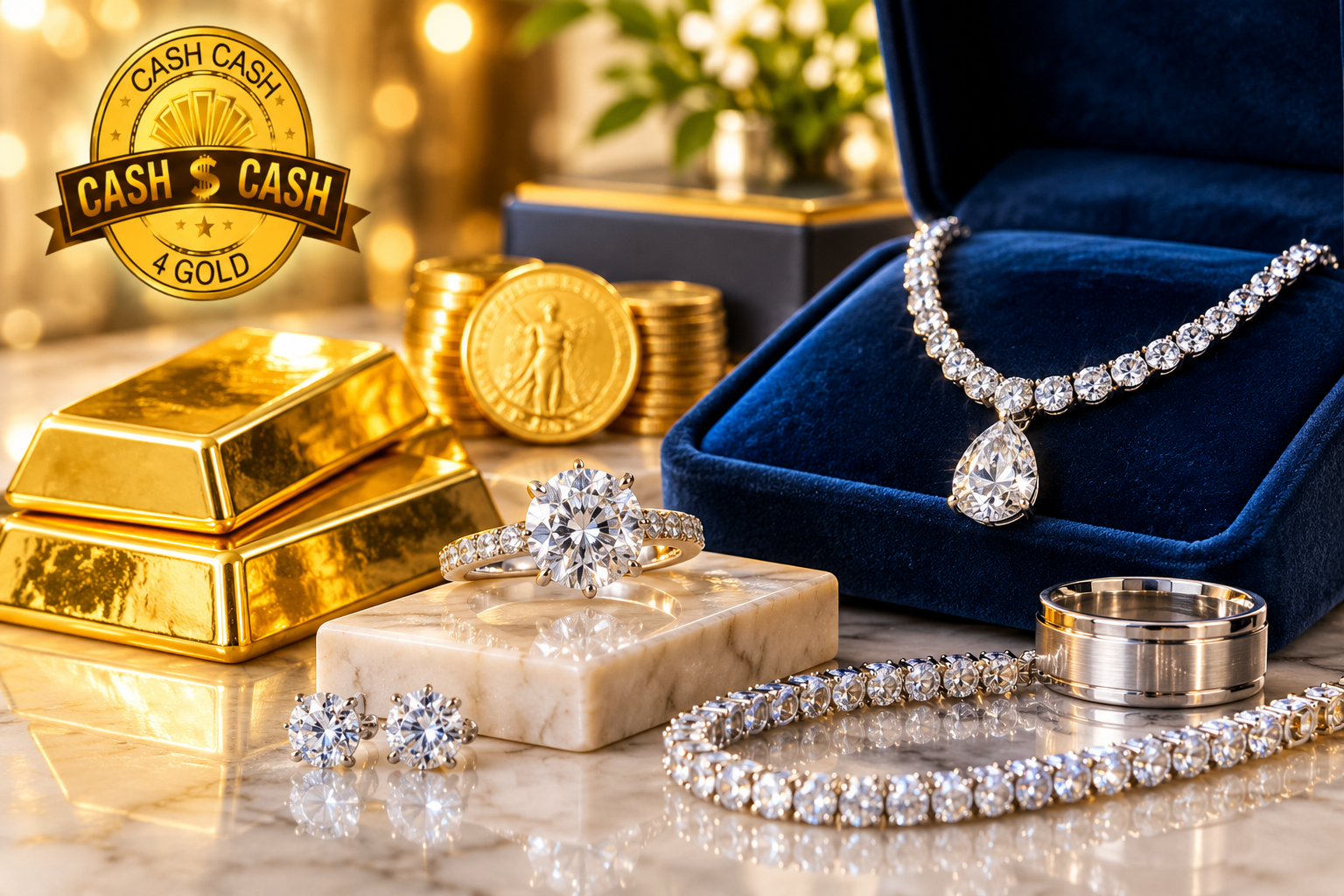
Diamond jewelry can hold both financial and sentimental value. But when you no longer wear a necklace, engagement ring, pair of diamond earrings, or other gemstone piece, selling it may be worth considering. The important part is understanding how diamond buyers evaluate jewelry before you accept an offer.
If you are planning to sell diamond jewelry in Houston, TX, start by identifying the type of diamond you own, gathering any available documentation, and learning about the factors that influence its resale value. A diamond’s price is not determined by carat weight alone. Its cut, color, clarity, condition, setting, and current resale demand can all matter.
This guide explains how to prepare diamond jewelry for evaluation, what to ask a buyer, and how to compare offers when looking for a local diamond buyer.
Quick Overview: Where Can You Sell Diamond Jewelry in Houston?
You can begin by contacting jewelry buyers in Houston that evaluate diamond jewelry, loose diamonds, necklaces, rings, and earrings. Before visiting, confirm that the buyer accepts your particular item.
To prepare:
- Identify whether your diamond is loose or mounted in jewelry.
- Gather any grading reports, receipts, or previous appraisals.
- Understand the diamond’s basic characteristics.
- Ask how the buyer evaluates the stone and its setting.
- Compare offers and review payment terms before accepting.
Cashcash4gold is a jewelry buyer listed in Houston, TX 77069. Contact the business directly to confirm whether it currently evaluates your type of diamond jewelry.
1. What Types of Diamond Jewelry Can You Sell?
Not all diamond jewelry is evaluated in exactly the same way. The type of item, gemstone characteristics, setting, and condition can influence how a buyer assesses it.
Diamond Rings and Engagement Rings
Diamond engagement rings, solitaire rings, and anniversary rings may contain a center stone surrounded by smaller diamonds. A buyer may consider the center diamond separately from the side stones and precious-metal setting.
If you have an original grading report or purchase documentation, bring it along. It can provide useful information about the stone, although it does not guarantee a particular resale offer.
Diamond Necklaces and Pendants
If you want to Sell diamond necklaces, understand that the buyer may evaluate both the diamonds and the necklace’s metal setting.
A solitaire pendant, for example, may have one main diamond, while a tennis necklace may contain multiple stones. The number of diamonds alone does not determine the value. Their individual characteristics, total carat weight, condition, and market demand may also matter.
Diamond Earrings
People planning to Sell diamond earrings should organize both earrings and any matching backs or original packaging they still have.
A matching pair may be evaluated differently from a single earring. Buyers may consider whether the stones match in size and quality, whether the settings are intact, and whether the earrings are made from gold or platinum.
If one earring is missing, the remaining piece may still be worth asking about. Confirm whether the buyer accepts single earrings or incomplete pairs.
Loose Diamonds
Loose diamonds are gemstones that are not mounted in rings, necklaces, or earrings. Their evaluation may be more straightforward in some respects because the stone can be examined without its setting.
However, loose diamonds still require proper identification and assessment. A grading report can help communicate the stone’s characteristics, but the final resale offer depends on the buyer’s assessment and market conditions.
2. Understanding the 4Cs Before You Sell Diamonds
One of the most useful ways to understand diamond quality is the 4Cs framework developed by the Gemological Institute of America (GIA): cut, color, clarity, and carat weight.
These characteristics help describe a diamond and provide a common language for discussing its quality.
Cut
Cut describes how a diamond’s proportions and facets interact with light. A well-cut diamond can show more brilliance, fire, and sparkle.
Cut does not simply mean the diamond’s shape. Round, oval, pear, princess, and emerald are examples of shapes, while cut quality relates to the craftsmanship and proportions of the stone.
Color
For many traditional white diamonds, color grading measures how close the stone is to colorless. The GIA D-to-Z scale is commonly used for this purpose.
Some diamonds have natural fancy colors, such as yellow, pink, or blue. These stones are assessed differently from traditional colorless-to-light-yellow diamonds.
Clarity
Clarity refers to internal characteristics, known as inclusions, and surface characteristics, known as blemishes. Their size, number, location, and visibility can influence the clarity assessment.
A diamond does not need to be completely flawless to have resale value. Its overall characteristics and market demand matter.
Carat Weight
Carat measures a diamond’s weight, not its physical dimensions. Larger diamonds may be rarer, but two diamonds with the same carat weight can have different values because of their cut, color, and clarity.
For this reason, a buyer should not calculate a diamond’s value using carat weight alone.
3. How to Find a Cash Diamond Buyer in Houston, TX
When searching for a Cash Diamond buyer in Houston, TX, look for a buyer who can explain the evaluation process rather than simply providing an unexplained number.
Before taking your jewelry in, ask:
- Do you evaluate loose diamonds and mounted diamond jewelry?
- Do you accept necklaces, earrings, and engagement rings?
- How do you assess diamond quality?
- Do you consider grading reports and certificates?
- Are the diamonds evaluated separately from their metal settings?
- Are there any fees or conditions associated with the transaction?
If you are comparing a Diamond Buyer in Houston, TX, request clear information about how each offer was calculated.
A buyer’s ability to explain the evaluation is important because the resale value of a diamond can differ from its original retail price or insurance replacement value.
4. What Does a Diamond Grading Report Tell You?
A diamond grading report can help you understand the characteristics of your stone. It may include information about its shape, measurements, carat weight, color grade, clarity grade, and other identifying details.
GIA reports, for example, document diamond characteristics using established grading methods. The report number can also help identify the specific report.
Before visiting a buyer:
- Locate the original grading report if you have one.
- Check that the report details match the diamond you own.
- Keep the report with your jewelry during the evaluation.
- Ask whether the buyer uses the report as supporting information.
- Understand that the report describes the diamond; it does not set its current resale price.
Do not assume that an old appraisal guarantees the same amount today. Retail replacement values and resale offers serve different purposes.
5. What Factors Affect the Offer for Diamond Jewelry?
Several factors can influence how much a buyer may offer.
Diamond characteristics: Cut, color, clarity, carat weight, shape, and overall appearance all contribute to the assessment.
Metal setting: Gold or platinum settings may have separate material value. The metal’s purity and weight can affect that portion of the evaluation.
Condition: Loose stones, damaged settings, missing stones, and worn clasps may influence resale options.
Matching pieces: Complete pairs of earrings or matching jewelry sets may be easier to evaluate as complete items than incomplete sets.
Market demand: Not every diamond shape, size, or quality category has the same resale demand. A buyer’s available resale channels can influence the offer.
Documentation: Grading reports, receipts, and original certificates can help identify the item and provide useful background.
A useful question is: “Can you explain how much of this offer relates to the diamond and how much relates to the metal setting?”
6. How to Prepare Before Selling Diamond Jewelry
Preparing your jewelry can make the evaluation process more organized.
Gather All Available Documents
Collect grading reports, certificates, original receipts, and previous appraisals. Do not worry if you no longer have every document; ask the buyer whether the item can still be evaluated.
Keep Jewelry in Its Original Groups
Keep matching earrings together and store necklaces separately to prevent tangling. If you have loose diamonds, use a secure container rather than placing them in a pocket or loose bag.
Avoid Aggressive Cleaning
Do not use harsh chemicals, household cleaners, or abrasive materials on delicate jewelry. A damaged setting or loosened stone can create additional problems.
Take Clear Photographs
Photographs can help you organize your items and describe them when contacting a buyer. However, photographs cannot replace an in-person examination or professional testing.
Compare More Than One Offer
If practical, obtain evaluations from multiple buyers. Compare the amount offered, the explanation, and the transaction terms rather than focusing only on the highest initial quote.
7. Cash for Diamonds in Houston, TX: Questions to Ask Before Selling
Searching for Cash for Diamonds in Houston, TX can bring up different types of jewelry buyers. Before choosing one, use these questions to understand the service:
| Question | Why it matters |
|---|---|
| Which diamond items do you accept? | Confirms whether your specific jewelry qualifies |
| Do you evaluate loose diamonds? | Helps determine whether loose stones are accepted |
| How do you assess diamond quality? | Explains the basis of the evaluation |
| Do you evaluate the setting separately? | Clarifies how metal value is considered |
| Are there any fees? | Helps you understand the final amount |
| How is payment handled? | Clarifies the transaction process |
A clear conversation before your visit can save time and help you make a more informed decision.
8. Contact Cashcash4gold in Houston, TX
If you are researching local options, Cashcash4gold is listed as a jewelry buyer in Houston, Texas, ZIP code 77069.
You can contact the business to ask whether it currently evaluates diamond rings, necklaces, earrings, loose diamonds, or other jewelry. Confirm accepted items and any evaluation requirements before visiting.
Business Name: Cashcash4gold
Location: Houston, TX 77069, United States
Phone: 1-570-840-4243
If you are looking to sell diamond jewelry, calling ahead is a practical first step. Ask about the specific item you have, the evaluation process, and whether an appointment is necessary.
Frequently Asked Questions
1. Where can I sell diamond jewelry in Houston?
Start by contacting local jewelry buyers that evaluate diamond jewelry. Ask whether they accept your specific item, how they assess diamonds, and whether they consider the metal setting separately.
2. Can I sell diamond necklaces without the original certificate?
You can ask a buyer whether they will evaluate a necklace without its original certificate. The buyer may need to examine and assess the diamond independently. Documentation can be helpful, but its absence does not automatically mean an item cannot be evaluated.
3. Can I sell just one diamond earring?
Some buyers may consider single earrings, although policies vary. Contact the buyer first and explain whether you have one earring or an incomplete pair.
4. Is a diamond grading report the same as a resale appraisal?
No. A grading report describes characteristics such as cut, color, clarity, and carat weight. A resale appraisal or buyer’s offer addresses value for a particular purpose and market. These documents should not be treated as interchangeable.
5. Does a larger diamond always have a higher resale value?
Not necessarily. Carat weight is one factor. Cut, color, clarity, shape, condition, and market demand also influence how a diamond is evaluated.
6. Should I sell the diamond and gold setting separately?
Not automatically. Ask the buyer whether the complete jewelry piece or its individual components are more suitable for evaluation. The answer depends on the diamond, setting, and resale options.
7. How can I compare offers for my diamond jewelry?
Ask each buyer to explain the evaluation, including the diamond characteristics and any metal value. Compare offers for the same item and review payment terms and possible deductions before accepting.
Final Thoughts
Selling diamond jewelry requires more than knowing its original purchase price or carat weight. Understanding the 4Cs, gathering available documentation, and asking how a buyer evaluates the gemstone and its setting can help you approach the process with confidence.
Whether you want to sell diamond necklaces, diamond earrings, engagement rings, or loose stones, take time to understand the offer before making a decision.
If you are in Houston, TX, contact Cashcash4gold at 1-570-840-4243 to confirm whether your diamond jewelry is currently accepted and ask about the evaluation process.