







Starting a food business involves more than preparing quality products and setting competitive prices. Packaging is equally important because it affects product protection, operating expenses, and customer satisfaction. For bakeries, restaurants, food trucks, and home-based food businesses, custom food boxes offer a practical way to package products according to their specific requirements. Unlike standard containers, customized packaging allows businesses to select suitable dimensions, materials, and printing options. Understanding these choices helps small business owners avoid unnecessary expenses and develop a packaging strategy that supports long-term growth.
Why Small Businesses Need Custom Food Packaging
Small businesses often compete with established food brands that already have recognizable packaging and loyal customers. Using packaging designed around specific products can help smaller companies establish their own identity in a competitive market.
Custom food packaging also gives business owners greater control over their packaging requirements. Instead of purchasing standard containers that may not fit their products properly, they can choose structures that accommodate different portion sizes and food categories. This flexibility is particularly useful for businesses introducing new products or expanding their menus.
Types of Food Boxes for Different Small Businesses
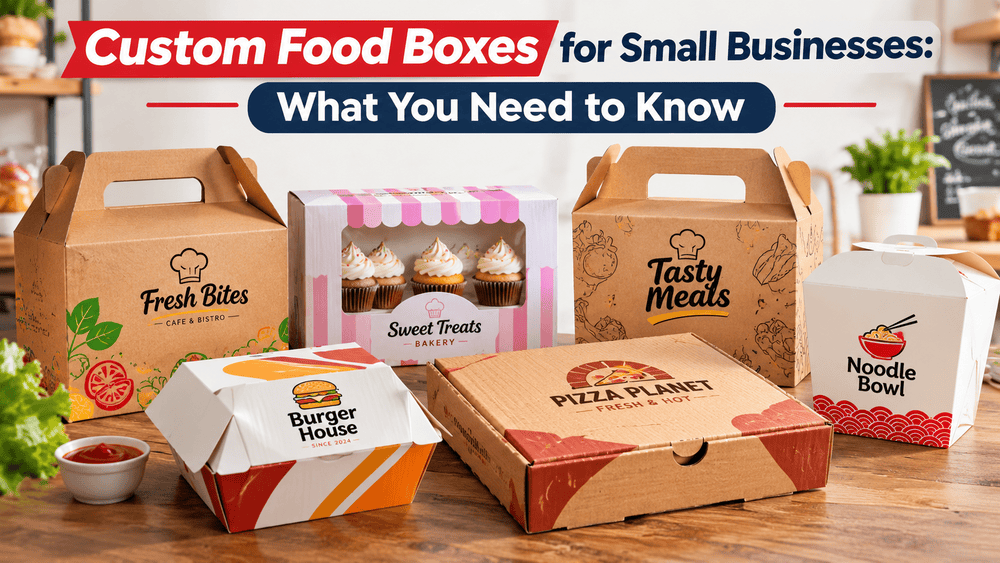
Every food business has different packaging requirements. Selecting the appropriate box style depends on the type of food, serving size, storage conditions, and distribution method.
| Business Type | Recommended Box Style | Primary Purpose |
| Bakeries | Window and cupcake boxes | Product display and protection |
| Restaurants | Takeout and meal boxes | Convenient food transportation |
| Pizza shops | Corrugated pizza boxes | Structural support |
| Food trucks | Burger and snack boxes | Quick serving |
| Home-based businesses | Folding kraft boxes | Affordable product packaging |
| Catering businesses | Gable and compartment boxes | Organized meal distribution |
Business owners should identify their most frequently sold products before choosing packaging styles. Maintaining a limited range of suitable box sizes can simplify purchasing and daily operations.
Selecting the Right Packaging Materials
The materials used to manufacture Food Boxes influence their durability, appearance, and overall cost. Small businesses should select materials according to the weight, moisture content, and temperature of their products rather than appearance alone.
Kraft paperboard is commonly used for lightweight bakery and takeaway products. Solid bleached sulfate (SBS) paperboard provides a smooth printing surface, making it suitable for retail food packaging. Corrugated cardboard offers additional structural strength for larger orders and transportation.
A food packaging box intended for greasy or moist products may require a suitable protective coating or food-safe liner. Confirming material specifications with the supplier helps businesses avoid packaging failures after production.
Understanding Food Safety and Packaging Requirements
Food safety should remain a priority when purchasing packaging. In the United States, the Food and Drug Administration regulates substances intended to come into contact with food, including applicable packaging materials, coatings, and adhesives.
Business owners should confirm that packaging components are suitable for their intended use. Materials appropriate for dry cookies may not be suitable for hot, oily meals. Similarly, ordinary cardboard should not automatically be considered microwave-safe.
Retail food businesses should also check applicable labeling requirements, including ingredient declarations, allergen information, and net quantity statements. Compliance obligations can vary according to the product and available exemptions.
How Much Do Custom Food Boxes Cost?
Packaging costs depend on several factors, including material thickness, box dimensions, printing requirements, order quantity, and finishing options. Small businesses should calculate the total packaging expense before approving an order.
For example, consider a business ordering 500 boxes at $0.60 per unit. The initial packaging expense would be $300. If shipping costs an additional $40, the actual cost per box increases to $0.68.
This is an illustrative calculation rather than a supplier quotation. Understanding the total delivered cost helps businesses establish realistic product prices and protect their profit margins.
We Print Boxes: Packaging Solutions for Small Food Businesses
Small businesses can explore customized packaging options through We Print Boxes according to their product specifications, branding requirements, and purchasing budgets. Identifying the correct dimensions and preferred box style is an important first step.
When purchasing Custom Boxes, business owners should consider how packaging fits into their daily operations. Custom Packaging allows businesses to develop structures that match their products rather than adjusting products to fit standard containers.
Businesses considering Custom Boxes with Logo should prepare readable artwork and consistent brand colors. Reviewing material samples and printed proofs before production can help identify potential design or structural problems.
How Printed Food Packaging Supports Business Marketing
Small businesses often operate with limited advertising budgets, making everyday customer interactions valuable marketing opportunities. Custom printed food packaging provides space for businesses to communicate their identity without requiring separate promotional materials for every order.
Custom food boxes with logo designs can feature recognizable colors, business names, and contact information. Businesses may also include QR codes that connect customers to digital menus, loyalty programs, or feedback forms.
For seasonal promotions, personalized food boxes can feature limited-edition artwork or special messages. However, businesses should avoid overcrowding their designs with unnecessary information that makes the packaging difficult to read.
Buying Wholesale Food Boxes on a Limited Budget
Purchasing wholesale food boxes may reduce per-unit expenses, but ordering excessive quantities can create cash flow and storage problems. New businesses should estimate their monthly packaging consumption before committing to large orders.
When comparing Custom Boxes Wholesale options, consider the following factors:
- Minimum order quantity
- Total production and delivery costs
- Printing and setup charges
- Manufacturing turnaround time
- Available storage space
- Expected monthly sales
Some packaging suppliers offer minimum orders starting at 50 or 100 units, depending on the product. These smaller quantities can help businesses test their packaging before increasing order volumes.
Test Your Packaging Before Placing Large Orders
A digital packaging mockup shows how the finished design may appear, but a physical sample provides a better opportunity to evaluate its performance.
Business owners should place their actual food products inside sample boxes and observe how the packaging performs during normal handling. Check whether the closures remain secure, the base supports the product weight, and the dimensions provide sufficient space.
Testing custom food packaging boxes with logo printing also allows businesses to evaluate color accuracy, text placement, and the appearance of folded panels before approving mass production.
Managing Packaging Inventory as Your Business Grows
Running out of packaging during busy periods can interrupt sales and create unnecessary operational pressure. Small businesses should maintain a record of daily packaging consumption and establish a reorder schedule based on supplier lead times.
For example, a restaurant using 50 boxes daily would require approximately 700 boxes to cover a 14-day replenishment period, plus additional safety stock for unexpected demand.
Store unused cartons in a clean, dry area away from moisture and floor contact. Organizing inventory by size and product category can also help employees locate suitable packaging quickly.
Conclusion
Custom food boxes offer small businesses greater flexibility when managing packaging expenses, product requirements, and brand development. Successfully introducing customized packaging requires careful material selection, realistic purchasing decisions, and practical product testing.
Start with manageable quantities, monitor packaging consumption, and adjust your purchasing strategy as sales increase. This approach helps businesses maintain packaging quality without placing unnecessary pressure on their operating budgets.
Frequently Asked Questions (FAQs)
Are custom food boxes suitable for startups?
Yes, startups can begin with small quantities and increase their orders as customer demand grows.
Can small businesses order food boxes with their logo?
Yes, businesses can customize packaging with logos, brand colors, and relevant product information.
What is the most affordable food packaging material?
Kraft paperboard is often economical for suitable lightweight food products, although costs vary by specification.
Can custom food boxes be recycled?
Many clean paper-based boxes are recyclable, depending on coatings, food residue, and local recycling requirements.
How can small businesses reduce packaging costs?
Choose suitable box sizes, simplify printing, compare supplier quotations, and purchase quantities based on expected sales.