




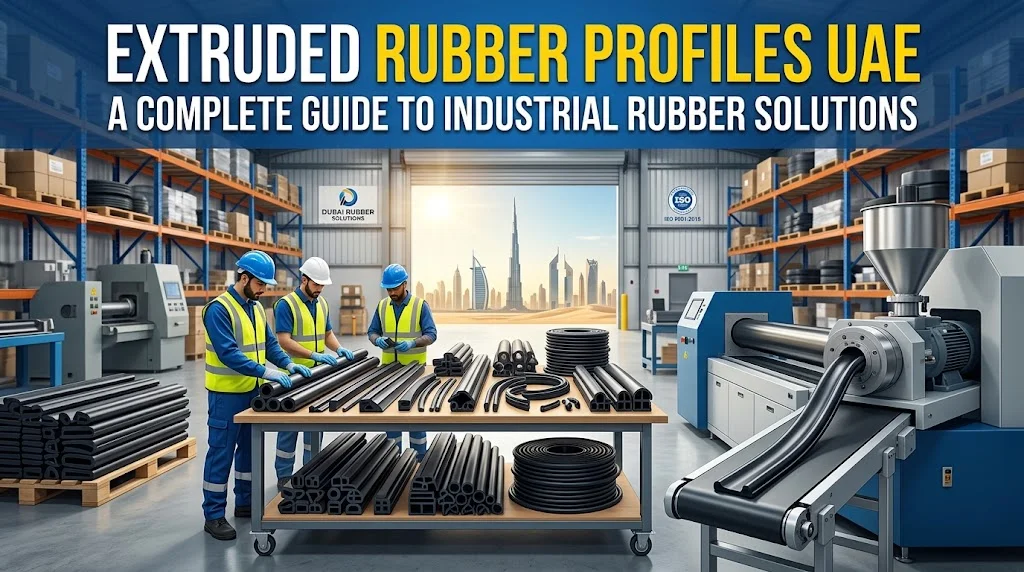
Extruded rubber profiles are widely used in industrial, commercial, construction, automotive, and manufacturing applications. These products are manufactured by pushing rubber compounds through specially designed dies to create continuous shapes with specific dimensions and cross-sectional designs. Depending on the material and profile, they can provide sealing, cushioning, edge protection, insulation, and finishing benefits.
Businesses searching for extruded rubber profiles UAE often require dependable products for machinery, industrial enclosures, doors, windows, panels, and specialised equipment. Selecting the right rubber profile is important because material quality, dimensional accuracy, and environmental resistance can affect product performance and service life.
The UAE’s industrial and construction sectors create demand for rubber components suited to different operating conditions. From commercial buildings in Dubai to industrial facilities in Abu Dhabi and Sharjah, suitable rubber profiles help manufacturers, contractors, and maintenance teams address a variety of installation requirements.
What Are Extruded Rubber Profiles?
Extruded rubber profiles are continuous rubber components produced in specific shapes using an extrusion process. During manufacturing, a rubber compound passes through a shaped die, creating a profile with the required cross-section. The material may then undergo curing or vulcanisation, depending on the manufacturing method and rubber compound.
Unlike moulded rubber components, which are typically produced as individual shaped parts, extruded profiles can be manufactured in continuous lengths and cut to the required size.
Common profile shapes include U-shaped channels, D-shaped seals, hollow sections, solid strips, rectangular profiles, and custom-designed cross-sections. Each shape serves a different purpose, depending on the installation and performance requirements.
These products are selected according to factors such as flexibility, hardness, temperature resistance, compression behaviour, and exposure to moisture, chemicals, or sunlight.
Why Choose Extruded Rubber Profiles in UAE?
Choosing appropriate rubber profiles can help businesses maintain consistent installation quality and meet specific operational requirements.
Suitable for Different Industrial Applications
Extruded rubber profiles are available in various shapes and materials, making them suitable for a broad range of applications. Depending on their design, they may be used for sealing equipment enclosures, cushioning moving components, protecting edges, and reducing the passage of air or water through compatible joints.
Businesses should select profiles according to their actual application rather than relying on appearance alone.
Resistance to Environmental Conditions
The UAE experiences high temperatures, strong sunlight, and humid conditions in many coastal areas. These factors can affect rubber materials over time.
Certain compounds, such as EPDM, are commonly selected for outdoor weather resistance, while silicone may be suitable for applications requiring a wider operating temperature range. The correct choice depends on the manufacturer’s specifications and the conditions in which the product will operate.
Consistent Dimensions and Performance
Accurate profile dimensions are important for proper fitting and sealing. Variations in cross-sectional shape, thickness, or hardness can affect compression and installation.
Working with a supplier that can provide relevant technical information helps procurement teams confirm whether a profile meets their requirements.
Customisation for Specific Requirements
Some applications require specialised shapes or dimensions that are not available as standard products. Custom extruded rubber profiles may be produced according to technical drawings, samples, or approved specifications.
Before ordering custom products, buyers should confirm production quantities, tooling requirements, sample approval procedures, and manufacturing lead times.
Common Types of Extruded Rubber Profiles
Different rubber compounds offer different properties. Understanding the available options helps businesses select a profile that matches the intended environment.
1. EPDM Rubber Profiles
EPDM, or ethylene propylene diene monomer, is commonly used in outdoor sealing and weatherproofing applications. It offers good resistance to weathering, ozone, and sunlight, making it suitable for many building and industrial installations.
EPDM profiles are often used in window and door systems, external enclosures, weather seals, and selected automotive applications.
However, EPDM is generally not the preferred choice for applications involving substantial exposure to petroleum-based oils or fuels. Buyers should check chemical compatibility before selecting this material.
2. Silicone Rubber Profiles
Silicone rubber profiles are valued for their flexibility and ability to perform across a broad temperature range, depending on the specific grade.
They may be used in industrial equipment, specialised enclosures, food-processing environments, and applications requiring particular thermal properties.
Where hygiene or food-contact requirements apply, the selected product must have the appropriate documentation and compliance for the intended use. Standard silicone rubber should not automatically be assumed to meet every regulatory requirement.
3. Neoprene Rubber Profiles
Neoprene, also known as chloroprene rubber, is used in a variety of industrial sealing, cushioning, and protective applications. Depending on its formulation, it can provide a useful balance of flexibility, weather resistance, and resistance to selected oils and chemicals.
Neoprene profiles may be suitable for equipment housings, industrial panels, and other assemblies requiring a resilient rubber component.
The precise performance characteristics depend on the compound, so technical specifications should be reviewed before purchase.
4. Nitrile Rubber Profiles
Nitrile rubber, commonly known as NBR, is frequently used where resistance to oils and petroleum-based fluids is important.
NBR profiles may be suitable for selected industrial machinery, equipment seals, and applications involving compatible lubricants. However, resistance varies according to the compound and the specific fluid involved.
For installations exposed to high temperatures, outdoor sunlight, or specialised chemicals, buyers should confirm that the selected grade is suitable.
5. PVC and Thermoplastic Profiles
Some suppliers also offer extruded profiles made from PVC or thermoplastic elastomers. Although these products may serve similar purposes to rubber profiles, their material properties differ.
They can be used in selected glazing systems, edge trims, protective channels, and finishing applications. Buyers should confirm the material composition because a thermoplastic profile is not necessarily interchangeable with a rubber profile.
Applications of Extruded Rubber Profiles
Extruded rubber profiles support a variety of industrial and commercial applications throughout the UAE.
Construction and Building Systems
Building projects frequently require sealing products for doors, windows, glazing systems, partitions, and external enclosures. Suitable profiles can help reduce unwanted air and water infiltration when correctly designed and installed.
The appropriate product depends on the frame design, joint dimensions, expected movement, and exposure conditions.
Automotive and Transportation
Vehicles and transportation equipment may use rubber profiles around doors, windows, access panels, and body components. These profiles can help reduce vibration, limit water ingress, and protect adjoining surfaces.
Automotive applications often require precise dimensions and compounds designed for the relevant temperature, weather, and operational conditions.
Industrial Machinery and Equipment
Manufacturing facilities use rubber profiles in equipment covers, machine enclosures, access doors, and selected sealing assemblies. A suitable profile can provide cushioning, protect contact surfaces, or help prevent contaminants from entering an enclosure.
Where machinery involves moving parts or elevated operating temperatures, the profile must be compatible with the equipment’s design and operating conditions.
Electrical Cabinets and Control Panels
Electrical cabinets and control panels may require rubber gaskets or sealing profiles to help protect internal components from dust and moisture.
The enclosure’s required protection level depends on its complete design, including the cabinet, joints, fasteners, and selected seal. A rubber profile alone does not guarantee a particular ingress protection rating.
Marine and Coastal Applications
Marine and coastal environments can expose materials to humidity, salt, sunlight, and changing temperatures. Appropriate rubber profiles may be used for sealing and cushioning in compatible equipment and enclosures.
Material selection should account for the specific exposure conditions and any relevant marine or industry requirements.
Furniture and Interior Finishing
Rubber and thermoplastic profiles are also used in furniture, cabinetry, display systems, and interior fittings. Depending on their shape, they may provide edge protection, cushioning, or a neat finished appearance.
The profile dimensions and installation method should be matched to the furniture or panel design.
How to Select the Right Extruded Rubber Profile
Choosing the correct product involves evaluating the installation requirements and the characteristics of the material.
Identify the Application
Start by determining whether the profile is required for sealing, cushioning, edge protection, vibration reduction, or finishing. Different functions require different profile shapes and material properties.
Providing the supplier with a clear description of the application can make product selection more accurate.
Check Material Compatibility
Consider exposure to sunlight, moisture, oils, chemicals, cleaning agents, and temperature changes. EPDM, silicone, neoprene, and nitrile rubber each have different strengths and limitations.
Ask for a technical datasheet when the application has specific performance requirements.
Confirm Dimensions and Hardness
Profile dimensions should match the installation space. Important measurements include width, height, wall thickness, internal opening, and overall cross-sectional shape.
Rubber hardness, often expressed using the Shore A scale, also affects flexibility and compression behaviour. A profile that is too hard may not seal properly, while an unsuitable soft profile may deform excessively.
Evaluate Temperature Requirements
The operating temperature range should be checked against the selected material’s technical specifications. Consider both continuous operating temperatures and short periods of temperature extremes.
Environmental conditions in the UAE can make this especially important for outdoor equipment and installations exposed to direct sunlight.
Consider the Installation Method
Some profiles fit into channels, while others are secured using adhesive, mechanical fixing, compression, or a dedicated mounting arrangement.
Confirm that the profile design is compatible with the installation method and that the surrounding surfaces are suitable for the intended use.
Review Quality Documentation
Depending on the application, useful documentation may include technical datasheets, material specifications, dimensional tolerances, batch identification, and relevant compliance certificates.
For specialised or safety-critical applications, confirm any required industry standards before approving the product.
Finding a Reliable Extruded Rubber Profiles Supplier in UAE
When comparing suppliers, businesses should consider more than the initial quotation. Product suitability, availability, material consistency, technical support, and delivery arrangements can all influence the overall purchasing decision.
A supplier offering multiple rubber compounds, standard profile shapes, and custom manufacturing options may be useful for businesses with varied requirements. However, the available materials, manufacturing capabilities, and delivery coverage should always be confirmed directly.
Industrial buyers in Dubai, Abu Dhabi, Sharjah, and other UAE locations should ask about stock availability, minimum order quantities, sample provision, and delivery schedules.
For repeat orders, maintaining approved drawings and material specifications can help ensure consistency between purchases. Where a profile is being replaced, supplying a physical sample or accurate cross-sectional drawing can reduce the risk of ordering an incompatible product.
Businesses should also compare quotations on an equivalent basis. Two profiles may have similar shapes but differ in compound, hardness, dimensions, and expected performance.
Benefits of Using Quality Extruded Rubber Profiles
Selecting an appropriate rubber profile can provide several practical benefits.
- Effective sealing: Suitable profiles can help limit the passage of air, dust, and water through compatible joints.
- Surface protection: Rubber profiles can help protect vulnerable edges and adjoining components from contact damage.
- Vibration reduction: Certain profiles can provide cushioning and help reduce vibration transmission in suitable assemblies.
- Flexible design options: Different shapes, compounds, and dimensions support a wide range of applications.
- Simplified installation: Profiles supplied in appropriate lengths and dimensions can help reduce unnecessary cutting and fitting work.
- Maintenance support: Replacing worn or damaged profiles with compatible products can help maintain the intended performance of equipment and enclosures.
These benefits depend on correct material selection, product quality, and installation. No single profile is suitable for every industrial environment.
Conclusion
Extruded rubber profiles are essential components in many construction, manufacturing, automotive, and industrial applications. Their ability to provide sealing, cushioning, edge protection, and finishing makes them useful across a wide range of projects.
For businesses searching for extruded rubber profiles UAE, the key is to identify the right material, confirm the required dimensions, and select a profile that matches the environmental and operational conditions.
Whether the requirement involves EPDM weather seals, silicone profiles, nitrile rubber components, or custom extruded shapes, reviewing technical specifications before ordering helps minimise compatibility issues and supports reliable installation.
By working with a suitable supplier and maintaining clear product specifications, UAE businesses can source extruded rubber profiles that meet their project requirements and provide dependable performance over their intended service life.