






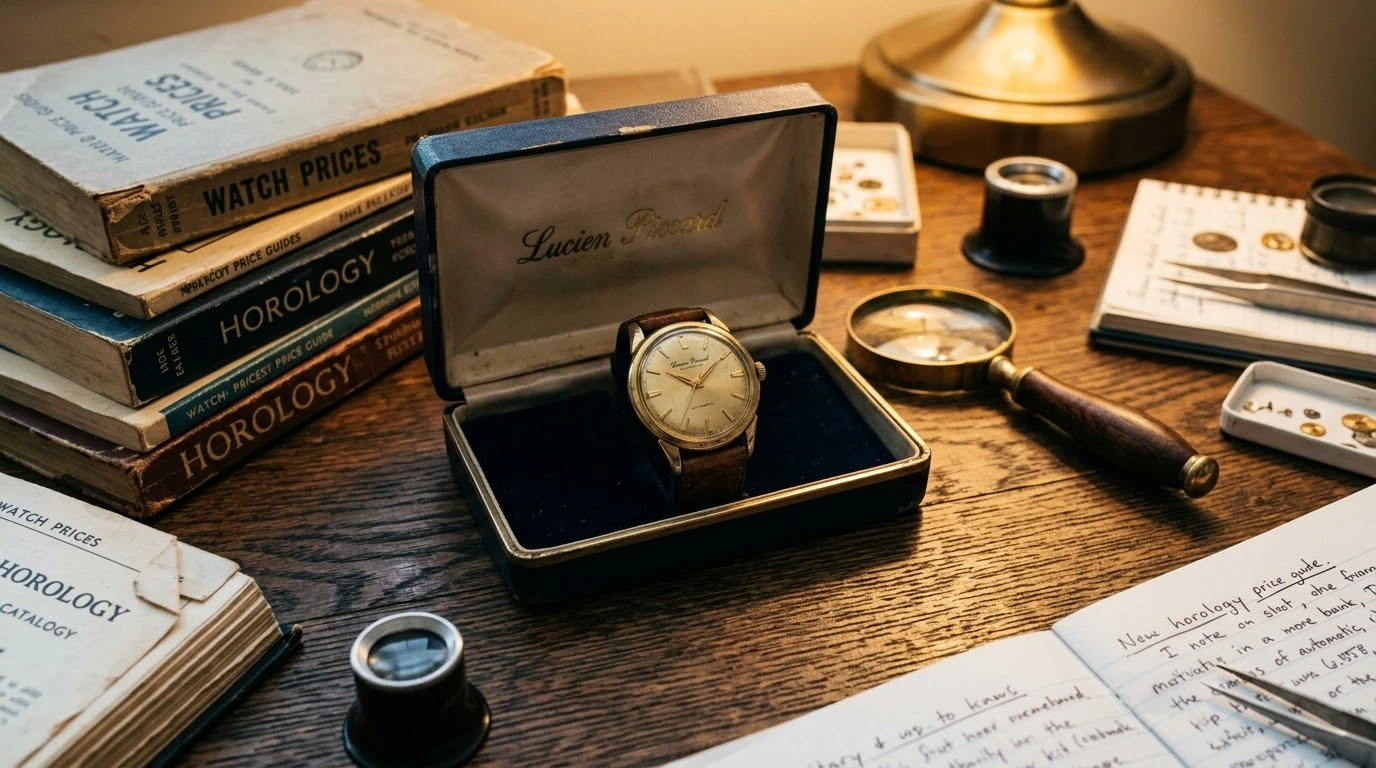
Say you turn up an old timepiece at an estate sale, sitting in a velvet box with the name “Lucien Piccard” on the dial. Before you move on, it’s worth a second look. That watch could be worth real money—or close to nothing—and the gap between those two outcomes comes down to a handful of very specific details. Knowing what actually drives the price of a Lucien Piccard watch in today’s resale market is the difference between making a smart call and walking away with the wrong one.
The Brand Behind the Name: A Century of Swiss Craftsmanship
Lucien Piccard traces its origins to Lausanne, Switzerland, where the brand was founded in 1923. When the workshop first opened its doors, every timepiece was exclusively handcrafted by Swiss artisans, and that heritage of craftsmanship defined the brand’s early reputation for decades.
Lucien Piccard was considered a designer watchmaker, and while it was once associated with expensive luxury pieces when it launched in 1923, over the years the brand shifted direction to offer finely crafted timepieces at more accessible price points. That shift matters when you’re trying to put a number on a piece, because not all Lucien Piccard watches are playing in the same league. The vintage models—especially those made before quartz movements took over—sit in a completely different category from what the brand produces today.
Back in the day, Lucien Piccard operated as a respected établisseur, assembling watches from available high-quality parts. Unlike the brand’s current gold-tone timepieces, their vintage gold watches still command serious sums on today’s market.
What Determines the Value of a Lucien Piccard Watch
The amount a Lucien Piccard timepiece may sell for varies based on several key factors: age, materials, style, condition, and rarity. These elements pull the price in different directions, and sometimes one factor alone can double or halve what a buyer will pay.
Materials: Where the Money Actually Is?
Case material is the biggest single variable in any valuation conversation. Lucien Piccard watches are generally not worth significant amounts unless they were made with 14k, 18k gold, or platinum and diamonds. A standard stainless-steel model from the 1970s or 1980s might sell for $30 to $150 on the secondary market. A solid gold example from that same decade can be worth several times that without breaking a sweat.
A 14k gold Lucien Piccard with an authentic mechanical movement has a fair market value in the range of $800 to $1,000, assuming it runs. For context, a heavy 14k gold case and bracelet from the early 1970s with a mechanical movement has been offered at retail for over $3,000, though retail prices typically run two to three times actual fair market value.
Movement Type: Mechanical vs. Quartz
A mechanical movement adds real weight to a vintage watch’s value, and Lucien Piccard’s early Swiss-made calibers are no exception. The Lucien Piccard Calibre 50, made with 17 jewels, is a notable example. The plates are marked “Lucien Piccard, Swiss, LP50” and are tied to the brand’s higher-quality production years. Quartz examples, which became the norm through and after the 1970s quartz crisis, hold much less appeal for serious collectors. That distinction alone can swing the price by hundreds of dollars on an otherwise similar piece.
Precious Stones and Decorative Elements
Gem-set models sit at the top of the value range by a wide margin. Recent sales data from 1stDibs shows vintage Lucien Piccard watches selling for anywhere from $320 for a 14k gold diamond-accented quartz model to $6,300 for a white gold, diamond, and pearl example from the 1950s. Art Deco-era pieces with platinum settings and meaningful diamond weight are the most collectible, and they sometimes reach five figures at auction, depending on condition and provenance.
Notable Models That Collectors Actually Want
Certain pieces draw consistent attention. The GTO Seashark 600 automatic from the 1970s, built on the motorsports-era aesthetic, has a real following among vintage sports-watch buyers. Art Deco cocktail watches from the 1920s through the 1940s—platinum cases, diamond accents, and a slim profile—represent the best of what the brand ever produced. Having the original box and documentation can meaningfully push the value of any Lucien Piccard piece higher.
The Dufonte subline is a different story. It was Lucien Piccard’s entry-level offering, and prices reflect that. A working Dufonte in stainless steel rarely clears $100. A gold-toned or gold-filled Dufonte with original packaging and tags might get to $200 or $300 in genuinely excellent condition, but not much more.
Where the Market Lives Today
The secondary market for vintage Lucien Piccard is active enough to be useful. eBay, 1stDibs, and Chrono24 all carry listings that stretch from cheap stainless-steel finds to serious gold and diamond pieces. Auction houses handle the premium examples, particularly Art Deco cocktail watches with substantial gemstone content.
For the most accurate read on what a specific piece is actually worth, a certified watch appraiser or a jeweler who specializes in vintage timepieces is the most reliable option. Online listings show asking prices, not market reality. An in-person appraisal accounts for gold weight, movement condition, and recent comparable sales—details that a photo on a marketplace simply cannot capture.
Is It Worth Buying as an Investment?
The vintage Lucien Piccard market occupies an interesting position. The brand is not prestigious enough to compete with Rolex or Patek Philippe, but the best pre-1970s Swiss-made mechanical pieces in solid gold or platinum hold genuine collector appeal and tend to move when priced right. Modern Lucien Piccard watches are largely commodity items and depreciate quickly once they leave the store.
The pieces with the most upside are pre-1970s Swiss mechanicals in solid gold or platinum cases, ideally with original paperwork and a service history that can be traced. Those are the ones collectors look for and the market rewards. Everything else is priced on feel, condition, and whatever the gold market happens to be doing that week.
Whether you found it at an estate sale or inherited it from a relative who had good taste, the right question is always the same: what is it made of, does it run, and do you have the box? Answer those three honestly and you will have a clear picture of what a Lucien Piccard watch is actually worth to the people buying them today.