






Key Takeaways
- Boost efficiency: Connecting telemedicine, EMR and billing removes duplicate data entry and gets clean claims out faster.
- Improve the patient experience: Upfront coverage checks and clear cost statements turn a good consultation into a good overall journey.
- Stay competitive: Providers that track claim and documentation KPIs will outperform those that only track consultation volume.
- Plan for regulation: Dubai’s updated telehealth standards and claims directive both took effect in November 2025.
- Use AI with oversight: AI can support coding, eligibility and denial prediction, but licensed professionals make the final call.
Picture a Dubai clinic running 40 video consultations a day. Patients are happy, doctors like the workflow, and consultation volume climbs every month. Then the finance team opens the claims queue. A missing diagnosis here, a lapsed policy there, a code that doesn’t match the documented procedure.
That gap between a good consultation and a paid claim is the real story of UAE telehealth heading into 2027.
Telemedicine has moved from convenience to core delivery. Providers have invested in virtual consultations, digital records, e-prescriptions and remote monitoring. Ask a telemedicine app development company in the UAE what clients request first, and you’ll hear about video quality, booking flows and Arabic and English interfaces. Far fewer ask what happens after the call ends.
That’s where revenue is won or lost. Incomplete notes, unverified coverage, coding errors and billing tools that never see the clinical record all surface weeks later as rejections and write-offs. Telemedicine app development in the UAE is only half the job. Telemedicine and healthcare revenue cycle management in the UAE need to run as one connected system. This article shows why, and what it takes.
The UAE Healthcare Technology Shift Heading into 2027
Government-Led Digital Healthcare Is Creating New Opportunities
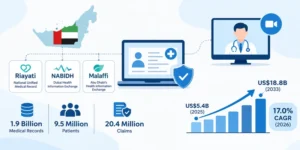
The UAE has spent years building shared digital infrastructure. Riayati, the National Unified Medical Record platform run under the Ministry of Health and Prevention (MoHAP), connects more than 3,000 healthcare facilities, including public and private hospitals, clinics, day care centres and diagnostic centres. It’s integrated with NABIDH, Dubai’s health information exchange, and Malaffi, Abu Dhabi’s.
When the three platforms announced their integration in January 2023, reporting put the figures at roughly 1.9 billion medical records for 9.5 million patients. Riayati also runs the e-Claims Post Office for the Northern Emirates, which MoHAP lists as handling 20.4 million claims across 26 insurers and third-party administrators.
For anyone building a virtual care platform, the message is clear. Interoperability isn’t a bonus feature. Patient data and claims data already move through national rails, and your platform either plugs into them or sits outside them.
Telemedicine Is Becoming Part of Routine Healthcare Operations
Virtual care is no longer a pandemic workaround. It handles specialist access, follow-ups and chronic disease management as part of hybrid delivery, where a patient might see the same doctor in person one month and on video the next.
Regulators have noticed. Dubai Health Authority (DHA) issued version 4 of its Standards for Telehealth Services on 26 September 2025, effective 26 November 2025. Separately, the Dubai Health Insurance Corporation’s Claims Management Policy Directive took effect on 16 November 2025. It requires claims to be submitted electronically through eClaimLink and sets a 141-day adjudication cycle.
Healthcare Providers Are Looking Beyond Consultation Volume
Consultation counts are easy to report and easy to inflate. They say little about whether a digital programme works. Smart operators now watch patient retention, continuity of care, reimbursement speed and cost to serve.
The money is following that shift. Grand View Research sizes the UAE healthcare IT market at about US$5.4 billion in 2025, forecasting growth to roughly US$18.8 billion by 2033 (17.0% CAGR from 2026). For healthcare software development in the UAE, demand is moving toward platforms that join clinical and financial workflows rather than serve one side.
The Hidden Revenue Problem: Why Telemedicine and RCM Cannot Operate Separately
Most telehealth revenue isn’t lost at the point of care. It leaks in the handoffs afterward. Four gaps show up again and again.
Virtual Consultations Without Complete Clinical Documentation
A video visit moves fast. The doctor discusses symptoms, reviews a lab result, adjusts a prescription and books a follow-up, all in fifteen minutes. If the platform doesn’t capture the diagnosis, treatment details and supporting information in a structured way, the coder inherits a thin note. Then begins the chase: queries to the clinician, days of delay, and sometimes a claim that goes out incomplete or never goes out at all.
The fix is architectural, not behavioural. Documentation fields tied to claim requirements should sit inside the consultation screen, so what the doctor records is what the payer needs to see. Reconstructing a visit from memory a week later is a workflow failure, not a doctor failure.
Insurance Eligibility and Authorization Problems
A patient books online, joins the call, and only afterward learns the policy excludes the service, has hit its limit, or needed prior authorization. Manual checks by phone or portal are slow and easy to skip when the front desk is busy. The result is a consultation delivered in good faith that the payer won’t cover, plus an awkward conversation about who pays.
Verifying coverage at booking, and again before the visit where it applies, moves the problem to a moment when it can still be solved.
Claim Rejections and Delayed Reimbursements
Rejections usually come from small, preventable things: a code that doesn’t match the documented service, a missing field, a format error, a payer rule nobody remembered. When telemedicine, the EMR and billing run as separate tools, staff retype the same encounter data into each one. Every retype is a chance for a mismatch.
Denial work then eats hours that should go to new claims. Revenue leakage stops being an exception and becomes a permanent line in the monthly report. Strong claim denial management in the UAE starts upstream, before the claim exists.
Poor Patient Payment Experiences
Patients judge a virtual visit by more than the video. If the invoice arrives late, the copay differs from what they expected, or three departments send three messages about one consultation, trust drops fast. Linking the consultation charge, insurance coverage and the patient’s share into one clear statement is as much a retention tool as a billing one.
Quick Question: “What is revenue leakage in healthcare?”— Revenue leakage is income a provider has earned but never collects, caused by unbilled services, coding errors, rejected claims that aren’t resubmitted, or missed patient payments. In telemedicine, it often starts with incomplete documentation or unverified insurance coverage.
What a 2027-Ready Telemedicine Platform Must Include
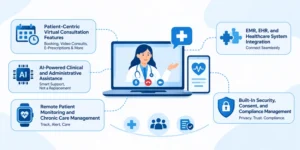
A 2027-ready platform has to do more than connect two people on video. The telemedicine solutions that will hold up are built around the whole patient-to-payment journey. Here’s what belongs in them.
Patient-Centric Virtual Consultation Features
The basics still matter, and they still get compromised when budgets tighten:
- Online appointment booking and rescheduling
- Secure video and audio consultations
- Digital registration and medical history
- E-prescriptions and digital treatment plans
- Arabic and English interfaces
- Appointment notifications and follow-up reminders
- Secure in-app patient messaging
AI-Powered Clinical and Administrative Assistance
AI earns its place in the quiet jobs: patient intake and symptom pre-screening, clinical documentation drafts, smarter scheduling and automated patient communication. Decision-support features can surface relevant information to the doctor during the visit.
One boundary shouldn’t blur. AI-generated suggestions support licensed professionals. They don’t replace their judgment, and the platform should make that review step visible and auditable.
Remote Patient Monitoring and Chronic Care Management
Remote patient monitoring turns one-off consultations into ongoing care. A strong remote patient monitoring app in the UAE connects to medical devices and wearables for blood pressure, glucose, heart rate and similar readings, then adds medication reminders, adherence tracking, automated alerts for abnormal values and nurse-led escalation workflows.
For finance teams, that matters too. Monitoring creates a stream of recurring interactions that need documenting, coding and billing correctly, which is why monitoring and RCM can’t be designed in isolation.
EMR, EHR, and Healthcare System Integration
A platform that doesn’t talk to the rest of the hospital creates more work than it saves. Look for integration with existing EMR and EHR systems, lab and pharmacy connectivity, insurance and claims systems, structured clinical data exchange and well-documented APIs. If you’re comparing options for telemedicine app development in Dubai or elsewhere in the UAE, ask vendors to demonstrate this live, not describe it in a slide.
Built-In Security, Consent, and Compliance Management
Healthcare data needs role-based access controls, encryption in transit and at rest, audit trails, and patient consent management that records who agreed to what and when. Data residency deserves early attention too, a point we’ll return to below. Any serious telemedicine software development in the UAE treats these as foundations, not add-ons.
Where Revenue Cycle Management Fits into the Telemedicine Workflow
Think of RCM as the financial twin of the clinical journey. Each step in care has a matching step in revenue.
Understanding the Complete Patient-to-Payment Journey
- Appointment booking: patient registration and consultation scheduling.
- Insurance eligibility verification: coverage, benefits and authorization requirements checked.
- Virtual consultation: the visit takes place and clinical information is captured.
- Clinical documentation and coding: records are completed and medical codes validated.
- Claim submission: claims prepared and sent through the right payer workflow.
- Denial management: errors identified, rejections investigated, resubmissions managed.
- Payment reconciliation: insurer payments and patient balances matched.
- Patient follow-up: outstanding balances and continuing care handled.
Break the chain at any link, and the downstream steps inherit the damage. A coverage miss at step two becomes a denial at step six.
How Integration Reduces Manual Administrative Work
When patient and encounter data flow between the telemedicine platform, the EMR and the RCM system, staff stop retyping. Automated claim checks catch missing fields before submission rather than after rejection. Centralised dashboards show finance leaders where claims are stuck, which payers reject most often and which clinics need documentation support.
That’s the practical test for any revenue cycle management software hospital finance teams shortlist: does it read encounter data directly from the virtual care platform, or does someone export a spreadsheet? If it’s the spreadsheet, the integration isn’t real.
Why Healthcare Providers Need UAE-Specific RCM Workflows
UAE claims don’t follow one national template. Dubai providers submit through DHA’s eClaimLink. Abu Dhabi providers work through the Department of Health’s Shafafiya platform, and Northern Emirates providers use the e-Claims Post Office on Riayati. Each has its own data standards, validation rules and payer expectations.
A provider operating across emirates needs reimbursement workflows configured by emirate, payer and facility, not a generic billing engine with a UAE flag stuck on it.
AI-Powered RCM: The Technology Differentiator for UAE Healthcare in 2027
AI revenue cycle management in the UAE matters because RCM is rule-heavy, repetitive and data-rich. That’s exactly where machine assistance helps most.
AI-Assisted Medical Coding and Documentation
AI can read clinical documentation, suggest relevant codes and flag missing details such as an unspecified diagnosis or an absent procedure note. Coders then review suggestions instead of starting from a blank screen. Human validation stays in the loop before anything is finalised or submitted.
Predictive Claim Denial Management
Past rejections hold patterns. AI can learn which payers reject which combinations, flag claims that resemble earlier failures and point to root causes, such as a specific clinic that keeps omitting one field. Fixing the source beats resubmitting the symptom.
Automated Eligibility and Prior Authorization
Automated workflows can verify coverage at booking, track authorization requests and notify staff of status changes. That cuts the repetitive portal-checking that eats front-desk hours.
AI-Based Financial Analytics and Payment Reconciliation
Forecasting, outstanding-claim monitoring, payment matching and discrepancy detection give finance teams a view they rarely get from manual reports. Underpayments and unreconciled remittances become visible while they’re still recoverable.
Why Human Oversight Still Matters
Healthcare reimbursement decisions carry clinical, legal and financial weight. Providers need AI that’s transparent and auditable, with clear data protection and governance rules. Disputed or complex cases should always reach a person with authority to decide.
Quick Question: “Will AI replace medical coders and billing teams?”— No. AI speeds up routine tasks like code suggestions and missing-information checks, but certified professionals still review, approve and handle disputes. The realistic outcome is smaller backlogs and fewer avoidable rejections, not unattended billing.
Interoperability and Compliance: Two Requirements Healthcare Providers Cannot Ignore
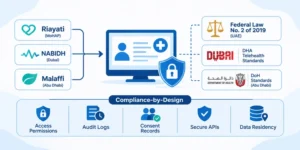
Why NABIDH, Malaffi, and Riayati Integration Matters
Health information exchanges exist so a patient’s history follows them from clinic to clinic. A cardiologist in Abu Dhabi seeing a patient first treated in Dubai shouldn’t have to repeat the tests. For NABIDH integration, Malaffi integration and Riayati connectivity, structured data exchange is what makes that possible, and it supports continuity of care across EMR, EHR, pharmacy, laboratory and RCM systems.
One honest caveat: these integrations require the right technical specifications, regulator approvals and access credentials. They’re not plug-and-play, and timelines should reflect that.
UAE Healthcare Data Protection and Telehealth Regulations
Federal Law No. 2 of 2019 on the use of ICT in health fields is the anchor. It applies across the UAE, including free zones, and requires health data to stay confidential and circulate only in authorised cases. Legal commentary on the law also highlights restrictions on storing or transferring health data outside the UAE unless authorised by the relevant authority, which makes hosting decisions a compliance question, not just an IT one.
Layered on top are emirate-level requirements, including DHA’s telehealth standards in Dubai and DoH standards in Abu Dhabi. Providers operating across emirates should get written guidance on which rules apply to their model rather than assume one licence covers everything.
Building Compliance into the Software Architecture
Compliance-by-design means access permissions, audit logs, consent records and secure APIs exist from the first sprint. Data residency and regulatory mapping happen before development begins. Retrofitting these after launch costs more and usually means rebuilding parts of the system.
Who Needs an Integrated Telemedicine and RCM Platform?
Hospitals and multi-specialty clinic chains. Consultations, documentation, billing and claims across several facilities, one shared view.
Telehealth startups and digital health businesses. A scalable platform that combines patient experience with operational and financial workflows from day one.
Insurance companies and TPAs. Better coordination of eligibility, authorization, claims and reimbursement data with the providers they work with.
Remote monitoring and chronic care providers. Recurring programmes with monitoring, follow-up, reporting and the right billing workflows behind them.
Employers and corporate healthcare providers. Connected virtual care and employee wellness management under one roof.
How SISGAIN Can Help Build Integrated Telemedicine and RCM Platforms
Choosing a healthcare IT company is as much about process as technology. The right partner starts with your workflows, payers and regulatory position, and then designs the software around them.
SISGAIN, an IT software development company founded in 2009, helps healthcare organisations build customised digital solutions that connect patient-facing applications with clinical, administrative and financial workflows.
Custom telemedicine app development for UAE healthcare. Patient apps, doctor portals, admin dashboards and virtual consultation workflows, with Arabic and English interfaces and integration into existing healthcare systems.
Integrated RCM and AI-powered workflows. Connected billing, claims, eligibility and denial management, plus AI-assisted documentation, coding support and financial analytics, working alongside your current systems.
Scalable, compliance-aware architecture. Secure APIs, access management, audit trails and data protection designed around your operations and the UAE requirements that apply to you.
If you’re weighing a new build or an upgrade, SISGAIN’s team can walk through your telemedicine and RCM requirements with you.

A Practical 2027 Roadmap for Healthcare Providers Planning Integration
Step 1: Audit existing workflows. List every system a consultation touches, from booking to payment. Mark manual handoffs, documentation gaps and spreadsheet workarounds.
Step 2: Identify revenue leakage points. Review eligibility failures, coding errors, claim rejections, delayed payments and outstanding balances. Quantify them before you pitch a budget.
Step 3: Plan EMR, EHR and RCM integration. Map infrastructure, data flows, APIs, payer connectivity and interoperability needs, including NABIDH, Malaffi or Riayati where relevant.
Step 4: Introduce AI and remote monitoring gradually. Start with use cases that have measurable value, such as coding suggestions or eligibility checks, and keep human review in place.
Step 5: Measure performance. Track these KPIs:
- First-pass claim acceptance rate
- Claim denial rate
- Days in accounts receivable (A/R)
- Clean-claim rate
- Consultation-to-claim conversion rate
- Patient collection rate
- Documentation completion rate
Capture baselines before implementation. Without a “before,” the “after” proves nothing.
Conclusion
Telemedicine and revenue cycle management can’t stay in separate boxes. Virtual care that ignores billing leaks revenue, and billing that ignores the clinical record creates rework. AI, remote monitoring, interoperability and compliance only deliver value when they sit on a connected foundation.
So judge digital platforms on clinical continuity and financial performance together.
The winning UAE healthcare platforms in 2027 will not choose between telemedicine and revenue cycle management. They will connect both to create a healthcare ecosystem that delivers better patient experiences, stronger operational efficiency, and more predictable revenue.
Frequently Asked Questions
What is the difference between telemedicine and revenue cycle management?
Telemedicine delivers virtual consultations, while revenue cycle management handles everything financial around them, from eligibility checks and coding to claims, denials and payments. Together, they connect patient care with reimbursement.
Why should UAE healthcare providers integrate telemedicine with RCM?
Integration removes duplicate data entry, catches missing documentation before submission, and verifies coverage early. That means fewer rejected claims, faster reimbursement and less revenue leakage from virtual consultations across clinics.
Which UAE regulations affect telemedicine platforms?
Federal Law No. 2 of 2019 governs health data confidentiality and storage. Dubai providers must also follow DHA’s Telehealth Standards version 4, while Abu Dhabi providers follow Department of Health requirements.
How are health insurance claims submitted in the UAE?
Dubai providers submit claims electronically through DHA’s eClaimLink, Abu Dhabi providers use the Department of Health’s Shafafiya platform, and Northern Emirates providers use the e-Claims Post Office on Riayati.
Can AI handle medical coding and claims on its own?
No. AI can suggest codes, flag missing information and predict likely denials, but certified professionals must review and approve final coding and submissions, especially for complex or disputed claims.
Which KPIs should providers track after integrating telemedicine and RCM?
Track first-pass claim acceptance, denial rate, days in accounts receivable, clean-claim rate, patient collection rate and documentation completion. Record baselines before launch so post-implementation improvements are measurable and credible.