






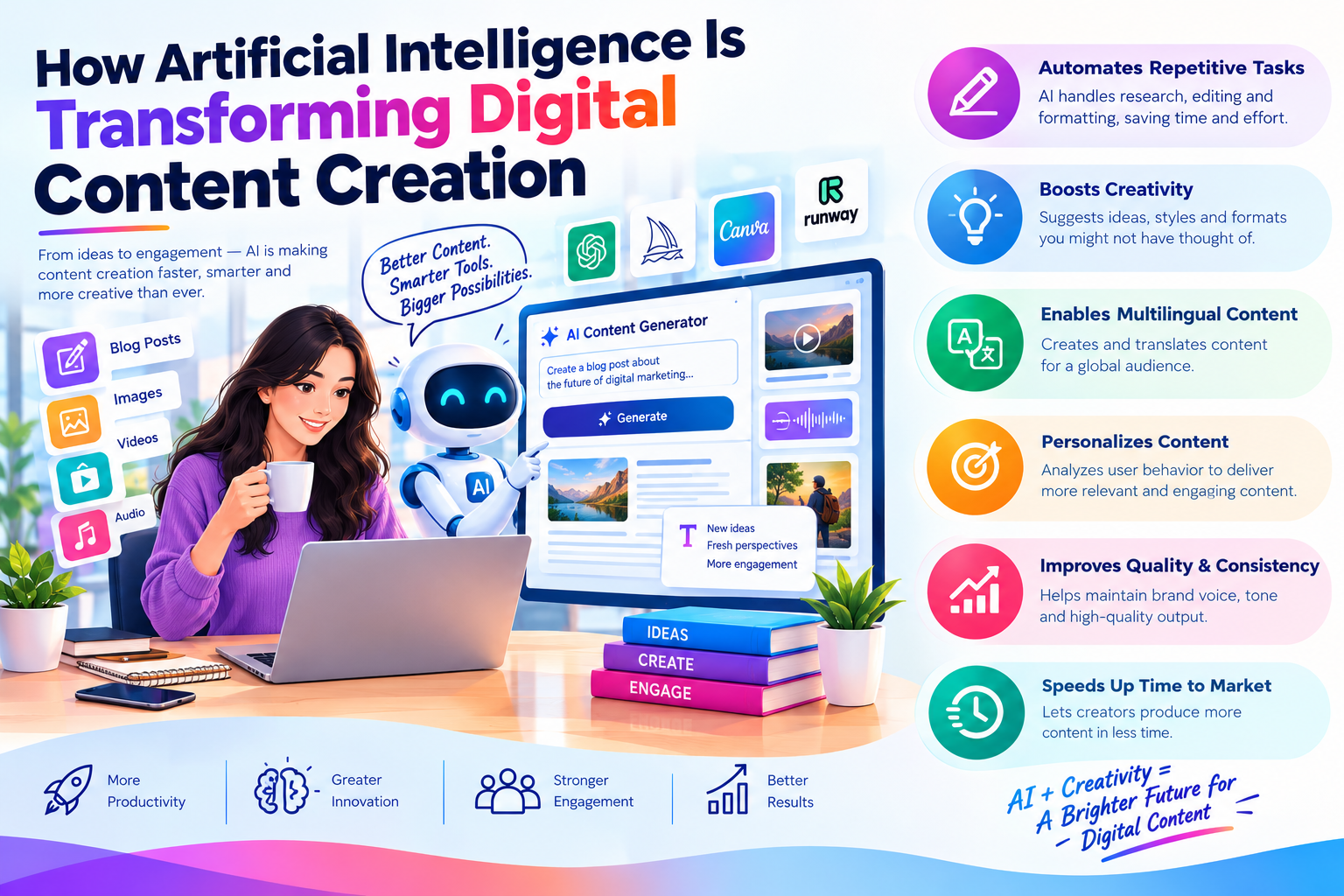
Digital content has become one of the most important ways businesses communicate with their audiences. From blog posts and social media updates to videos, podcasts, newsletters, and interactive experiences, content helps brands share information, build relationships, and establish their presence in an increasingly competitive online environment.
However, creating content that consistently attracts attention is not as simple as publishing a few articles or uploading occasional social media posts. Audiences expect useful information, engaging storytelling, original ideas, visual appeal, and content that addresses their specific needs. At the same time, businesses must maintain a consistent publishing schedule, respond to changing trends, and measure whether their efforts are producing meaningful results.
These growing demands have made artificial intelligence an important part of the digital content creation process.
Artificial intelligence, commonly known as AI, is changing how creators research topics, develop ideas, write articles, design visuals, edit videos, produce audio, and understand audience preferences. Tasks that once required several tools and hours of manual work can now be completed more efficiently with AI-assisted workflows.
For example, a content marketer can use AI to identify potential article topics, organize research, develop an outline, improve a draft, and prepare social media variations from a single piece of content. A video creator can generate captions, remove background noise, experiment with editing styles, and produce different versions of a video for various platforms.
Yet the transformation goes far beyond speed. AI is also changing how creative decisions are made, how content is personalized, how teams collaborate, and how businesses measure the effectiveness of their communication.
This does not mean human creativity is becoming unnecessary. In many cases, the strongest results come from combining AI’s ability to process information and automate repetitive tasks with human judgment, experience, imagination, and emotional understanding.
Businesses that understand this relationship can build more efficient content strategies without losing the originality and authenticity that audiences value.
In this comprehensive guide, we will explore how artificial intelligence is transforming digital content creation, the technologies driving this change, its applications across different formats and industries, the benefits and challenges involved, and the practical steps creators and businesses can take to use AI responsibly.
1. Understanding Artificial Intelligence in Digital Content Creation
Artificial intelligence refers to computer systems designed to perform tasks that traditionally require human intelligence. These tasks can include recognizing patterns, interpreting language, analyzing information, generating text and images, and making predictions based on available data.
Within digital content creation, AI serves several different purposes. It can help creators discover opportunities, organize information, generate creative material, improve existing content, and evaluate audience responses. For example, tools such as Genspark AI can support research and information gathering, helping content creators explore topics, organize relevant insights, and develop ideas for more informative and engaging digital content. Some AI tools focus on a particular task, such as spelling correction, image enhancement, or speech recognition. Others combine multiple capabilities in a single platform, allowing users to work with text, images, audio, and video.
Within digital content creation, AI serves several different purposes. It can help creators discover opportunities, organize information, generate creative material, improve existing content, and evaluate audience responses.
Some AI tools focus on a particular task, such as spelling correction, image enhancement, or speech recognition. Others combine multiple capabilities in a single platform, allowing users to work with text, images, audio, and video.
Generative AI has become especially influential because it can create new material in response to instructions. Depending on the tool, users can generate an article draft, develop a visual concept, summarize a document, create a voice-over, or produce a video from a written description.
However, AI-generated content is not created in the same way humans create content. Generative systems learn statistical patterns from training data and use those patterns to produce outputs. Their results may sound convincing without necessarily being accurate, original in every meaningful sense, or appropriate for a particular audience.
Understanding this distinction is important.
AI can generate a first draft of a blog post, but it may not understand the business experience behind a real customer success story. It can suggest social media captions, but it cannot automatically determine which message best represents a company’s values. It can summarize research, but it may misinterpret a finding or overlook an important limitation.
For this reason, AI is most effective when it supports a clearly defined creative process rather than operating without direction.
A successful content workflow typically combines several activities:
- Human planning to establish goals, audience needs, and editorial direction.
- AI-assisted research and ideation to explore topics and possible approaches.
- Human evaluation to verify information and select promising ideas.
- AI-supported production to accelerate drafting, editing, and asset creation.
- Human review to improve originality, accuracy, tone, and relevance.
- Performance analysis to understand results and refine future content.
This combination allows creators to benefit from automation while maintaining responsibility for the final material.
2. The Evolution of Digital Content Creation
Digital content creation has changed significantly over the past two decades.
In the early stages of online publishing, creating professional content often required specialized technical knowledge. Building a website, editing photographs, producing videos, and distributing content could involve expensive software and dedicated teams.
Content management systems, social media platforms, cloud-based design tools, and accessible video editors gradually lowered these barriers. More individuals and smaller businesses gained the ability to publish content without maintaining a large production department.
AI represents another major stage in this evolution.
Instead of simply providing tools for publishing and editing, modern AI systems can assist with the intellectual and creative tasks involved in producing content.
A small business owner can use AI to brainstorm a month of social media topics. A teacher can develop learning materials for different skill levels. A marketing team can turn customer feedback into a list of potential article topics. A video producer can generate captions and create rough cuts more efficiently.
This change makes certain forms of content production accessible to people who may not have advanced technical skills.
Nevertheless, easier production does not automatically result in better content. When many creators have access to similar tools, publishing more material becomes less of a competitive advantage. Quality, originality, expertise, and audience understanding become even more important.
The central question is no longer simply how quickly someone can produce content. It is whether that content provides something worth reading, watching, listening to, or sharing.
AI is changing the production process, but the responsibility to create meaningful work remains with the people using it.
3. How Generative AI Is Changing Content Production
Generative AI has become one of the most visible developments in digital content creation because it can produce different types of material from natural-language instructions.
A creator can describe an intended outcome, provide context, and ask an AI system to generate a starting point. The result may be a written draft, a set of headlines, a visual concept, a video script, or a collection of alternative creative approaches.
This can significantly change the way projects begin.
Traditionally, a writer might spend considerable time staring at a blank page before finding a suitable introduction. With AI assistance, the writer can explore several possible openings, compare their strengths, and develop the most promising direction.
A designer might generate several visual concepts before deciding which one deserves detailed refinement. A marketing team could test different messaging approaches before investing in a full campaign.
Generative AI can also help creators adapt one central idea into different formats. A detailed report might become a blog article, a short newsletter, a presentation outline, and several social media posts.
However, each format has its own requirements. A social media caption should not simply be a shortened article paragraph, and a video script should not read like a formal report.
Human editing remains necessary to make each version suitable for its intended purpose.
Another consideration is factual reliability. AI-generated material can contain fabricated details, misleading statements, or unsupported conclusions. This is especially important when creating educational, financial, legal, scientific, or health-related content.
Creators should therefore treat generated material as a draft or creative suggestion rather than an unquestionable source of truth.
The greatest value of generative AI lies in expanding creative possibilities and reducing repetitive work, while leaving final decisions in the hands of people who understand the subject and the audience.
4. AI-Powered Writing and Blog Content Creation
Writing is one of the areas where AI has had a substantial influence on everyday content workflows.
Bloggers, copywriters, journalists, business owners, and content marketers often need to produce material regularly while maintaining a consistent voice and level of quality. AI writing assistants can support several stages of this process.
Topic discovery and brainstorming
Finding fresh topics can be difficult, particularly when a business has already published dozens or hundreds of articles.
AI can help explore related questions, identify different audience perspectives, suggest content categories, and generate alternative angles for familiar subjects.
For example, a company that publishes content about personal finance might explore budgeting for freelancers, managing irregular income, planning emergency savings, and understanding common subscription expenses.
The ideas provide a starting point, but the creator still needs to assess their usefulness, originality, and relevance.
Creating outlines and first drafts
An effective article usually requires a logical structure. AI can help organize a topic into sections, suggest headings, and identify questions that an article should address.
A writer can then use the outline to develop a draft more quickly.
This is particularly useful for complex topics that involve several related concepts. Instead of organizing every section manually, the writer can evaluate an initial structure and spend more time improving the explanation.
However, a generic outline can produce a generic article. Strong content needs a distinctive perspective, specific examples, and a clear reason for the reader to continue.
Improving clarity and readability
AI tools can identify unnecessarily complicated sentences, suggest simpler wording, correct grammatical errors, and improve transitions between paragraphs.
They can also help writers adapt explanations for different audiences. A technical explanation intended for experienced developers may need a different style from an introduction written for beginners.
The writer should ensure that simplification does not remove essential details or introduce inaccuracies.
Repurposing existing material
AI can help transform a webinar transcript into an article outline, summarize a long report, or develop social media posts based on a published guide.
This allows businesses to make better use of material they have already invested time and money in creating.
The resulting content should still be adapted to the needs of each platform rather than copied mechanically.
Ultimately, AI writing tools are most valuable when they help writers spend less time on routine drafting and more time on research, storytelling, original insights, and editorial judgment.
5. Transforming Content Research and Information Gathering
Research is an essential part of producing credible digital content. Before writing a detailed article, creators may need to review industry reports, compare competing viewpoints, examine customer questions, and understand recent developments.
AI can make this process more manageable by helping organize large amounts of information.
For instance, a content strategist researching sustainable packaging could use AI tools to categorize research notes into material innovation, manufacturing challenges, recycling systems, consumer preferences, and regulatory considerations.
A business analyst might summarize lengthy documents to identify relevant sections for closer examination. A journalist could use transcription and text analysis tools to search interview material for recurring themes.
AI can also help generate questions that deserve further investigation. If an initial research document focuses mainly on benefits, a tool might suggest examining limitations, implementation costs, environmental trade-offs, or alternative explanations.
This can help creators approach topics more comprehensively.
However, research assistance introduces an important risk: confusing a summary with verified evidence.
AI-generated summaries may omit context, misinterpret technical language, or attribute statements incorrectly. Some systems can produce references that appear credible but do not support the claims being made.
Creators should verify important claims against original sources, check publication dates, confirm statistics, and distinguish established findings from opinions or forecasts.
When a topic involves current events, changing regulations, market conditions, or recent scientific developments, up-to-date primary sources are particularly important.
A reliable research process uses AI to improve navigation and organization, not to replace source verification.
This distinction helps businesses produce content that is not only faster to prepare but also more dependable.
6. AI and Search Engine Optimization
Search engine optimization, or SEO, helps people discover useful content through search engines. AI is changing how marketers research keywords, organize articles, improve content quality, and understand search intent.
One practical application is keyword and topic analysis. AI-assisted tools can help group related search terms into topic clusters, identify recurring questions, and suggest supporting articles around a central subject.
For example, a business covering home energy efficiency might organize content around insulation, energy consumption, heating systems, smart thermostats, and household energy savings.
This structure can help editors plan a more complete collection of resources rather than publishing disconnected articles.
AI can also assist with title variations, meta descriptions, content outlines, internal linking suggestions, and readability improvements.
Another useful application is search intent analysis. A query might indicate that someone wants a definition, a comparison, a practical tutorial, or a product recommendation. Understanding this intent helps writers create content that answers the actual question.
Nevertheless, using AI for SEO does not mean generating large quantities of similar articles and expecting strong search performance.
Search visibility depends on many factors, including relevance, usefulness, technical accessibility, competition, authority, and the overall quality of the experience. Search engines can change their systems, and no tool can guarantee a particular ranking.
Content creators should also consider how search behavior is evolving. People increasingly discover information through conversational interfaces, video platforms, community discussions, and AI-powered search experiences.
In this environment, trustworthy explanations, original research, first-hand experience, and clear answers can help content stand out.
AI should support the creation of genuinely useful material rather than encourage keyword repetition or mass production without editorial value.
7. Revolutionizing Graphic Design and Visual Content
Visual communication plays a central role in digital marketing. Images, illustrations, diagrams, product mockups, and social media graphics can make complex information easier to understand and help audiences recognize a brand.
AI-powered design tools are making it easier to explore visual ideas and create initial assets.
A marketer can describe a campaign concept and generate several reference images. A designer can experiment with color combinations, layouts, backgrounds, or artistic directions. An online retailer may use AI-assisted image editing to prepare product photographs for different formats.
AI can also support background removal, image enhancement, object recognition, resizing, and certain forms of image restoration.
These capabilities can reduce time spent on repetitive editing tasks, especially when a campaign requires many visual variations.
For example, a small business launching a seasonal product might need website banners, email graphics, social media posts, and promotional images. AI-assisted workflows can help create initial concepts and adapt approved assets to different dimensions.
However, AI-generated visuals require careful review.
Images may contain distorted objects, inaccurate details, inconsistent branding, or text that is difficult to read. Generated representations of people can also introduce ethical concerns when they are presented as genuine photographs or testimonials.
Copyright, licensing, training-data questions, and commercial usage rights may vary by tool and jurisdiction. Businesses should review the applicable terms before using generated material in commercial campaigns.
AI should also support rather than eliminate design strategy. Understanding contrast, hierarchy, accessibility, brand identity, and audience expectations remains essential.
The most effective workflow combines AI’s ability to generate options with human design expertise to select, refine, and validate the final visual.
8. Changing Video Production and Editing
Video has become a major format for education, entertainment, product demonstrations, advertising, and brand communication. However, producing quality video can involve scripting, recording, editing, sound correction, captioning, and distribution.
AI is helping simplify several of these activities.
Script development
AI can assist creators in organizing ideas into video scripts, writing alternative introductions, developing explanations, and suggesting transitions between scenes.
A creator making a product tutorial might use AI to structure the video around the problem, the solution, a demonstration, common mistakes, and a final summary.
The creator should still ensure that the script sounds natural when spoken and accurately reflects the product.
Automated editing
Some video tools can detect pauses, identify speech, generate rough cuts, and help creators organize footage. Other systems can suggest highlights from longer recordings.
This can be especially useful for podcasts, interviews, webinars, and educational videos that need to be converted into shorter clips.
Captions and translation
Speech recognition can automatically generate subtitles and transcripts. Translation tools can then help prepare versions in additional languages.
These features can make video content more accessible and expand its potential audience.
However, automated captions may misinterpret names, accents, technical terms, and background speech. Important videos should receive a proofreading pass.
Visual effects and synthetic media
AI can support background generation, object removal, visual enhancement, and other editing tasks. Some tools can generate video sequences from text or image inputs.
These capabilities are expanding creative possibilities, but synthetic media should be handled responsibly. Realistic depictions of people, events, or products should not mislead audiences about what actually occurred.
AI can reduce certain production barriers, but compelling video still depends on a strong concept, good storytelling, effective pacing, and a clear understanding of the viewer.
9. Transforming Audio Production and Podcasting
Audio content has become an important channel for education, storytelling, interviews, entertainment, and professional communication.
AI is making podcasting and audio production more accessible by assisting with tasks that previously required specialized software or substantial manual editing.
Speech-to-text technology can turn recordings into searchable transcripts. AI-assisted audio tools can help reduce background noise, identify long pauses, improve vocal clarity, and organize recorded material.
A podcast creator can use a transcript to identify useful excerpts, prepare episode summaries, generate show notes, and develop promotional content.
For example, a forty-minute interview could become a searchable transcript, a detailed article, several short video clips, and a newsletter summarizing the main discussion.
This creates more opportunities to reuse valuable conversations without recording entirely new material for every platform.
AI voice generation also allows creators to produce synthetic narration for certain applications, including demonstrations, educational content, and accessibility features.
However, synthetic voices should not be used to impersonate real people without appropriate authorization. Businesses should also consider disclosure requirements and the expectations of their audience.
Voice cloning presents additional risks because a person’s voice can be imitated in ways that enable deception or fraud.
The best use of AI in audio production is to remove unnecessary technical friction while protecting authenticity, consent, and the integrity of the original message.
10. Personalizing Content for Different Audiences
One message rarely works equally well for every audience.
A first-time visitor may need a simple introduction, while an experienced customer may prefer advanced information. A small business owner might focus on affordability, whereas an enterprise buyer may prioritize integration, reliability, and security.
AI can help businesses adapt content to these different needs.
Using appropriate audience information and clearly defined rules, content systems can recommend relevant articles, adjust the order of information, suggest suitable product resources, or tailor messaging to a customer’s stage in the buying journey.
An online learning platform, for example, could recommend beginner resources to a new learner and more challenging material to someone who has already mastered the fundamentals.
A software company might display onboarding guidance based on the features a customer has selected. An e-commerce website could suggest useful buying guides based on a product category rather than presenting the same promotional material to everyone.
Personalization can also extend to language, reading complexity, and accessibility preferences.
However, responsible personalization requires boundaries. Businesses should avoid inferring sensitive personal characteristics unnecessarily or using behavioral information in ways users would reasonably find intrusive.
They should also avoid creating overly narrow content experiences that repeatedly show people only what they have already engaged with.
Good personalization helps users discover relevant information while leaving room for exploration and choice.
Conclusion
Artificial intelligence is transforming digital content creation by changing how people research ideas, write articles, design visuals, produce videos, develop audio, personalize communication, and evaluate audience behavior.
It allows creators to explore ideas faster, automate selected repetitive tasks, adapt content for different channels, and identify opportunities through data analysis. For businesses, these capabilities can improve operational efficiency and make certain forms of professional content production more accessible.
However, the availability of AI tools does not guarantee better results.
Content can still be inaccurate, repetitive, misleading, inaccessible, or disconnected from the needs of its intended audience. Privacy concerns, copyright questions, biased outputs, and unpredictable generation costs also require careful attention.
The businesses most likely to benefit are those that combine technological capability with clear editorial standards and an understanding of their audiences.
They use AI to accelerate research without abandoning verification, improve writing without losing their brand voice, automate repetitive work without removing accountability, and personalize experiences without compromising user trust.
They also recognize that meaningful content depends on more than production speed. It requires a clear purpose, credible information, thoughtful communication, and a genuine understanding of the people receiving the message.
As AI capabilities continue to develop, content creation will likely become more interactive, adaptable, and connected across different formats. New tools will introduce opportunities, but they will also create greater competition for audience attention.
In this environment, originality and credibility will remain essential.
Ultimately, artificial intelligence is most valuable when it helps people create content that is more useful, accessible, relevant, and engaging. By combining AI-assisted efficiency with human creativity and responsible decision-making, businesses and individual creators can build content strategies that are not only productive today but also adaptable to the demands of tomorrow.