






Not every piece of equipment can run on a standard household cord. Commercial kitchen appliances, laboratory instruments, workshop machinery, and high-draw electronics often need more current than a typical 15-amp cable can safely deliver. That is where a NEMA 5-20 power cord comes in. Choosing the correct one means looking at more than just the plug shape. This guide walks through the key factors step by step so you can match a cord to your equipment with confidence.
What Is a NEMA 5-20 Power Cord?
A NEMA 5-20 power cord is built to carry up to 20 amps at 125 volts. NEMA, the National Electrical Manufacturers Association, assigns a code to each plug and receptacle configuration. In 5-20, the “5” identifies a grounded, two-pole, three-wire design, and the “20” is the amp rating. A letter P after the number, as in 5-20P, means plug, while R means receptacle.
Many people look for a 5-20P power cord when equipment draws more current than a standard cord allows. Because it is a true 20 amp power cord, its conductors, insulation, and plug are all built to handle a heavier load than the more common 5-15 style.
Recognizing the 5-20P Plug and Receptacle
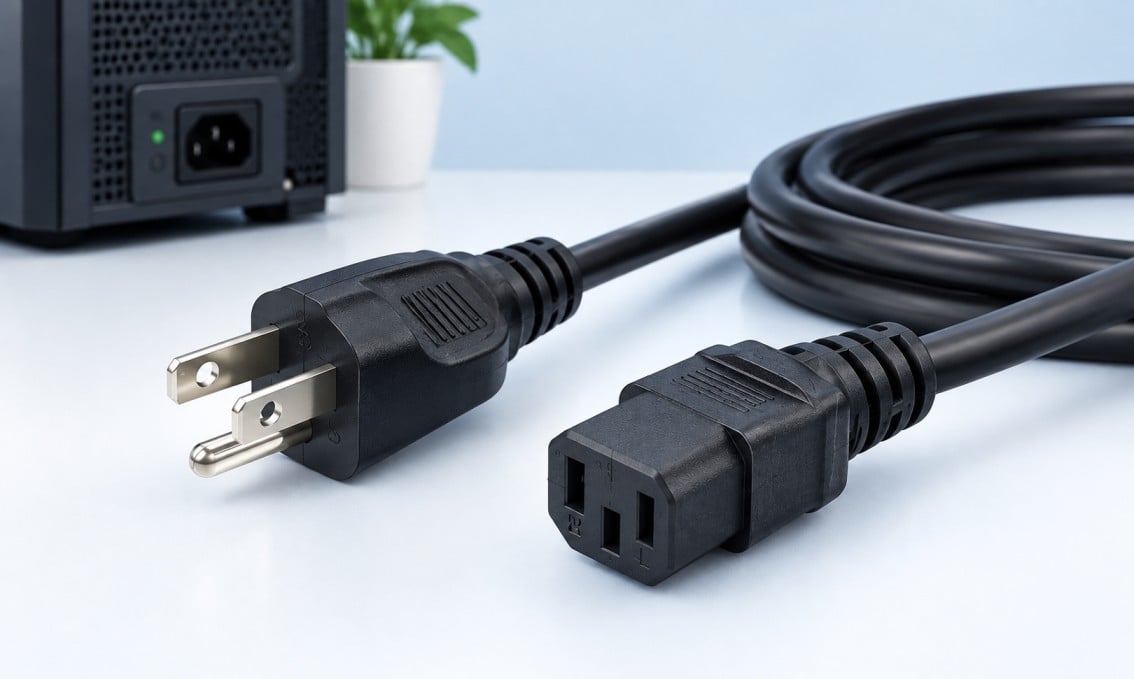
The easiest way to identify a 5-20P is by its blades. One blade, the neutral, is turned sideways to form a T shape, while the other blade is vertical and the grounding pin is round. This T-slot design is intentional, because it keeps a 20-amp plug from being inserted into an outlet rated for only 15 amps.
Compatibility works in one direction only. A 5-20R receptacle has a T-shaped slot that accepts both 5-20P and standard 5-15P plugs. A 5-15R receptacle, however, cannot accept a 5-20P. If your wall outlet has only straight slots, you cannot simply plug in a 5-20P power cord, and you should never modify a plug or outlet to force a fit.
Step 1: Confirm Your Equipment Needs 20 Amps
Start with the equipment’s nameplate or manual, which lists the voltage, amperage, or wattage. If it lists amps, compare directly. If it lists watts, divide by the voltage. A 1,800-watt device on a 120-volt supply draws about 15 amps.
As a general rule, continuous loads should stay at or below 80 percent of a cord or circuit rating. That works out to about 12 amps on a 15-amp rating and 16 amps on a 20-amp rating. Equipment that draws between roughly 12 and 16 amps for long periods is a typical candidate for a 20 amp power cord. When the manual names a specific plug or cord type, follow it.
Step 2: Check the Circuit and Outlet
A cord rating does not increase the capacity of the wall circuit. A 5-20P power cord should be used with a receptacle fed by a 20-amp circuit, which is normally wired with 12 AWG wire and protected by a 20-amp breaker. On a 15-amp circuit, a heavy load can trip the breaker repeatedly or create a heat hazard. If you are unsure about your wiring, have a licensed electrician inspect it before installing new equipment.
Step 3: Match the Wire Gauge
Wire gauge, shown as AWG, is the most important physical feature of a cord. A lower number means thicker copper, which carries more current with less heat. Cords intended for 20 amps are typically built with 12 AWG conductors, while thinner 14 AWG or 16 AWG wire is common on lighter-duty cords.
Never assume that a cord with a 5-20P plug has the right wire inside. Check the printed jacket markings for gauge, conductor count, and ampere rating. A marking such as 12/3 means three conductors of 12 AWG: hot, neutral, and ground.
Step 4: Choose a Practical Length
Longer cords add resistance, which can cause voltage drop and extra heat under heavy loads. Use the shortest cord that reaches comfortably from the outlet to the equipment, with a little slack to avoid strain on the plug. If you need extra distance, choose a heavier gauge instead of a thin cord stretched across the room. Avoid leaving excess cable coiled while it is in use, since coils can trap heat.
Step 5: Pick the Right Jacket for the Environment
The outer jacket protects the conductors, and the best type depends on where the cord will be used.
- General-purpose jackets: Types such as SJT suit indoor locations like offices, workshops, and equipment rooms.
- Weather and oil resistance: A W in the jacket code indicates weather and water resistance, and an O indicates oil resistance, which helps in garages, kitchens, and outdoor settings.
- Heavy-duty jackets: Types such as SO or SOOW offer greater abrasion resistance and flexibility for industrial settings or equipment that moves often.
Step 6: Confirm the Equipment-End Connector
The 5-20P is only one end of the cord, and the other end must match the equipment. Options include a molded 5-20R connector for extension-style use, a stripped end for hardwiring a device, or a specialty connector such as the C19 found on many servers and power distribution units. Check your device’s inlet, confirm the connector shape, and make sure it is rated for the same current as the plug.
Step 7: Look for Safety Certification
Look for markings from recognized testing organizations, such as UL or CSA, on the plug or jacket. These marks indicate that the cord has been evaluated for heat resistance, insulation strength, and electrical performance. An uncertified 20 amp power cord may have undersized conductors or weak insulation, and the risk grows with every hour it carries a heavy load.
Common Mistakes to Avoid
- Forcing a fit with an adapter: Adapters that let a 5-20P plug into a 5-15 outlet can hide a mismatch between the cord and the circuit.
- Judging by thickness alone: A thick-looking cord is not automatically heavy-duty, so always read the printed markings.
- Daisy-chaining: Plugging heavy equipment into power strips or light-duty extension cords adds weak links to the chain.
- Hiding cords: Running a cord under rugs or through tight doorways lets heat and damage go unnoticed.
Caring for Your Power Cord
A well-chosen cord can last for years with simple habits. Unplug it by gripping the plug body rather than pulling on the cable. Avoid sharp bends near the ends, where wires are most likely to fatigue. Inspect it regularly for cracks, exposed wire, discoloration, or a plug that feels warm during use. If you see any of these signs, stop using the cord and replace it.
Final Thoughts
Selecting the right NEMA 5-20 power cord comes down to a few clear questions. How much current does the equipment draw, and does the circuit support it? Is the wire gauge, jacket, and length suited to the environment? Does the connector on the far end match the device, and does the cord carry a recognized safety mark? Answering these before you buy helps your equipment run reliably and keeps the setup safe for the long term.