





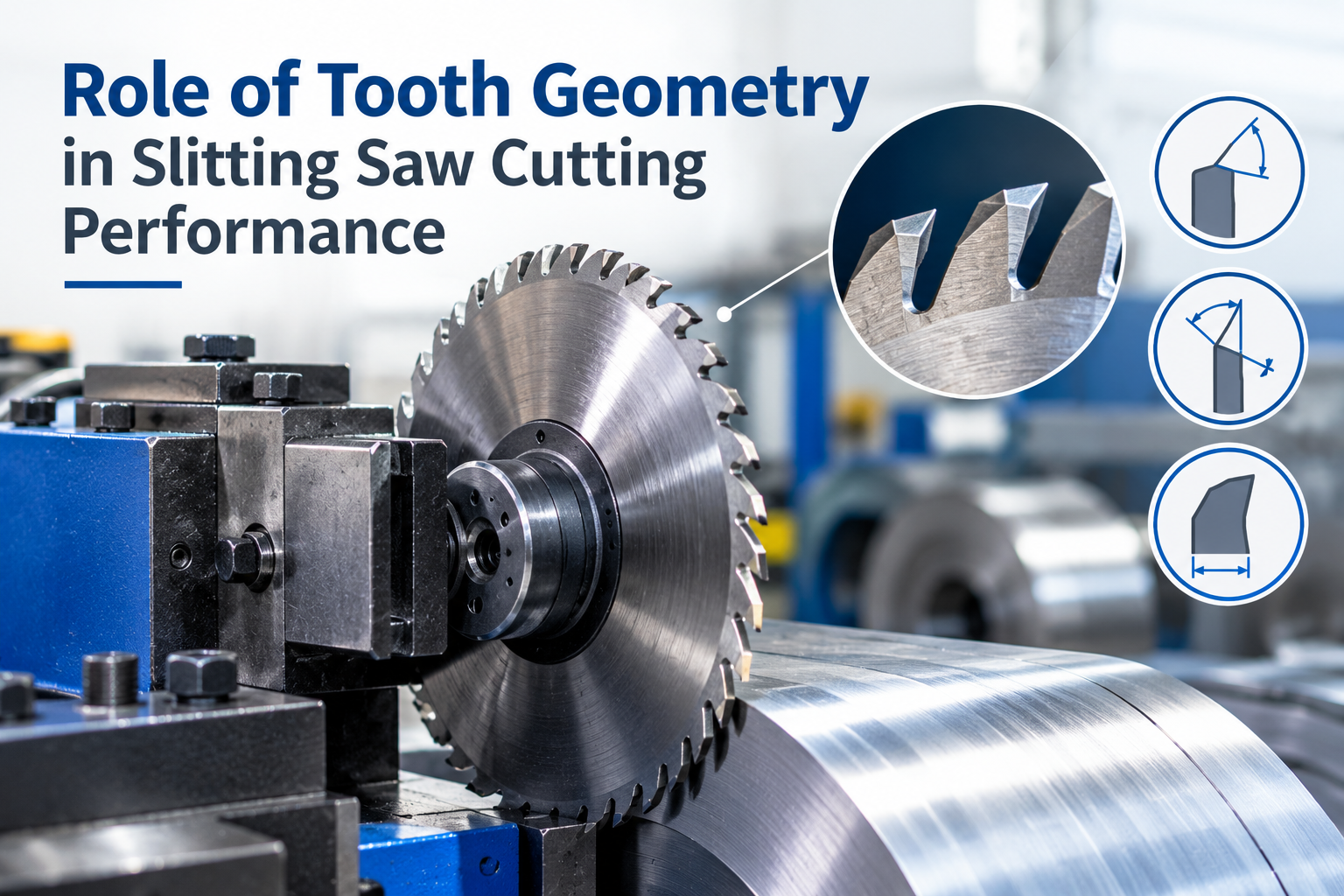
Precision cutting is an essential part of modern manufacturing, particularly in industries that require narrow slots, accurate dimensions, and consistent surface finishes. The performance of a cutting tool depends on several factors, including material selection, operating speed, feed rate, machine rigidity, and tool design. Among these factors, tooth geometry plays an important role in determining how efficiently a cutting tool removes material.
A slitting saw is commonly used for cutting narrow slots, separating workpieces, and performing precision machining operations. Its tooth shape, spacing, rake angle, and edge design influence cutting forces, chip formation, heat generation, and overall tool life. Understanding these characteristics helps manufacturers select suitable tooling and achieve more reliable machining results.
What Is Tooth Geometry in a Slitting Saw?
Tooth geometry refers to the shape, arrangement, and cutting-edge characteristics of the individual teeth on a saw blade. It includes parameters such as tooth pitch, rake angle, clearance angle, tooth profile, and edge preparation.
Each geometric feature affects the way the tool engages with the workpiece. For example, tooth spacing influences chip accommodation, while rake and clearance angles affect how the cutting edge enters the material and moves through the cut.
The appropriate geometry depends on the workpiece material, required slot dimensions, cutting conditions, and machine capabilities. Selecting a suitable design can help improve machining consistency while reducing unnecessary tool stress.
1. Rake Angle and Cutting Efficiency
The rake angle describes the orientation of the cutting face relative to the workpiece. It influences how the cutting edge penetrates the material and how chips flow away from the cutting zone.
A suitable rake angle can reduce cutting resistance and support smoother material removal. However, the ideal angle varies with the material being machined and the strength required at the cutting edge.
For relatively soft materials, a more positive rake angle may help reduce cutting forces. Harder materials or applications involving interrupted cutting may require a more conservative geometry to maintain sufficient edge strength.
An unsuitable rake angle can increase cutting resistance, encourage edge damage, or produce unstable machining conditions. Manufacturers should therefore consider material properties and operating requirements when selecting the tool.
2. Tooth Pitch and Chip Formation
Tooth pitch refers to the distance between adjacent teeth. It affects how frequently the teeth engage with the workpiece and how much space is available for chip formation and evacuation.
A fine-pitch design provides more teeth within a given cutting diameter. This can support smoother engagement in certain applications, particularly when working with thin materials or seeking a consistent finish.
A coarser pitch provides more space between teeth, which can be beneficial when machining materials that produce larger chips. Adequate chip space helps prevent material from accumulating between the teeth.
Choosing an unsuitable pitch may lead to poor chip evacuation, excessive cutting forces, or inconsistent results. The correct configuration should match the workpiece material, cut depth, and machining conditions.
3. Clearance Angle and Friction Control
The clearance angle provides space behind the cutting edge so that the tool body does not rub excessively against the newly machined surface.
Proper clearance helps reduce friction and unnecessary heat generation. It can also support smoother cutting and limit wear along the tool’s flank surface.
However, excessive clearance can weaken the cutting edge, making it more vulnerable to chipping or premature damage. Insufficient clearance, on the other hand, may increase rubbing, heat, and cutting resistance.
The ideal clearance angle balances edge strength with the need to minimize friction. Tool manufacturers consider these requirements when designing blades for different materials and production environments.
4. Tooth Profile and Material Compatibility
Tooth profile influences how the cutting edge enters the workpiece and how material is removed. Different profiles may be suited to different machining requirements, depending on their design and intended application.
When machining aluminum, for example, chip formation and adhesion can be important considerations. A geometry that supports effective chip evacuation may help reduce material buildup on the cutting edge.
When cutting tougher alloys, edge strength and resistance to chipping may become more important. The tooth profile must withstand the forces generated during machining without compromising the required cutting accuracy.
Manufacturers should evaluate tooth geometry alongside blade material, hardness, and any recommended coating or surface treatment. No single profile is ideal for every material or cutting operation.
5. Tooth Sharpness and Edge Preparation
The condition of the cutting edge directly affects how the tool interacts with the workpiece. Sharp, consistently finished teeth can help achieve predictable cutting behavior and reduce unnecessary deformation.
Depending on the application, the cutting edge may be prepared to prioritize sharpness, durability, or resistance to chipping. A highly sharp edge may work well under suitable conditions, while certain demanding applications may benefit from additional edge strength.
Inconsistent tooth preparation can cause uneven loading, vibration, and variations in cutting quality. Regular inspection helps identify chipped or worn teeth before they significantly affect production.
Proper handling and storage are also essential because accidental impacts can damage the cutting edges even before the tool is installed.
6. Tooth Geometry and Heat Management
Cutting generates heat through deformation and friction at the tool-workpiece interface. Tooth geometry affects how efficiently material is removed and how easily chips leave the cutting zone.
When chips cannot escape effectively, they may rub against the tool or workpiece, increasing heat and potentially damaging the cutting edge. Excessive heat can accelerate wear and negatively affect dimensional consistency.
Appropriate tooth spacing, suitable rake and clearance angles, and effective chip evacuation can help manage these conditions. Correct cutting speed, feed rate, and coolant use, where appropriate, are equally important.
Geometry should therefore be evaluated as part of the complete machining setup rather than as an isolated factor.
7. Tooth Geometry and Surface Finish
Surface finish depends on several interacting variables, including tooth geometry, tool condition, machine rigidity, feed rate, and workpiece stability.
A properly selected tooth configuration can support consistent material removal and help minimize roughness, burr formation, and irregular cutting marks. However, geometry alone cannot guarantee a high-quality finish.
Excessive runout, poor workpiece clamping, incorrect feed settings, and worn teeth can still produce defects even when the blade design is appropriate.
Manufacturers should assess finished parts against the required surface and dimensional specifications. If defects occur repeatedly, checking tooth condition and geometry alongside machine setup can help identify the underlying cause.
8. Selecting the Right Slitting Saw for Production
Choosing the right tool starts with understanding the application. Before selecting a slitting saw, manufacturers should evaluate the following factors:
- Workpiece material: Identify the material’s hardness, toughness, and chip-forming characteristics.
- Slot dimensions: Confirm the required slot width, depth, and dimensional tolerances.
- Cutting conditions: Review machine speed, feed rate, and expected cutting loads.
- Chip evacuation: Determine whether the tooth spacing is appropriate for the material and cut depth.
- Tool stability: Check spindle runout, machine rigidity, and workpiece clamping.
- Service requirements: Consider tool life, maintenance needs, and production consistency.
Following these steps helps align tooth geometry with actual operating requirements and reduces the risk of selecting a tool based solely on diameter or thickness.
The Importance of Precision Tooling in Modern Manufacturing
As manufacturing processes demand greater consistency and tighter tolerances, careful tooling selection becomes increasingly important. Tooth geometry influences cutting forces, chip formation, thermal conditions, and edge durability, making it a key consideration in precision machining.
Maxwell Slitter Industries recognizes the importance of cutting-tool design and manufacturing quality in industrial applications. Understanding the relationship between tooth geometry and machining performance helps manufacturers evaluate tooling more effectively and make informed decisions based on their production needs.
A well-selected tool, combined with correct machine settings and regular inspection, can contribute to reliable cutting operations and consistent finished components.
Conclusion
Tooth geometry is a significant factor in slitting saw cutting performance. Rake angle, tooth pitch, clearance angle, tooth profile, and edge preparation each influence how the tool cuts material and manages chips and heat.
By matching these characteristics to the workpiece material and machining conditions, manufacturers can improve cutting consistency, reduce avoidable wear, and maintain dimensional accuracy. Combining appropriate tool selection with sound machining practices provides a practical foundation for efficient and dependable industrial production.