






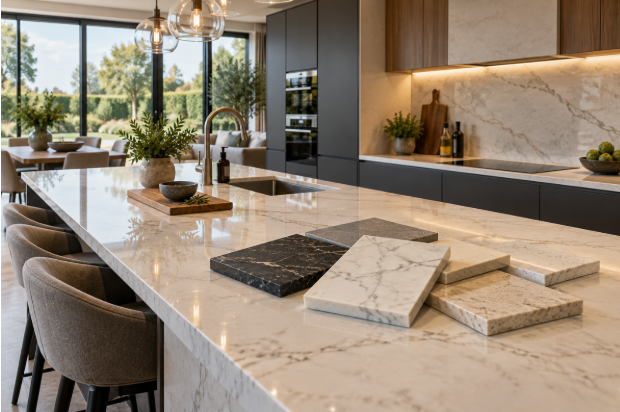
Choosing a new worktop involves more than selecting a colour that complements the kitchen. The surface needs to suit the room’s design, everyday use, cleaning routine, budget, and installation requirements. From engineered quartz to granite, marble, and other stone surfaces, homeowners have several options to consider when planning a renovation. For anyone researching stone worktops in Essex, understanding the characteristics of each material can make the selection process more straightforward.
Worktops are exposed to spills, heat, moisture, utensils, cleaning products, and everyday wear. The right material therefore needs to balance appearance with practical requirements.
What Are Stone Worktops?
Stone worktops can refer to surfaces made from natural stone or engineered materials containing stone aggregates.
Natural options such as granite and marble are quarried stone products, meaning that each slab can have its own variations in colour, veining, and pattern. Engineered quartz, by contrast, combines quartz aggregates with other materials and resins to create a manufactured surface with more controlled visual characteristics.
Quartz Supply describes quartz as a composite product made using materials including quartz, silica, and granite, with colour and pattern variations that can be more controlled than those found in purely natural stone.
The distinction is useful when comparing materials because the appearance, maintenance requirements, and fabrication characteristics can differ.
Why Consider Quartz for a Kitchen Worktop?
Quartz is frequently selected for kitchens because of its combination of appearance and practical characteristics.
Quartz Supply describes its quartz worktops as non-porous and resistant to scratches, stains, and chemicals, while requiring relatively little maintenance.
A non-porous surface can also make everyday cleaning relatively simple. However, “low maintenance” does not mean that quartz is indestructible. The material still needs appropriate care, particularly around heat and unsuitable chemicals.
Quartz is available in a wide range of colours and patterns, including options designed to resemble natural stone. This gives homeowners flexibility when coordinating a worktop with kitchen cabinets, flooring, splashbacks, handles, and appliances.
Quartz, Granite, and Marble Compared
When considering stone worktops in Essex, it is useful to compare the main material categories rather than concentrating only on colour.
Quartz
Quartz is an engineered material that offers relatively consistent patterns and a broad selection of colours. Its non-porous characteristics mean it generally does not require routine sealing.
Granite
Granite is a natural stone and is known for its strength and distinctive patterns. Because it is natural, colour and mineral variation can be more pronounced from one slab to another.
Marble
Marble is another natural stone with distinctive veining and a wide range of tones. It can create a particular visual character, but its care requirements should be considered before installation.
The best choice depends on how the surface will be used, the desired appearance, and the maintenance routine the homeowner is comfortable with.
Think About the Kitchen’s Everyday Use
A worktop used by a family every day may face very different conditions from one installed primarily for occasional use.
Consider how the surface will be used for:
- Food preparation
- Cooking
- Dining
- Appliance placement
- Cleaning
- Storage
- Entertaining
- Bathroom or utility-room activities
For example, someone who frequently prepares food directly on the worktop may prioritise easy cleaning and resistance to everyday staining. A homeowner focused heavily on visual continuity may instead place greater importance on slab pattern and edge design.
Considering practical use before selecting the material can help prevent disappointment after installation.
Colour and Pattern Choices
The visual design of a worktop can significantly influence how a kitchen looks.
Light-coloured surfaces can create a brighter appearance, while darker materials can provide stronger contrast with pale cabinetry. Veined quartz can introduce a marble-inspired appearance without relying on naturally occurring veining.
Quartz Supply’s current range includes numerous colours and patterns from different collections and manufacturers, demonstrating how varied engineered quartz can be. Its published options include plain, concrete-inspired, marble-effect, grey, black, and patterned designs.
It is worth viewing physical samples where possible because lighting can change how a worktop colour appears compared with an online photograph.
Consider the Worktop Thickness
Thickness affects both appearance and installation.
A thicker worktop can create a substantial, traditional appearance, while slimmer profiles can complement contemporary kitchen designs. The appropriate thickness can depend on the material, cabinetry, edge profile, overhangs, and structural requirements.
The visual thickness can also be influenced by the edge fabrication. A detailed edge profile may create a different appearance from a simple square or eased edge.
These details should ideally be considered before fabrication because changes after production can be difficult or impossible.
Edge Profiles and Finishing
The edge of a worktop is both a functional and design consideration.
Possible finishes can include:
- Straight edges
- Eased edges
- Bevelled edges
- Rounded profiles
- More decorative profiles
The appropriate option depends on the overall kitchen design and the material being used.
A rounded or softened edge can reduce the sharpness of a corner, while a simple straight profile may suit a minimalist kitchen. Fabricators can also advise on which profiles are technically suitable for a particular slab.
Heat and Worktop Care
Quartz surfaces can tolerate normal kitchen conditions, but that does not mean hot cookware should routinely be placed directly on the surface.
Quartz Supply’s care guidance recommends using trivets or heat mats rather than placing very hot pots and pans directly onto quartz. It explains that repeated exposure to high temperatures can eventually discolour the surface.
This is a simple precaution that can help preserve the worktop’s appearance.
The same principle applies to cleaning products. Although quartz is resistant to many everyday substances, unsuitable chemicals can affect some surfaces. Quartz Supply recommends checking with the supplier before using heavy-duty cleaning products.
Cleaning and Maintenance
One of the practical advantages of quartz is its relatively simple maintenance routine.
For everyday cleaning, Quartz Supply recommends wiping the surface with a soft cloth and appropriate surface cleaner, followed by rinsing and drying. Its maintenance guidance also states that quartz does not require sealing because of its non-porous characteristics.
Natural stone surfaces can have different maintenance requirements, so homeowners should follow the recommendations provided for the specific material.
Avoid abrasive cleaning methods unless they have been confirmed as suitable for the particular surface.
Measuring and Templating
Accurate measurements are essential before fabrication.
A worktop may need cut-outs for:
- Sinks
- Hobs
- Taps
- Sockets
- Appliances
- Plumbing
- Other fixtures
Small measurement errors can create significant installation problems because stone and engineered surfaces cannot simply be adjusted in the same way as some laminate worktops.
Quartz Supply describes a process involving measurement and an actual-size template before fabrication and installation.
Professional templating can therefore be an important part of achieving a suitable fit.
Choosing a Surface for Bathrooms
Stone worktops are not limited to kitchens. Quartz can also be used for bathroom surfaces, including vanity tops and other applications.
Quartz Supply states that quartz can be used for both kitchen and bathroom worktops.
Bathrooms have different requirements from kitchens, particularly around moisture, cleaning products, basins, taps, and available space. The design should therefore account for plumbing and fixture positions during the templating stage.
Why Samples Matter
Online photographs can help narrow down choices, but physical samples provide a more useful indication of colour and texture.
Natural and engineered stone can look different depending on:
- Natural and artificial lighting
- Cabinet colour
- Flooring
- Wall colour
- Splashback material
- Room size
- Surface finish
Quartz Supply offers samples for customers in Essex so they can assess materials before making a final decision.
Viewing samples alongside cabinet doors, flooring, and other finishes can make it easier to judge whether the overall combination works.
Planning the Installation
Installation should be considered alongside material selection.
The project may involve removing an existing worktop, preparing cabinets, templating, fabrication, transporting the finished pieces, making cut-outs, and fitting the new surface.
Quartz Supply states that its worktops are fabricated to order and that its published process involves quotation, templating, and installation.
Homeowners should confirm the expected timeline, site requirements, access arrangements, cut-out details, and any additional work before installation begins.
Questions to Ask Before Ordering
Before committing to a worktop, it can help to ask:
- What material is the slab made from?
- What maintenance does it require?
- Does it need sealing?
- What cleaning products are suitable?
- How should hot cookware be handled?
- What thicknesses are available?
- Which edge profiles can be fabricated?
- How will the worktop be templated?
- What cut-outs are required?
- What warranty applies to the material and installation?
Getting these details in writing can make the project easier to manage and reduce misunderstandings.
Conclusion
Selecting stone worktops in Essex involves balancing appearance, durability, maintenance, installation requirements, and the way the kitchen or bathroom will actually be used. Quartz, granite, and marble each have different characteristics, while engineered quartz provides a wide range of controlled colours and patterns with relatively straightforward maintenance. For homeowners exploring Concrete Earth Quartz, understanding the specific slab’s composition, finish, care requirements, thickness options, and suitability for the intended application should form part of the decision-making process. Samples and professional templating can also help ensure that the chosen surface works with the surrounding cabinetry and room design.