




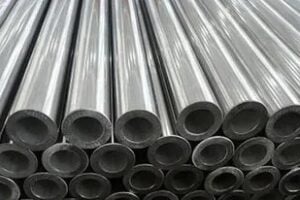


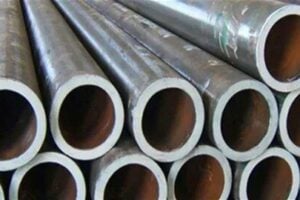
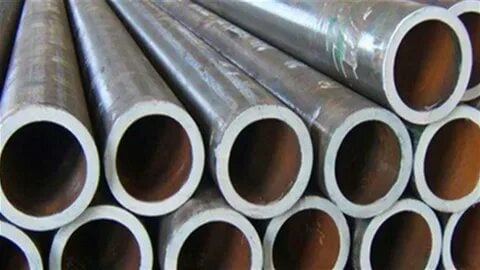
Pipe failure in a pressurised line rarely starts at the pipe body. It starts at the weld seam. Seamless pipe removes that risk by design, which is why refineries, boiler houses and shipyards specify it for pressure duty. Piping absorbs a large share of plant capital cost, and a wrong specification resurfaces as leaks, failed hydrotests or a rejected inspection report. A Mild Steel Seamless Pipe holds moderate carbon, machines cleanly and welds without preheat in standard wall thicknesses, so fabricators reach for it across general service, structural work and hot lines. Selecting correctly means matching grade, dimension and inspection scope to the conditions the system will face.
What Is a Mild Steel Seamless Pipe?
A Mild Steel Seamless Pipe is a hollow section formed from a solid steel billet, with no weld joint around its circumference. Mills heat the billet to roughly 1200 degrees Celsius, pierce it over a mandrel, then elongate and size the shell through rolling stands. Hot finishing covers the larger bores. Cold drawing or cold pilgering follows wherever a project demands tighter dimensional tolerance, a smoother bore and closer wall control, usually on small-diameter tube for heat exchangers and hydraulic circuits.
Welded pipe starts life as flat strip. Rollers form it into a cylinder and fuse the edges along a longitudinal seam, which remains the weakest point under cyclic pressure, bending and vibration. Mild steel carries carbon near 0.25 percent maximum, giving good ductility, straightforward weldability and easy cold bending. Seamless Mild Steel Pipes cost more per metre than welded equivalents and face practical size limits at the large end, though they handle pressure, thermal cycling and fatigue loading with a margin welded pipe cannot match.
Key Factors to Consider When Choosing MS Seamless Pipes
Six checks decide whether the pipe you order suits the line you are building.
- Material Grade: Match the grade to design pressure, service temperature and project specification before you release any purchase order.
- Pipe Dimensions: Confirm outside diameter, wall thickness, schedule and cut length against the piping isometrics and layout drawings.
- Pressure and Temperature: Rate the pipe against system design pressure and peak operating temperature, never against average running conditions.
- Mechanical Properties: Review tensile strength, yield point, elongation and impact toughness for the duty the line will handle.
- Corrosion Protection: Specify coating, galvanising or paint systems wherever buried, marine or chemically aggressive conditions apply to the installation.
- Quality and Inspection: Demand mill test certificates, dimensional tolerance reports and third-party inspection where the contract calls for it.
Understanding ASTM A106 Carbon Steel Pipes
ASTM A106 Carbon Steel Pipes cover seamless carbon steel pipe built for high-temperature service, and the specification remains the default reference on boiler, refinery and steam line work. Three grades sit inside it. Grade A holds carbon at 0.25 percent maximum with 330 MPa minimum tensile strength, which makes it the easiest of the three to bend and flare. Grade B dominates project specifications, offering 415 MPa minimum tensile and 240 MPa minimum yield alongside sound weldability. Grade C lifts carbon to 0.35 percent and tensile to 485 MPa for heavier pressure duty.
Confirm grade, schedule, length and the governing project standard in writing before fabrication begins. Substituting A53 for A106 in a hot line surfaces as a compliance failure at commissioning, long after the welders have left site.
Industrial Applications of Seamless Mild Steel Pipes
- Oil and gas processing lines move crude, gas and condensate through gathering, separation and transfer duty under pressure.
- Power stations and industrial boilers run seamless sections through superheater, economiser and main steam circuits.
- Chemical and petrochemical plants route reactive media where a weld seam would introduce an avoidable failure point.
- Construction contractors use Industrial Mild Steel Pipes for columns, piling, scaffolding and load-bearing structural frames.
- Water treatment plants, utility headers and general plant piping depend on seamless sections for long service life.
Mild Steel Seamless Pipes vs. Welded Pipes
Both types serve industrial piping. The right answer depends on duty, budget and the pressure your system sees daily.
| Factor | Seamless Mild Steel Pipe | Welded Pipe |
| Manufacturing | Pierced from a solid billet | Strip fused along a weld seam |
| Strength | Uniform wall, no seam | Weld line governs strength |
| Pressure and temperature | High pressure, hot service | Low to medium pressure duty |
| Cost and availability | Higher price, longer lead time | Cheaper, widely stocked |
| Best use | Boilers, hydrocarbon lines, steam headers | Water lines, structures, low-pressure transfer |
Benefits of Industrial Mild Steel Pipes
- Uniform wall structure absorbs sustained pressure and vibration without the seam fatigue welded pipe develops over time.
- One material family covers steam, oil, gas, water and structural duty across an entire plant.
- MS Seamless Pipes span 10 mm OD cold drawn through 406 mm OD hot finished sizes.
- Mild steel cuts, threads, bends and welds on site without preheat in standard wall thicknesses.
- Fewer replacements and lower maintenance offset the higher purchase price across the life of the line.
Common Mistakes to Avoid When Selecting Seamless Mild Steel Pipes
- Buying on the lowest quoted price alone leaves you with thin walls and failed hydrostatic tests.
- Ignoring design pressure and peak temperature exposes the line during upset and start-up conditions.
- Mixing A106 with A53 or IS 1239 grades opens compliance gaps at third-party inspection.
- Skipping coating on buried or marine runs lets external corrosion cut service life well short.
- Accepting delivery without mill test certificates removes traceability and leaves compliance impossible to prove.
Conclusion
Four checks settle the decision: grade, dimensions, pressure and temperature rating, and inspection scope. Align those with the conditions the line actually runs at, and the pipe outlasts the equipment around it. Specification work rewards precision, since schedule 40 pipe in a schedule 80 service fails early. Documentation carries equal weight with metallurgy, because a line without traceable mill certificates cannot be defended during an audit or a failure investigation. Supplier choice decides whether that paperwork arrives complete. Rajsagar Steel PVT. LTD has manufactured carbon and alloy steel seamless pipes, supplying 2 inch to 16 inch OD hot-finished and 10 mm to 108 mm OD cold-drawn sizes under ISO 9001 with full traceability.