







You’ve probably seen the forum posts. Someone grabs the lowest-priced lithium battery they can find, feels pretty good about the money they saved, and a few months later they’re asking strangers online why their cart quits halfway through a round. Or why the charger they bought separately keeps blinking red.
Batteries are funny like that. What you pay at checkout and what you pay over the next ten years can be two very different numbers. So it helps to know what you’re really comparing before you hit buy.
Comparing Lithium Golf Cart Batteries for Sale
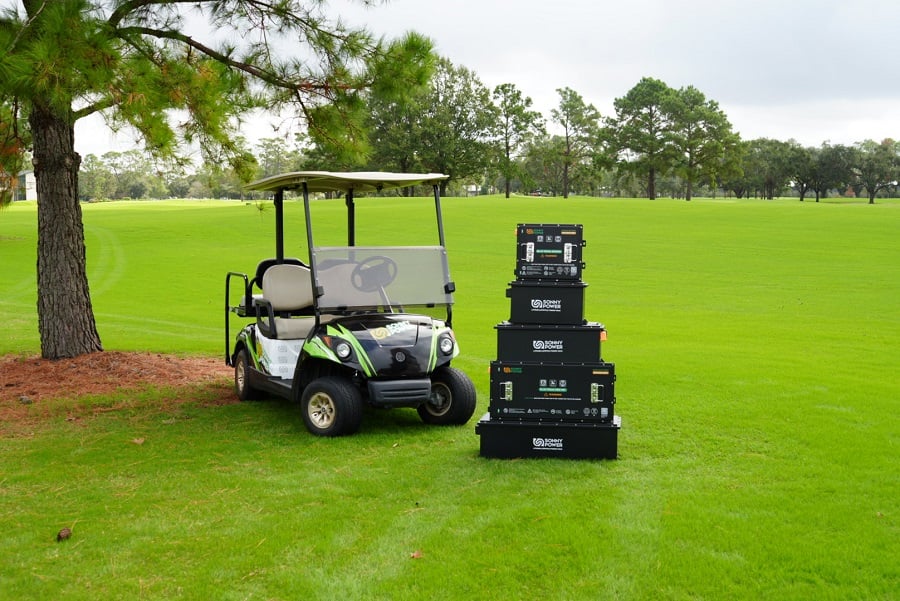
If you want a feel for current prices, take a look at the lithium golf cart batteries for sale from Sonny Power, a Houston outfit that sells complete LiFePO4 kits. Right now, the entry-level options (a 36V 105Ah or a 48V 67Ah) sit at around $1,700. The 48V 105Ah, which is what a lot of people end up choosing, comes in near $2,000. Need 72 volts? The 105Ah kit is about $2,700. And if range is your top priority, the 48V 200Ah tops out close to $3,000.
Here’s something easy to miss. These aren’t bare batteries. Take the 72V kit: it comes with a charger, a 12V converter for lights and accessories, a little charge display, Bluetooth so you can check the battery from your phone, and brackets made for E-Z-GO, Club Car or Yamaha. Shipping’s included too. So when another listing looks a few hundred dollars cheaper, check whether it’s missing the charger or the mounting hardware. Often it is.
When the Cheapest Lithium Golf Cart Batteries Cost You More
Try thinking in miles instead of dollars. The 48V 67Ah pack holds roughly 3.4 kWh. Step up to the 105Ah, and you get about 5.4 kWh. That’s over 50% more energy for around $300 extra. If your cart gets used most days, the bigger battery works out cheaper for every mile you drive.
There’s also the question of muscle. The smaller pack’s battery management system handles 180 amps continuously. The larger packs handle 250. Cruising on flat streets, you won’t feel much difference. Haul four people up a steep driveway in a lifted cart, though, and you’ll feel it right away.
Don’t get me wrong. The cheapest lithium golf cart batteries can make perfect sense if you only take short, easy trips a few times a week. Just pick one because it suits how you drive, not because it showed up first when you sorted by price.
Lithium vs. Lead-Acid Over the Years
Look after a set of lead-acid batteries well, keep them watered and charged properly, and you’ll usually get four to six years out of them. These lithium packs are rated for 3,500 full cycles at a 1C rate and 6,000 at lighter loads. That’s an expected life of 10 to 12 years. Throw in zero watering, no crusty terminals, and a cart that’s a whole lot lighter, and the higher upfront price stops looking so scary.
Wherever you end up buying, run through a quick check first. Read the warranty, all of it. (Here you get 10 years limited, full coverage for the first three, then prorated, as long as you register within 60 days.) Look for UN 38.3 certification, which shows the battery passed transport safety tests. Get the tape measure out and check your battery tray. And if you charge in an unheated garage, keep in mind that no LiFePO4 battery should be charged below freezing.
FAQs
How much do lithium golf cart batteries cost?
Complete kits usually run between about $1,700 and $3,000, depending on voltage and capacity. Larger packs cost more up front but often work out cheaper per kilowatt-hour.
How do I find the cheapest lithium golf cart batteries that I can still trust?
Stick to kits that use LiFePO4 cells, spell out their battery management system, carry UN 38.3 certification, and come with a long written warranty. If a listing is fuzzy on any of those, move on.
Do lithium golf cart batteries need any upkeep?
Hardly any. No watering, no acid to clean. Keep the connections snug, use a compatible charger, and don’t charge when it’s below freezing.
The Bottom Line
Buying lithium golf cart batteries for sale comes down to value over time, not the number at checkout. Look at the capacity, see what’s actually in the box, and read the warranty. Do that, and you’ll end up with a battery that’s still going strong long after the bargain-bin ones have called it quits.