




|
What this covers
|
There is a pattern that anybody who has sold height-adjustable desks recognizes and almost nobody writes about. The desk arrives. It gets used enthusiastically for a week or two. Somewhere in the third or fourth week the adjustments stop, and the desk settles permanently at one height.
The owner usually concludes the desk was a mistake, or that they lack discipline. Neither is typically what happened.
The Thing That Actually Stops It
Ask somebody whose desk stopped moving what went wrong and the answer is normally vague. It got in the way. It was a hassle. I just stopped.
Push past the vague answer and a specific obstruction almost always appears, and it is rarely the desk itself.
|
Stated reason |
What is usually underneath it |
|
“It was a hassle” |
A cable goes tight before the desk reaches full height |
|
“My feet hurt” |
Hard floor, no cushioned surface |
|
“I forgot” |
The desk is at the wrong height to start the day, so the first change never happens |
|
“It wobbled” |
Single column, loaded at the back edge |
|
“It did not fit the room” |
True, and it was true on day one |
The first row is the big one, and it is the one nobody anticipates when they buy.
The Cable Problem, in Detail
A desk that travels upward pulls everything plugged into it upward too. Every cable that runs from the desktop to a wall socket, a router, a dock or a floor strip has to have enough slack to cover the full travel.
Cables are almost never bought with that in mind. They are bought to reach from where the device sits to where the socket is, measured once, at seated height. The desk then rises and something goes tight.
What happens next is predictable. The owner does not re-cable. They lower the desk back to the height where everything reaches, and that becomes the permanent height.
A rough cable budget looks like this:
- Measure the full travel, not the height you expect to use. Desks get adjusted to their limits eventually.
- Add the travel distance to every cable’s existing length, then add a margin for the loop that forms as the desk drops.
- Route from a single point. One bundle leaving the desktop at one place behaves predictably. Six cables leaving at six points will snag at six different heights.
- Power strip on the desk, not on the wall. One cable crosses the gap instead of eight. This is the single highest-value change and it costs very little.
That last point resolves most cases on its own.
The Second-Monitor Event
The other common ending is an equipment change rather than a cable.
A second monitor arrives, or a laptop gets swapped for something heavier, or a monitor arm replaces a stand. The load on the desktop changes, and three things can follow. A pneumatic desk’s counterbalance is now wrong, so the desk either drifts or resists. A single-column desk that was borderline for stability becomes visibly unstable at height. And the cable count goes up, which reactivates the first problem.
None of these are dramatic. Each is enough friction to end the habit, because the habit was only ever a few seconds of convenience ahead of the alternative.
Why the Room Decides More Than the Desk
A height-adjustable desk in a dedicated office has a straightforward life. The same desk in a bedroom, a living room corner or a studio apartment is competing for space with everything else in the room, and it loses that competition during the hours nobody is working.
That produces a different failure. The desk does not stop being adjusted. It stops being wanted, because a full-size workstation parked in a living space is a permanent visual cost paid for an eight-hour benefit.
This is the constraint that shapes the small-space end of the category. Desks sold into rooms that have another job have to justify their footprint when they are not in use, which pushes designs toward folding, storing, or dropping to floor level rather than toward wider height ranges and bigger worktops. Lillipad builds specifically for that case, and the appeal of a sit to stand desk that fits the room is less about the height range than about what the desk does with itself the rest of the day.
The Recovery, Which Is Cheaper Than People Expect
A desk that has stopped moving can almost always be restarted, and the intervention is usually small.
- Raise it to full height and look for what goes tight. The obstruction will be visible in about thirty seconds.
- Put a power strip on the desk. Replace the eight-cable gap with one.
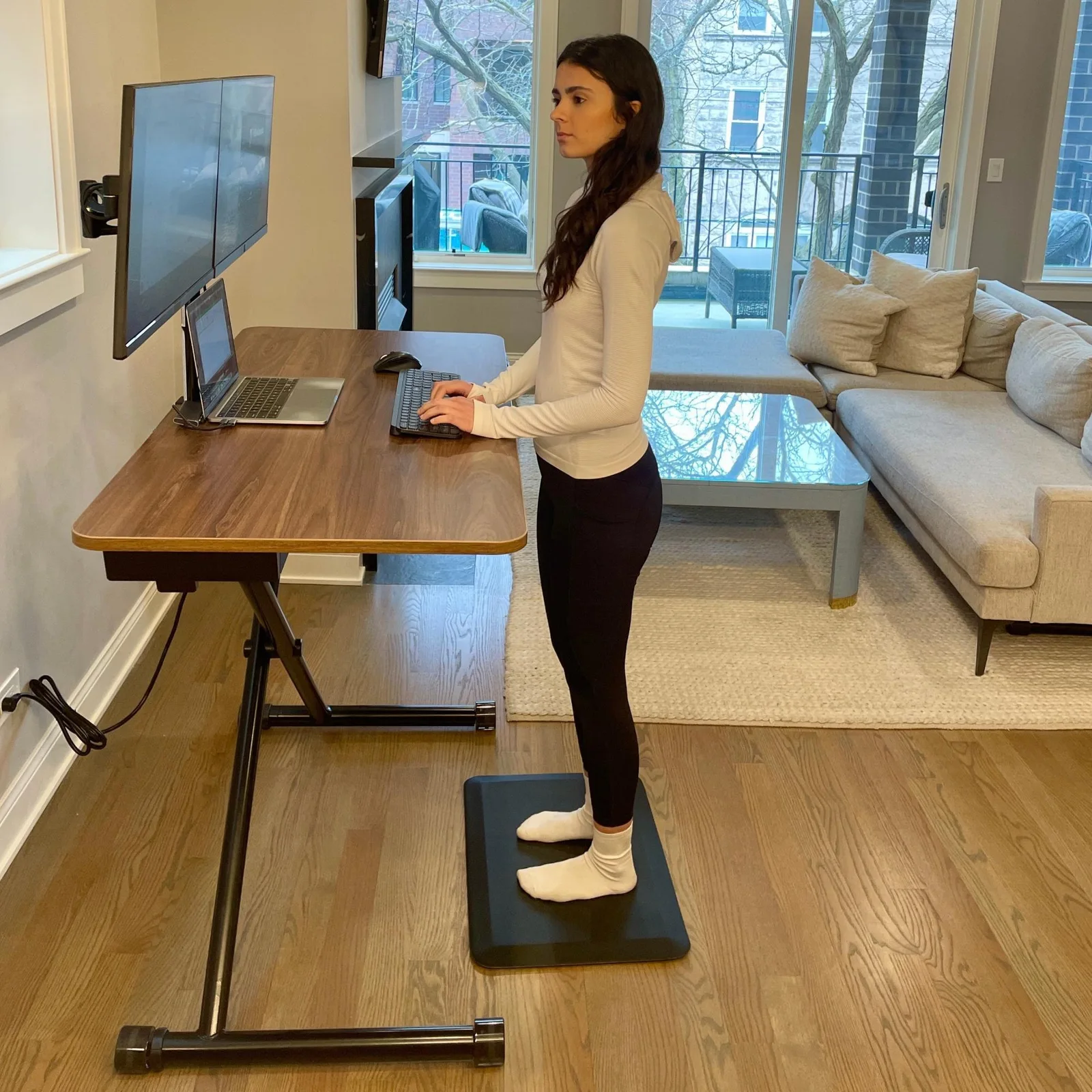
- Put something soft underfoot. An anti-fatigue mat is an inexpensive purchase against a desk that costs considerably more, and foot discomfort ends more standing sessions than any other single cause.
- Start the day raised, not lowered. The first adjustment of the day is the one least likely to happen, so remove the need for it.
- Check stability with everything loaded. If it sways, the fix is usually bracing or relocating the monitor arm inward, not a new desk.
The Timing of the Drop-Off Is Informative
The abandonment does not happen at a random point. It clusters, and where it clusters says something about the cause.
Week one. Almost nobody stops in week one. The desk is new, the novelty is doing the work, and any friction is tolerated as part of setting up.
Weeks two and three. This is where most of it happens. The novelty has gone and the friction has not, so the friction is now being paid without anything offsetting it. Anything that costs effort on every adjustment surfaces here.
Week four onward. A desk still being adjusted at week four usually keeps being adjusted, because the habit is established and the obstacles have already been encountered and either solved or routed around.
|
When it stops |
What that usually indicates |
|
Week one |
The desk is wrong for the room, and was always going to be |
|
Weeks two to three |
Friction: cables, floor, adjustment effort |
|
Week four to six |
An equipment change happened, usually a second screen |
|
After month two |
Life change, new job pattern, or the room got repurposed |
The useful consequence is that week three is when to intervene. A desk that is still moving at the end of the first month is very likely still moving at the end of the year, so the whole retention problem is concentrated in a fortnight that nobody is watching.
What to Establish Before Buying, Rather Than After
|
Check |
When to do it |
|
Where the nearest outlet is relative to the desk position |
Before ordering |
|
Full travel distance, top to bottom |
Before ordering |
|
Whether the floor under it is hard |
Before ordering |
|
What the room looks like with the desk in it at 8pm |
Before ordering |
|
Total weight of everything going on top, including the arm |
Before ordering |
Every one of those is answerable in advance and expensive to discover afterward.
None of that requires a different desk. It requires the buyer to know three things about their own room before the order goes in, and nothing in the buying process prompts them to find out.
What a Seller Could Do About It and Mostly Does Not
The interesting part of this pattern is that it is almost entirely preventable at the point of sale, and the industry largely does not try.
A product page that asked three questions before checkout would remove most of the failures. How far is the nearest outlet. Is the floor hard. Where will this live when you are not working. None of those is difficult to ask and all three predict the outcome better than any specification on the page.
The same is true of what ships in the box. A desk-mounted power strip and a set of cable ties cost very little against the price of the desk, and they remove the single most common cause of abandonment. They are almost never included.
The incentive explanation is straightforward enough. A desk that gets parked at one height does not generate a return, it generates a quiet non-user, and non-users do not appear in any metric the seller watches. The cost lands entirely on the buyer, who concludes they wasted the money and tells people so.
The Honest Conclusion
The desks largely work. The category’s real failure rate is not a manufacturing problem, it is an installation and environment problem, and it concentrates in the first month because that is when the mismatch between the desk and the room becomes obvious.
A desk that has stopped moving is not usually evidence of a bad purchase. It is evidence of a cable that is eighteen inches too short, a floor that is too hard, or a room that was always going to struggle to hold it. Two of those cost very little to fix. The third is worth knowing before the order is placed.