



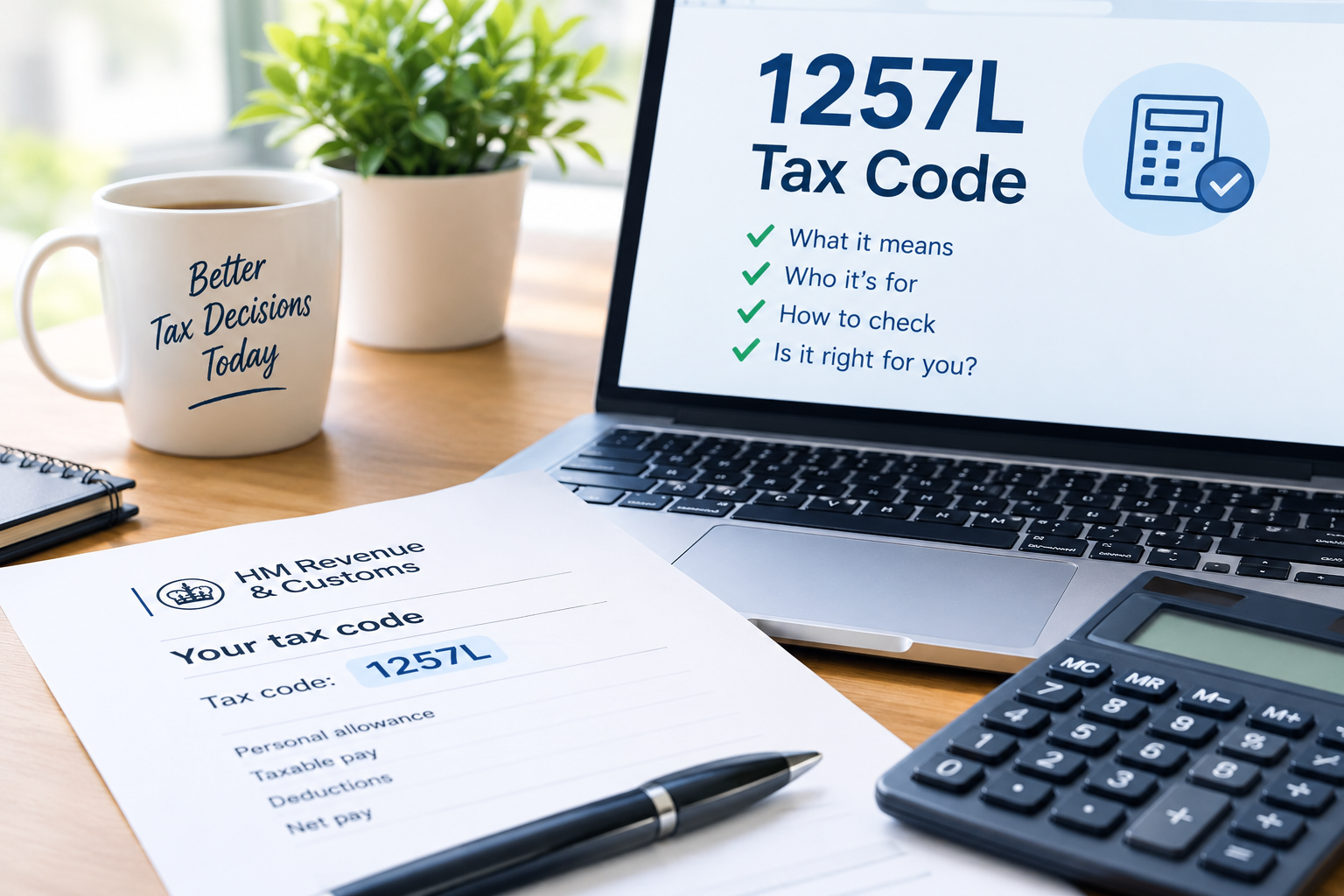
Your tax code tells your employer how much of your pay to treat as tax-free before deducting Income Tax through PAYE. It appears on every payslip, and if it is wrong, you could pay too much or too little tax without realising.
1257L is the most common tax code in the UK, but it is not right for everyone. This guide explains what the 1257L tax code means, when it is likely to be correct and how to check it step by step.
What Does the 1257L Tax Code Mean?
The numbers and letter each have a meaning:
- 1257 is your tax-free Personal Allowance of £12,570, divided by 10.
- L means you are entitled to the standard Personal Allowance, with no extra allowances or deductions.
Your employer or pension provider uses the code to spread that allowance across the tax year under PAYE. Because £12,570 is the standard Personal Allowance, tax code 1257L is the one most UK employees see. Scottish taxpayers see S1257L and Welsh taxpayers C1257L.
Is 1257L a Normal Tax Code?
Yes. 1257L is the standard UK tax code and is usually correct if you:
- have one job or one pension
- receive no taxable benefits, such as a company car
- have no untaxed income, such as rent or self-employment
- do not owe tax from a previous year
- earn less than £100,000
Having 1257L does not mean anything is wrong. Equally, a different code does not automatically mean a mistake. The right code depends on your circumstances.
How Does the 1257L Tax Code Affect Your Pay?
On 1257L tax code , your tax-free pay is spread evenly across the year, so you receive about £1,047.50 a month or £241.73 a week before any Income Tax is due. Income above that is your taxable income.
Example: someone in England paid £500 a week on 1257L:
- weekly tax-free pay: about £241.73
- taxable pay: about £258.27
- Income Tax at 20%: roughly £51.65 a week
This is a simplified illustration. Payroll software uses HMRC tables, and pension contributions, other income and where you live can change the figure. National Insurance is deducted separately.
If HMRC changes your code, your deductions change from the next payday your employer processes the new code.
How to Check If Your 1257L Tax Code Is Correct
- Check your payslip. Find your tax code and note whether anything follows it, such as W1, M1 or X.
- Check your HMRC record. Sign in to your personal tax account on GOV.UK or the HMRC app to see your current code and how HMRC worked it out.
- Review your employment and income. Make sure every employer and pension HMRC lists is correct, with realistic estimated pay.
- Check for other jobs or income. If you have a second job, pension or untaxed income, 1257L may not be right on your main job.
- Check benefits and deductions. Look for taxable benefits, expenses, Marriage Allowance or previous underpaid tax in HMRC’s calculation.
- Contact HMRC if something is wrong. Update your details online or call HMRC to correct them.
When Might 1257L Be the Wrong Tax Code?
1257L may not suit you if:
- you have started a new job and HMRC does not yet have your full details
- you have more than one job or pension, as your allowance is usually used on one, with a code such as BR on the other
- you receive taxable benefits, such as private medical insurance, which usually reduce the number in your code
- you claim job expenses, such as a flat rate allowance for uniform cleaning, which can increase it
- your employment or income has changed, for example a pay rise taking you over £100,000, where your Personal Allowance starts to reduce
- HMRC holds incorrect information, such as an old job still showing as live
- you are repaying underpaid tax from a previous year through your code
- you are on an emergency code, shown by W1, M1 or X after 1257L
Some of these lead to codes that look unusual but are entirely correct. The aim is to check that your code matches your circumstances, not that it says 1257L.
What Is an Emergency Tax Code Compared With 1257L?
Plain 1257L works on a cumulative basis. Payroll looks at your total pay and tax since 6 April, so unused allowance from earlier in the year is carried forward.
1257L W1, 1257L M1 and 1257L X work on a non-cumulative, or emergency, basis. Each week or month is taxed on its own, with no unused allowance carried forward. These codes are often used when you start a job without a P45 and are usually replaced once HMRC has your details.
If you started work part way through the tax year, an emergency code can mean paying more tax than you owe until it is corrected.
What Should You Do If Your Tax Code Is Wrong?
Contact HMRC if your income, employers, pensions or benefits are shown incorrectly, or if you have been on an emergency code for more than a few pay periods. You can update most details through your personal tax account or the HMRC app.
Have this information ready:
- your National Insurance number
- your employer’s PAYE reference, shown on your payslip or P60
- your current and expected pay for the tax year
- details of any other jobs, pensions or taxable benefits
HMRC sends the corrected code to your employer. Your employer cannot change your code themselves, but payroll can confirm which code they have received. If you have overpaid tax, it is usually refunded through your pay once the new code is applied, or after the tax year ends.
How Can I Find My Tax Code?
You can find your tax code:
- on your payslip, usually near your National Insurance number
- in HMRC letters, including tax code notices sent when your code changes
- in HMRC online services, through your personal tax account or the HMRC app
- from your employer’s payroll team, who can confirm the code they are using
Your P45 and P60 also show the code used by your employer.
Frequently Asked Questions About the 1257L Tax Code
What does the 1257L tax code mean?
It means you can earn £12,570 tax-free in the tax year. The number is your allowance divided by 10, and the L shows you get the standard Personal Allowance.
Is 1257L a normal tax code?
Yes. It is the standard code for people with one job or pension and no adjustments, but it is only correct if it matches your circumstances.
Is 1257L the standard tax code?
Yes. It reflects the standard Personal Allowance, so it is the starting point for most employees before any adjustments are made.
How much can I earn on 1257L before paying tax?
£12,570 across the tax year, or about £1,047.50 a month or £241.73 a week. You pay Income Tax on earnings above that.
Why has HMRC given me a 1257L tax code?
Usually because HMRC believes you have one job or pension and no adjustments to make, often after a new tax year or a change of job.
Can my 1257L tax code change?
Yes. It can change if you take another job, receive taxable benefits, claim expenses, earn over £100,000 or owe tax from a previous year.
What does 1257L W1 mean?
It means your tax is worked out on a weekly, non-cumulative basis. Each week is taxed on its own, often while HMRC confirms your details.
What does 1257L M1 mean?
It is the monthly equivalent of W1. Each month is taxed separately, without carrying forward unused allowance from earlier in the tax year.
How do I check whether my tax code is correct?
Compare the code on your payslip with your HMRC personal tax account, then check your jobs, pensions, income and benefits are all listed correctly.
What should I do if my tax code is wrong?
Update your details with HMRC online, through the HMRC app or by phone. HMRC will then send the corrected code to your employer.
Why has my tax code changed?
Usually because HMRC has new information, such as a new job, a benefit starting or ending, a change in pay or tax owed from an earlier year.
Conclusion
1257L is the standard tax code for people with one job and no adjustments, giving the full £12,570 Personal Allowance. Whether it is right for you depends on your jobs, income and benefits, so it is worth checking your payslip against your HMRC record whenever your circumstances change.
If your tax code looks wrong or keeps changing, our team can review your position and help you put it right with HMRC.