







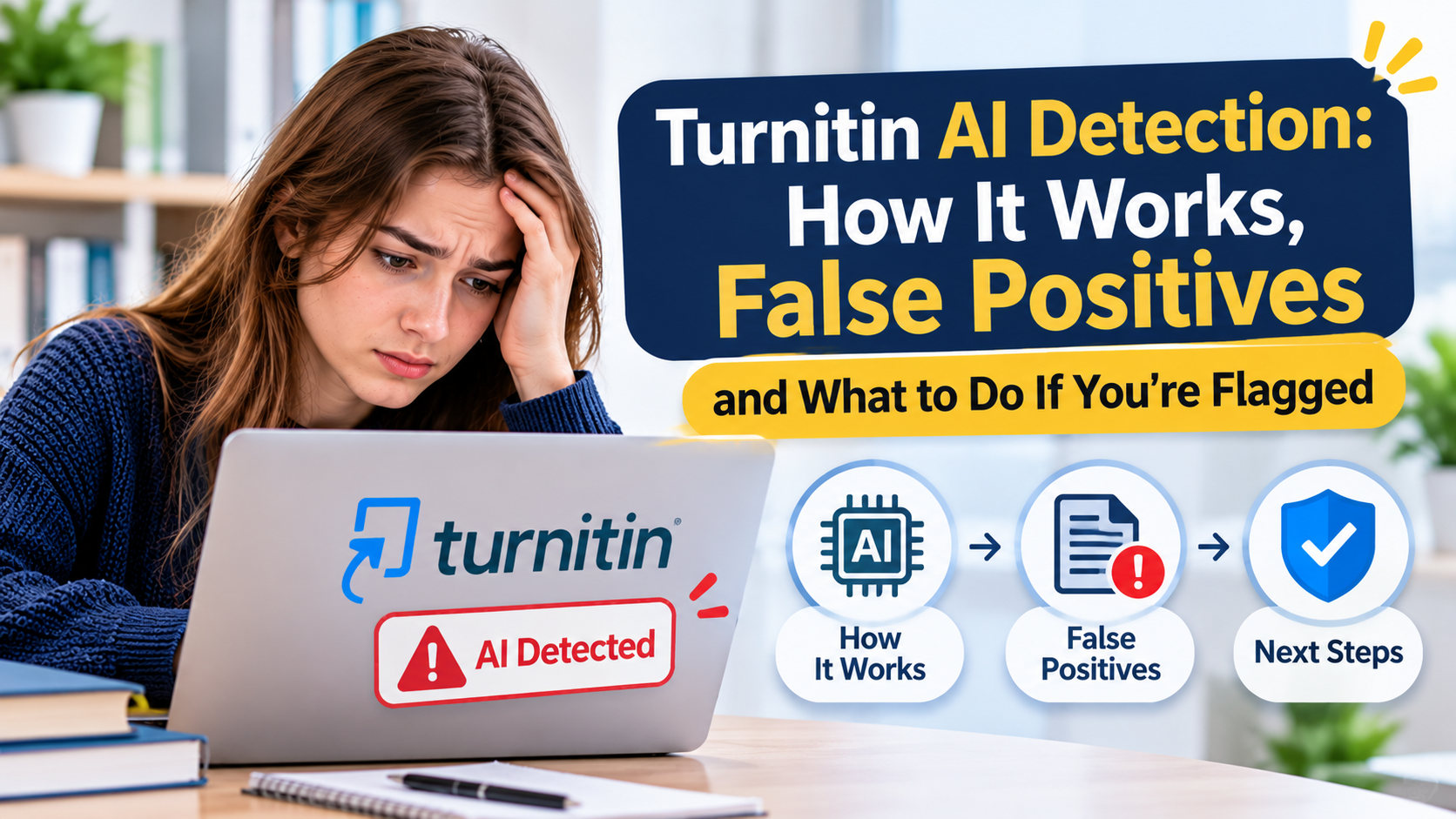
Yes, a Turnitin AI detection false positive can happen. Turnitin itself says its tool can wrongly flag human writing, especially in short pieces, when less than 20% of a document is flagged, and in individual sentences next to genuine AI text. A Turnitin AI score is an indicator, not proof. If you’re flagged, stay calm. Don’t admit to something you didn’t do. Gather your drafts, version history, notes and sources, and ask your university for the specific evidence against you. Many UK universities say the score alone isn’t evidence of misconduct.
The students who get cleared are rarely the ones with the best arguments. They’re the ones who can show how their work was built.
How Turnitin AI Detection Works
Turnitin’s AI checker is separate from its similarity (plagiarism) report. Instead of matching your text against sources, it predicts how likely your writing is to have been produced by a language model.
- Your text is split into overlapping segments of a few hundred words.
- Each sentence gets a score. Turnitin says it gives each sentence a score between 0 and 1 to determine whether it is written by a human or by AI.
- Scores are combined into a percentage of the document predicted to be AI-written, with flagged sentences highlighted for the marker.
Detectors like this look for predictable language: common word choices, even sentence lengths and stock transitions. That’s why clear, formulaic, “textbook” writing, exactly what many students are taught, can look machine-like.
Two things students often don’t know: the minimum length for analysis was raised from 150 to 300 words because accuracy improves with longer text. And at many universities, students can’t see the AI score at all. Only the marker can.
How Often Do Turnitin AI False Positives Happen?
Turnitin published two different rates in 2023, and the difference matters.
| Measure | Turnitin’s figure | What it means for you |
|---|---|---|
| Document-level false positive rate | Less than 1% for documents with 20% or more AI writing | A wholly human essay is rarely flagged at a high score |
| Sentence-level false positive rate | Around 4% | Individual highlighted sentences can be wrong |
| Scores under 20% | Shown with an asterisk as less reliable | A low score is weak evidence either way |
| Opening and closing sentences | Higher false positive rate observed | Intros and conclusions are more likely to be wrongly flagged |
Turnitin’s Chief Product Officer explained that the document false positive rate is less than 1% for documents with 20% or more AI writing, while the sentence-level rate is around 4%. The company also reported a higher incidence of false positives in the first few or last few sentences of a document.
Under 1% isn’t small at scale: Turnitin has reviewed over 250 million submissions since launch.
Who Is Most at Risk of a False Flag?
- Non-native English writers. A Stanford study of seven widely used AI detectors found they classified more than half of TOEFL essays (61.22%) written by non-native English students as AI-generated, while being near-perfect on essays by US-born students. Turnitin wasn’t among the detectors tested, but the researchers explain why: detectors that measure predictability can penalise writers with a narrower vocabulary.
- Neurodivergent students whose writing is highly structured or repetitive.
- Students who use grammar and paraphrasing tools that smooth sentences into a more predictable style.
- Anyone writing formulaic sections, such as methods, definitions or standard introductions.
Universities are split on the tool. Newcastle University says it does not use the AI detection feature within Turnitin, and the University of Hull told an FOI request it does not use AI detection tools. Bristol has it switched on but describes the score as an indicator rather than evidence of AI use.
Case Study: What the UK Ombudsman Found in a Turnitin AI Case
In July 2025, the Office of the Independent Adjudicator (OIA) published six case summaries involving alleged AI use. One of them, case CS072504, shows how a flag becomes a penalty.
What happened: Turnitin flagged an international student’s assignment as containing a high percentage of AI-generated content. After a viva, a panel found two offences: unacknowledged AI-generated material and collusion. The penalty was retaking the module, a 10% deduction from the overall degree mark and a reflective essay.
What the OIA found (Partly Justified):
- The university never asked for the student’s drafts, notes or earlier versions, even though its own procedures said it would.
- The panel’s record said the student admitted using AI to paraphrase. The viva transcript showed they’d only said they used Google to find synonyms because English isn’t their first language.
- The university didn’t consider whether Turnitin’s AI detection might be less reliable for non-native English speakers.
The OIA recommended the university reconsider the allegations afresh and let the student submit a new statement.
The twist: The collusion finding stood. The student had used an external tutor, and the help went beyond what the university’s proofreading policy allowed. Outside help can cause a misconduct finding on its own, whatever the AI score says.
What to Do If You’re Flagged by Turnitin: 6 Steps
- Don’t panic, and don’t confess to anything you didn’t do. A flag starts a process; it isn’t a verdict.
- Read your university’s academic misconduct procedure. Note deadlines, your right to a meeting or viva, and whether you can bring someone with you.
- Ask for the evidence. Request the AI report, the highlighted sections and any other reasons for the allegation. The OIA case shows you need to know what you’re answering.
- Gather proof of your process. Version history from Word or Google Docs, dated drafts, notes, reading lists, browser history for sources, and messages with tutors.
- Prepare to talk about your work. In a viva, explain your argument, your sources and why you made key choices. Knowing your work in depth is strong evidence you wrote it.
- Get independent advice. Your students’ union advice centre is free and knows the process. If you’re still unhappy after the university’s final decision, you can complain to the OIA (England and Wales).
Checklist: Protect Yourself Before You Submit
- Write in Word or Google Docs with version history switched on.
- Save dated drafts and plans, not just the final file.
- Keep reading notes and a list of sources you looked at.
- Check your module’s AI policy and declare any allowed AI use.
- Note any grammar, paraphrasing or translation tools you used.
- Make sure any proofreading stays within your university’s proofreading policy.
- Be ready to explain every source and key argument in your own words.
Assignment Experts and Professional Assignment Writers UK: What’s Safe?
After a false flag, some students wonder whether paying for help is safer. It depends entirely on what the help does.
Not safe: Paying the kind of professional assignment writers UK websites advertise to write work you then submit as your own. That’s contract cheating, whatever an AI detector says, and the OIA case above shows how a tutor’s help that goes too far can lead to a collusion finding on its own. In England, it’s also a criminal offence to provide, arrange or advertise essay mill services for financial gain to students.
Safe, if it stays within your university’s rules: Assignment experts who work as tutors or coaches. They can explain feedback, teach structure and referencing, help you plan, or proofread within your university’s proofreading policy, while every word you submit is still yours.
The test is simple: if you couldn’t explain and defend every sentence in a viva, it isn’t your work.
Conclusion
A Turnitin AI detection false positive is rare at the document level but real, more likely in low scores, short texts, introductions and conclusions, and for non-native English writers. The score is an indicator, not proof, and the UK ombudsman has criticised universities that didn’t look at drafts or consider the tool’s limits. Keep version history and notes; if flagged, ask for the evidence and show your process. And keep any outside help on the right side of the line: help that teaches you is fine; help that writes for you isn’t.
Frequently Asked Questions
Can Turnitin AI detection give a false positive?
Yes. Turnitin says its document-level false positive rate is under 1% for documents with 20% or more AI writing, but around 4% of individual highlighted sentences may be human-written. Scores under 20% are marked with an asterisk as less reliable.
What percentage on Turnitin AI is acceptable?
There’s no universal safe percentage. Universities set their own policies, and many treat the score as an indicator that prompts a conversation, not as proof of misconduct.
Can students see their Turnitin AI score?
Often not. At many universities, only the marker can see the AI writing report, even when students can see the similarity report.
How do I prove I didn’t use AI?
Show how your work was built: version history in Word or Google Docs, dated drafts, notes, sources and search history. Being able to discuss your argument confidently in a viva is also strong evidence.
Can Grammarly trigger Turnitin AI detection?
Tools that rewrite or paraphrase sentences can make writing more predictable and may raise the chance of a flag. Check your university’s policy and record what you used.