







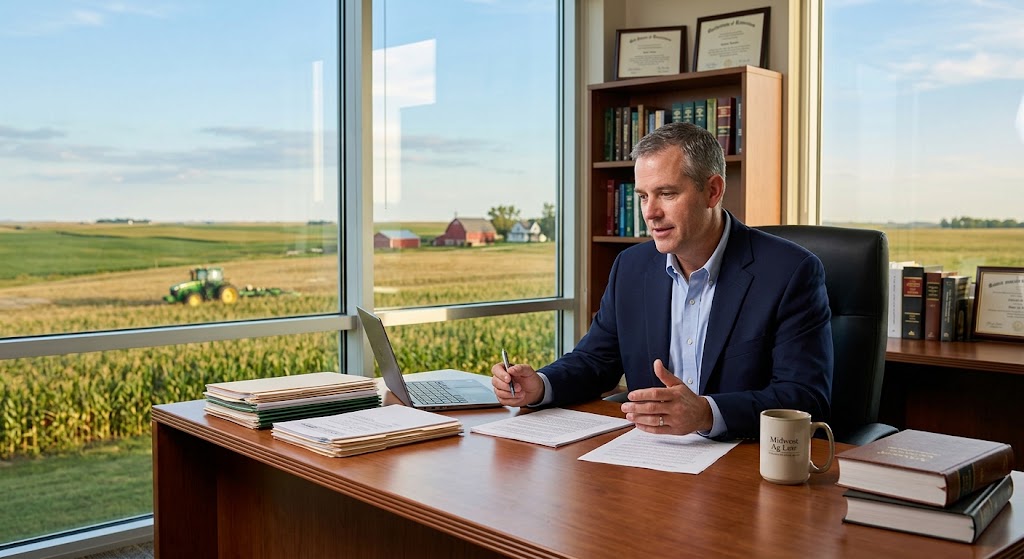
Operating an agricultural business requires more than working the land and managing livestock. Today, farms and ranches function as complex enterprises facing unique market, operational, and regulatory dynamics. Without proper legal structure, personal assets remain vulnerable to liability, estate transitions become chaotic, and operations face unnecessary financial exposure.
Building a solid structural foundation requires careful entity selection and strategic governance tailored to the reality of Midwestern agriculture.
The Core Foundations of Agricultural Business Entities
Selecting the right corporate or business structure determines how your operation handles taxation, manages liability, and transfers assets across generations. Generic corporate templates often fail to accommodate how real agricultural enterprises operate.
Limited Liability Companies (LLCs)
LLCs remain a preferred choice for modern family farms and agricultural partnerships. They create a protective barrier between personal assets and business liabilities, ensuring that operational risks do not endanger personal holdings. Key advantages include:
- Pass-through taxation that prevents double taxation on operational revenue.
- Flexible management structures tailored to multi-generational involvement.
- Simplified mechanics for transferring equity interest to successors without dividing physical acreage.
Family Limited Partnerships and Corporations
For larger operations or those with complex capital assets, traditional legal frameworks like Corporations (S-Corp or C-Corp) or Family Limited Partnerships (FLPs) provide distinct structural benefits:
- Structured governance that formalizes voting rights, management roles, and financial distributions.
- Defined share structures that streamline capital raising and operational expansion.
- Strategic tax planning opportunities regarding self-employment taxes and income distribution.
Shielding Land and Assets from Operational Liability
A fundamental strategy in agricultural corporate structure involves separating land ownership from everyday operational activities. Holding land and machinery in the same legal entity exposes your most valuable assets to routine operational liabilities.
To limit exposure, many producers establish a clear two-tiered structure:
- Landholding Entity: Holds title to real estate and leases the land to the operating company. This shields the land from operational risks, equipment claims, or third-party liabilities.
- Operating Entity: Owns livestock, equipment, and handles grain sales, chemical applications, and vendor contracts. All day-to-day risk remains confined within this entity.
Attorneys who understand rural business mechanics can draft lease agreements between these entities that withstand regulatory review and protect asset integrity. Working alongside established attorneys in nebraska ensures that local property laws, land use provisions, and leasing regulations are fully satisfied.
Strategic Succession Planning and Estate Integration
An entity framework is only as good as its long-term continuity plan. Estate planning and business structuring must work hand in hand to ensure a farm or ranch survives a transition.
Avoiding Common Succession Traps
When a plan relies solely on a basic will, the operation often faces public probate proceedings, unexpected tax burdens, or internal family friction. A clear business structure eliminates ambiguity by establishing rules for buyouts, valuation methods, and decision-making authority long before a transition occurs.
Integrating Trust Structures
Linking operational entities with living trusts ensures seamless management continuity if an operator passes away or becomes incapacitated. Specialized counsel from experienced Nebraska law firms ensures that trusts are properly funded and assets are retitled to match the operational governance plan.
Operational support from a dedicated firm like Midwest Ag Law ensures that farm families build airtight succession plans and custom entity frameworks that protect their legacy across generations.
Essential Governance Practices for Legal Protection
Forming an LLC or Corporation is only the first step. To maintain corporate liability protection, operators must adhere to standard corporate formalities:
- Maintain separate bank accounts for every entity and never commingle personal and business funds.
- Draft detailed Operating Agreements or Corporate Bylaws outlining ownership shares, transfer restrictions, and dispute resolution.
- Hold annual meetings and keep clear written minutes documenting key management decisions.
- Execute formal lease contracts and equipment agreements between related entity tiers.
Adhering to these operational practices ensures that courts respect the legal separation between you and your business entity during a claim or audit.
Frequently Asked Questions
Question 1: Why should farm land be held in a separate entity from daily operations?
Separating land from daily operations prevents operational liabilities, such as equipment accidents or contract disputes, from putting land ownership at risk.
Question 2: What is the main advantage of an LLC over a sole proprietorship for farmers?
An LLC protects personal assets from business debts and legal claims while maintaining pass-through tax treatment.
Question 3: How does a structured business entity simplify farm succession?
It allows owners to transfer non-voting ownership shares to heirs gradually without dividing land parcels or interrupting daily operations.
Question 4: Do family-owned agricultural LLCs need formal operating agreements?
Yes, written operating agreements establish clear rules for decision-making, owner buyouts, and dispute resolution among family members.
Question 5: Is a basic will enough to pass a farm operation to the next generation?
No, relying solely on a will often leads to probate delays, public scrutiny, and potential family disputes over asset division.