







Running a business in Thailand involves managing financial records, inventory, purchasing, production, and customer expectations. When these activities operate through separate systems, employees often spend valuable time correcting information, preparing reports, and checking transactions.
This is where Infor ERP Thailand becomes relevant for businesses looking to improve operational control. Infor provides enterprise resource planning solutions that help organizations manage important business processes through connected applications.
For companies that need stronger budgeting and financial analysis, Infor EPM adds planning, forecasting, and performance reporting capabilities. Understanding how these solutions work together can help Thai businesses make informed technology investments.
What Is Infor ERP Thailand?
Infor ERP Thailand refers to the use and implementation of Infor enterprise resource planning software by organizations operating in Thailand.
Infor offers industry focused ERP solutions for manufacturing, distribution, healthcare, and other business sectors. These systems connect operational information across departments, helping employees work with more consistent business data.
For example, a manufacturing company may need to manage raw material purchasing, production schedules, inventory availability, and financial transactions. An ERP system allows these activities to share relevant information instead of depending on separate spreadsheets.
Companies considering Infor ERP Thailand should select a solution based on their industry, business processes, reporting requirements, and local compliance needs.
Why Businesses in Thailand Need Modern ERP Solutions
Thailand has an established manufacturing sector alongside growing distribution, retail, and service industries. Businesses operating across these sectors often face challenges involving cost management, supply chain visibility, and financial reporting.
Infor ERP Thailand can help organizations address several operational requirements.
1. Better Financial Management
Finance departments need accurate information about expenses, revenue, outstanding payments, and cash flow.
Infor ERP solutions provide financial management capabilities that support accounting, transaction processing, and reporting. This helps finance teams reduce repeated data entry and improve financial visibility.
2. Improved Inventory Control
Inventory errors can affect customer deliveries and production schedules.
ERP software helps businesses monitor inventory transactions, purchasing activities, and stock movement. Managers can use this information to identify shortages, review stock levels, and support purchasing decisions.
3. More Effective Production Planning
Manufacturers must coordinate materials, equipment, employees, and delivery schedules.
Relevant Infor manufacturing solutions support production planning and operational monitoring. This helps teams understand resource requirements and respond to changes in production demand.
4. Better Departmental Coordination
When purchasing, sales, finance, and warehouse departments use disconnected information, mistakes become more likely.
Infor ERP Thailand can provide a shared operational environment where authorized employees access information relevant to their responsibilities.
Key Features of Infor ERP Thailand
The capabilities available depend on the selected Infor product, deployment model, and implementation scope.
Common ERP functions include:
- Financial Accounting: Manage general ledger activities, accounts payable, accounts receivable, and financial transactions.
- Supply Chain Management: Support purchasing, supplier coordination, and material planning.
- Inventory Management: Track stock quantities, warehouse transactions, and inventory movement.
- Manufacturing Management: Coordinate production orders, materials, and manufacturing operations.
- Business Reporting: Review operational performance through reports and dashboards.
- Integration Capabilities: Connect ERP processes with supported business applications and external systems.
Businesses should confirm which functions are included in their chosen solution rather than assuming every Infor product offers identical capabilities.
Understanding Infor EPM and Its Business Value
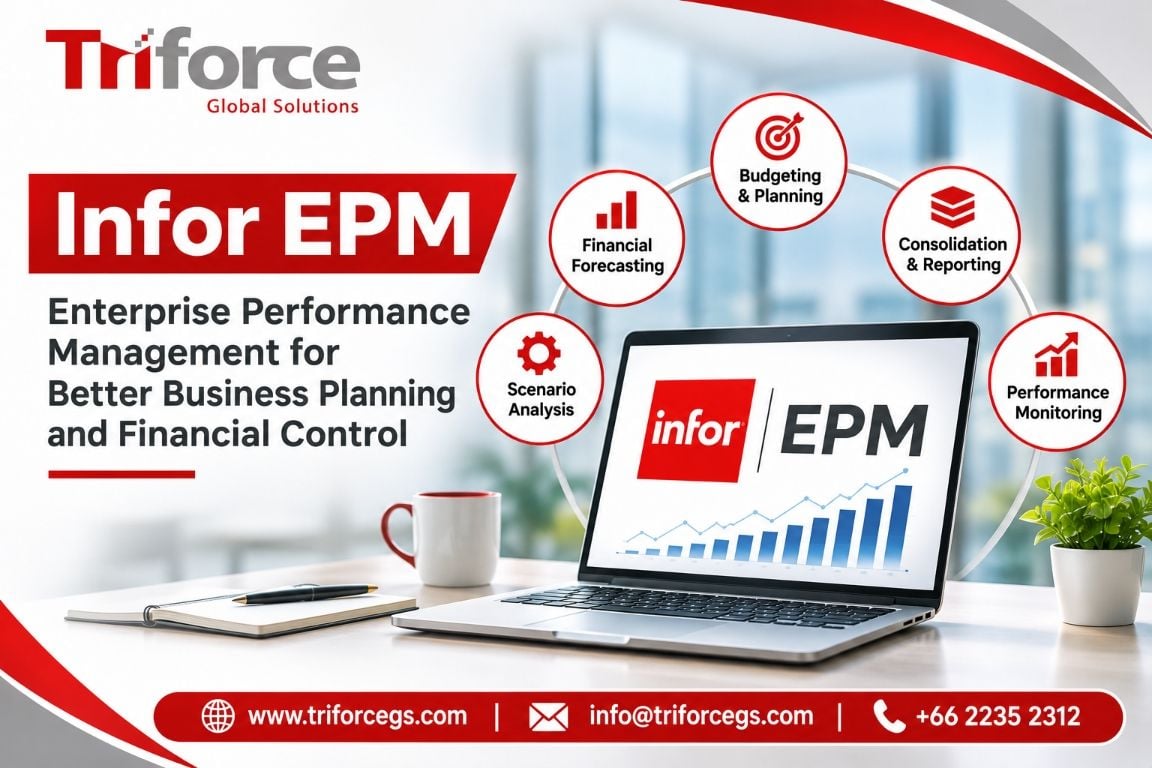
While ERP software manages daily business transactions, Infor EPM, or Enterprise Performance Management, focuses on financial planning, budgeting, forecasting, consolidation, and performance analysis.
Infor EPM helps finance teams examine financial results and prepare future business plans using information collected from enterprise systems.
For instance, a company may use ERP software to record actual operating expenses. Its finance department can then use Infor EPM to compare those expenses against approved budgets.
The platform supports important financial activities, including planning, reporting, and consolidation across multiple business entities.
Financial Budgeting and Planning
Infor EPM allows businesses to prepare financial budgets based on operational assumptions and organizational goals.
Finance teams can compare planned figures against actual results and investigate differences.
Forecasting and Scenario Planning
Market demand, material costs, and operating expenses may change throughout the financial year.
Infor EPM supports forecasting and scenario analysis, allowing businesses to evaluate how different assumptions could affect financial performance.
Financial Consolidation
Organizations operating multiple subsidiaries may need consolidated financial statements.
Infor EPM supports consolidation activities, including currency conversion and intercompany elimination, which can reduce manual reporting work.
Performance Reporting
Finance managers need clear reports to understand profitability, expenses, and departmental results.
Infor EPM provides reporting and analytical capabilities that help management review financial performance and identify areas requiring attention.
How Infor ERP Thailand and Infor EPM Work Together
The relationship between ERP and enterprise performance management is particularly useful for businesses that need both operational control and financial planning.
Infor ERP Thailand supports business transactions, while Infor EPM helps organizations analyze financial information and prepare future plans.
Consider a Thai manufacturing company operating several production facilities.
Its ERP system records purchasing expenses, manufacturing costs, inventory transactions, and customer sales. Financial teams can use relevant information in Infor EPM to prepare budgets, review profitability, and forecast future expenditure.
This connection helps management compare operational performance with financial expectations.
Infor supports ERP and EPM integration, although the exact data connections and configuration requirements depend on the systems involved.
Important Considerations for ERP Implementation in Thailand
Implementing Infor ERP Thailand requires more than selecting software. Companies must understand their operational requirements before configuring business processes.
Review Existing Business Processes
Start by identifying problems in accounting, purchasing, inventory, and reporting.
Documenting existing workflows helps determine which activities require improvement and which processes should remain unchanged.
Check Thai Tax and Reporting Requirements
Businesses must consider applicable Thai VAT requirements, withholding tax, invoicing, and statutory reporting.
Infor has documented Thailand localization functionality for certain products, including VAT and withholding tax reporting. However, businesses should verify current localization coverage for their specific ERP version and applicable regulations.
Prepare Accurate Business Data
Incorrect customer records, supplier information, inventory balances, and financial data can create problems after implementation.
Organizations should review and clean important records before transferring information into the new system.
Train Employees Properly
ERP implementation affects how employees perform daily tasks.
Practical training should cover common transactions, approval processes, reporting responsibilities, and error handling.
Select an Experienced Implementation Partner
A suitable implementation partner should understand the chosen Infor product, relevant industry workflows, integration requirements, and Thai business practices.
Companies should evaluate previous project experience, support arrangements, and implementation methodology before making a decision.
Which Businesses Can Benefit From Infor ERP Thailand?
Infor ERP Thailand may be suitable for organizations managing complex operations or requiring better coordination across departments.
Manufacturing companies can use relevant ERP capabilities to manage production and materials. Distribution businesses may benefit from purchasing, warehouse, and inventory functions.
Companies operating multiple business units can also benefit from centralized financial information and consistent reporting processes.
For organizations requiring detailed financial analysis, Infor EPM can complement ERP operations through budgeting, consolidation, and performance monitoring.
The suitability of either solution depends on company size, existing systems, operational complexity, and available resources.
Common Challenges During ERP Implementation
Even carefully planned ERP projects can experience difficulties.
Data migration errors, unclear responsibilities, limited employee involvement, and unnecessary customization can affect project outcomes.
Businesses considering Infor ERP Thailand should establish realistic implementation milestones and involve representatives from finance, operations, purchasing, and technology teams.
Testing real business transactions before launch is equally important.
When introducing Infor EPM, organizations should also define financial reporting structures, planning assumptions, and data ownership responsibilities.
These measures help ensure the systems support practical business needs rather than simply introducing additional software.
Final Thoughts
Infor ERP Thailand offers businesses a structured approach to managing financial transactions, inventory, purchasing, and operational processes. Selecting the right product and preparing a clear implementation plan are essential for achieving useful results.
Infor EPM extends these capabilities by helping finance teams manage budgets, forecasts, financial consolidation, and performance reporting.
For Thai businesses evaluating enterprise software, the strongest approach is to identify existing operational problems, assess integration requirements, and choose solutions that support measurable business objectives.
Frequently Asked Questions
1. What is Infor ERP Thailand used for?
Infor ERP Thailand refers to Infor ERP solutions implemented by businesses in Thailand. Depending on the product, these systems support accounting, purchasing, inventory management, manufacturing, and business reporting.
2. What is the difference between Infor ERP and Infor EPM?
Infor ERP primarily manages business transactions and operational processes. Infor EPM focuses on budgeting, forecasting, financial consolidation, and performance analysis. Both can work together to support business management.
3. Is Infor ERP Thailand suitable for manufacturing companies?
Yes. Infor provides ERP solutions designed for different manufacturing requirements. Businesses should evaluate production planning, inventory, purchasing, integration, and industry specific functionality before selecting a product.
4. Can Infor EPM help businesses improve financial forecasting?
Yes. Infor EPM supports financial forecasting, scenario planning, and budget comparisons. Finance teams can use these capabilities to evaluate financial assumptions and prepare updated business plans based on available information.
5. How should companies choose an Infor ERP Thailand implementation partner?
Companies should assess the partner’s Infor product knowledge, industry experience, understanding of Thai reporting requirements, project methodology, and technical support capabilities. Requesting relevant project references and a clear implementation scope can support the selection process.