




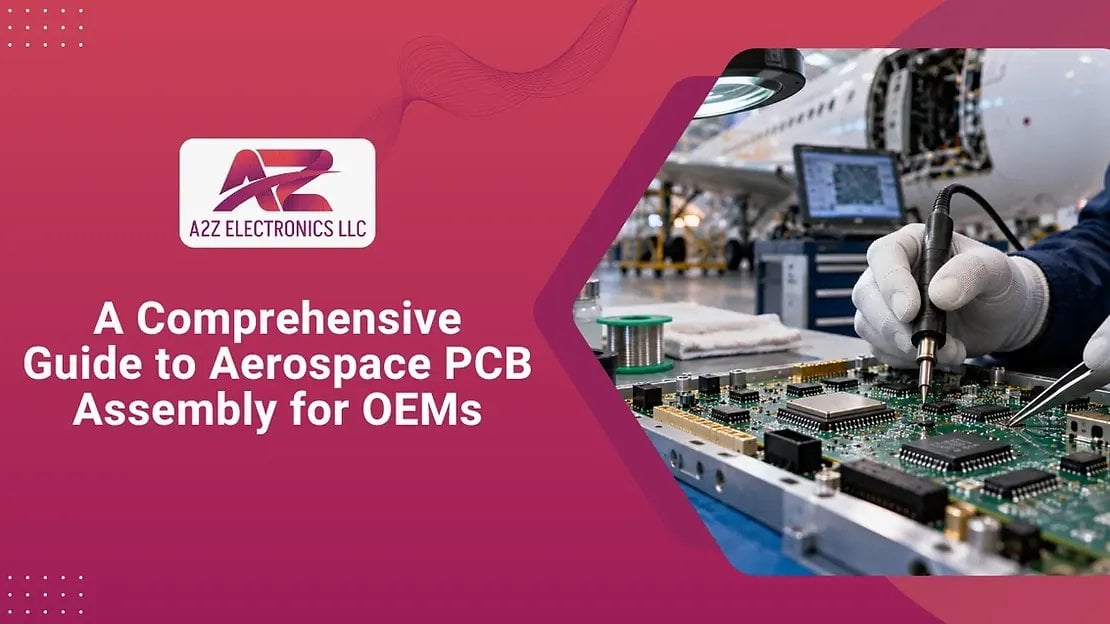
Aerospace electronics operate under conditions that ordinary commercial devices may never encounter. Temperature changes, vibration, mechanical stress, and extended operating periods place significant demands on printed circuit board assemblies (PCBAs).
For OEMs, reliable aerospace PCB assembly depends on suitable materials, controlled manufacturing, thorough testing, and component traceability.
This guide explains the PCB types, assembly processes, standards, and quality requirements involved in manufacturing aerospace electronics.
What Is Aerospace PCB Assembly?
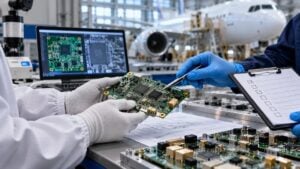
Aerospace PCB assembly involves mounting and soldering electronic components onto printed circuit boards used in aircraft, satellites, navigation systems, and other aerospace equipment.
Manufacturers use surface-mount technology (SMT), through-hole technology (THT), or mixed assembly methods depending on the design.
Unlike standard commercial production, PCB assembly for aerospace often requires tighter process controls, detailed documentation, and additional testing to meet application-specific reliability requirements.
Why Is Aerospace PCB Assembly Different?
Aerospace electronics must maintain performance in demanding operating environments. Component failures or damaged solder joints can affect critical systems, while repairs may be difficult once equipment is deployed.
Key requirements include:
- Thermal stability: Components and materials must tolerate specified operating temperatures.
- Vibration resistance: Connections must withstand mechanical stress and shock.
- Signal integrity: Circuit designs must limit interference and unwanted signal losses.
- Weight reduction: Compact electronics help meet aerospace size and weight restrictions.
- Traceability: Production records must identify components, materials, and manufacturing processes.
Common Applications of Aerospace PCB Assemblies
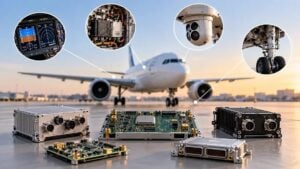
Aerospace PCBAs support electrical and electronic functions across aircraft and spacecraft.
Common applications include flight control and avionics, radar systems, GPS navigation, satellite communications, power management, engine monitoring, and onboard sensors.
Each application requires different electrical performance, environmental protection, and reliability specifications.
Types of PCBs Used in Aerospace Electronics
Selecting the right PCB structure is an important part of aerospace product design.
| PCB Type | Typical Application |
|---|---|
| Rigid PCB | Stable mounting for avionics and control electronics |
| Flexible PCB | Compact connections requiring bending or tight routing |
| Rigid-Flex PCB | Integrated connections in space-constrained equipment |
| Multilayer PCB | Complex circuits with multiple signal and power layers |
| HDI PCB | High-density electronics using fine-pitch components |
The appropriate design depends on available space, electrical complexity, weight, and operating conditions.
Key Materials Used in Aerospace PCB Assembly
Material selection directly affects electrical performance, heat resistance, and assembly reliability.
High-performance laminates: FR-4, polyimide, PTFE-based materials, and specialized laminates may be used depending on temperature and frequency requirements.
Copper: Conductive traces and planes distribute electrical signals and power. Copper thickness affects current capacity and thermal performance. Learn more about copper-plated PCB boards.
Solder alloys: Selected according to electrical, mechanical, process, and compliance requirements.
Conformal coatings: Provide additional protection against moisture and contaminants when required by the application.
Material specifications should be finalized during design to avoid unnecessary changes during production.
Aerospace PCB Assembly Process: Step by Step
The aerospace PCB assembly process follows controlled manufacturing stages to reduce defects and maintain consistency.
- Design review: Verify Gerber files, PCB specifications, the bill of materials (BOM), and assembly drawings.
- Material inspection: Check bare boards and components for quality and specification compliance.
- Solder paste application: Apply solder paste to designated SMT pads.
- Component placement: Position surface-mount components using automated placement equipment.
- Reflow soldering: Solder components using controlled temperature profiles.
- Through-hole assembly: Install and solder THT components where required.
- Inspection and testing: Identify assembly defects and verify electrical performance.
- Cleaning and coating: Apply specified cleaning procedures and protective coatings.
- Final documentation: Record inspection results, component traceability, and production details.
Aerospace PCB Assembly Standards and Quality Requirements
Aerospace manufacturers must follow standards relevant to the product and customer requirements.
IPC-A-610 and J-STD-001 define electronic assembly acceptance and soldering requirements. High-reliability applications may require IPC Class 3 workmanship.
Read our comparison of IPC Class 2 vs Class 3 for more detail.
AS9100D provides aerospace-specific quality management requirements, while ISO 9001 establishes broader quality management principles.
Learn about the importance of AS9100D certification in aerospace PCB assembly.
Certifications, inspection records, and documented controls should be evaluated against each project’s requirements.
Common Challenges in Aerospace PCB Manufacturing
Aerospace OEMs and manufacturers regularly face several production challenges:
- Thermal management: Preventing excessive heat from affecting components and solder joints.
- Component availability: Managing obsolescence and long product lifecycles.
- Design complexity: Fitting high-density circuitry into limited space.
- Supply chain traceability: Verifying component authenticity and sourcing records.
- Manufacturing defects: Detecting soldering, placement, and hidden connection problems.
Early engineering reviews, controlled sourcing, and appropriate inspection methods help address these issues before final assembly.
How to Choose an Aerospace PCB Assembly Manufacturer
An experienced aerospace PCB assembly manufacturer should provide more than component placement.
Evaluate the supplier’s certifications, aerospace project experience, SMT and THT capabilities, testing equipment, component traceability, and documentation practices.
Also consider prototype support, production capacity, lead times, and engineering communication.
For additional guidance, read why aerospace OEMs need a reliable PCB assembly partner.
Aerospace PCB Assembly Services at A2Z Electronics
A2Z Electronics LLC supports aerospace OEMs with PCB assembly, SMT, through-hole manufacturing, mixed-technology assembly, and electronics integration.
Our capabilities include prototype and production builds, component sourcing, inspection, testing, and manufacturing support based on project requirements.
We work with OEMs to review specifications, address manufacturing concerns, and maintain consistent assembly processes.
Explore our aerospace PCB assembly services or contact A2Z Electronics to discuss your project.
Frequently Asked Questions
1. What certifications are important for aerospace PCB assembly?
Common quality requirements include AS9100D, ISO 9001, and applicable IPC standards. Required certifications depend on the aerospace program and customer specifications.
2. What is the difference between aerospace and standard PCB assembly?
Aerospace PCB assembly often requires stricter workmanship, traceability, inspection, and environmental reliability controls.
3. How long does aerospace PCB assembly prototyping take?
Lead times depend on board complexity, component availability, production volume, and testing requirements. Complex prototypes may take several weeks or longer.
4. Which PCB materials are suitable for aerospace applications?
High-performance FR-4, polyimide, PTFE-based laminates, and other specialized materials may be suitable depending on temperature, electrical performance, and environmental conditions.