





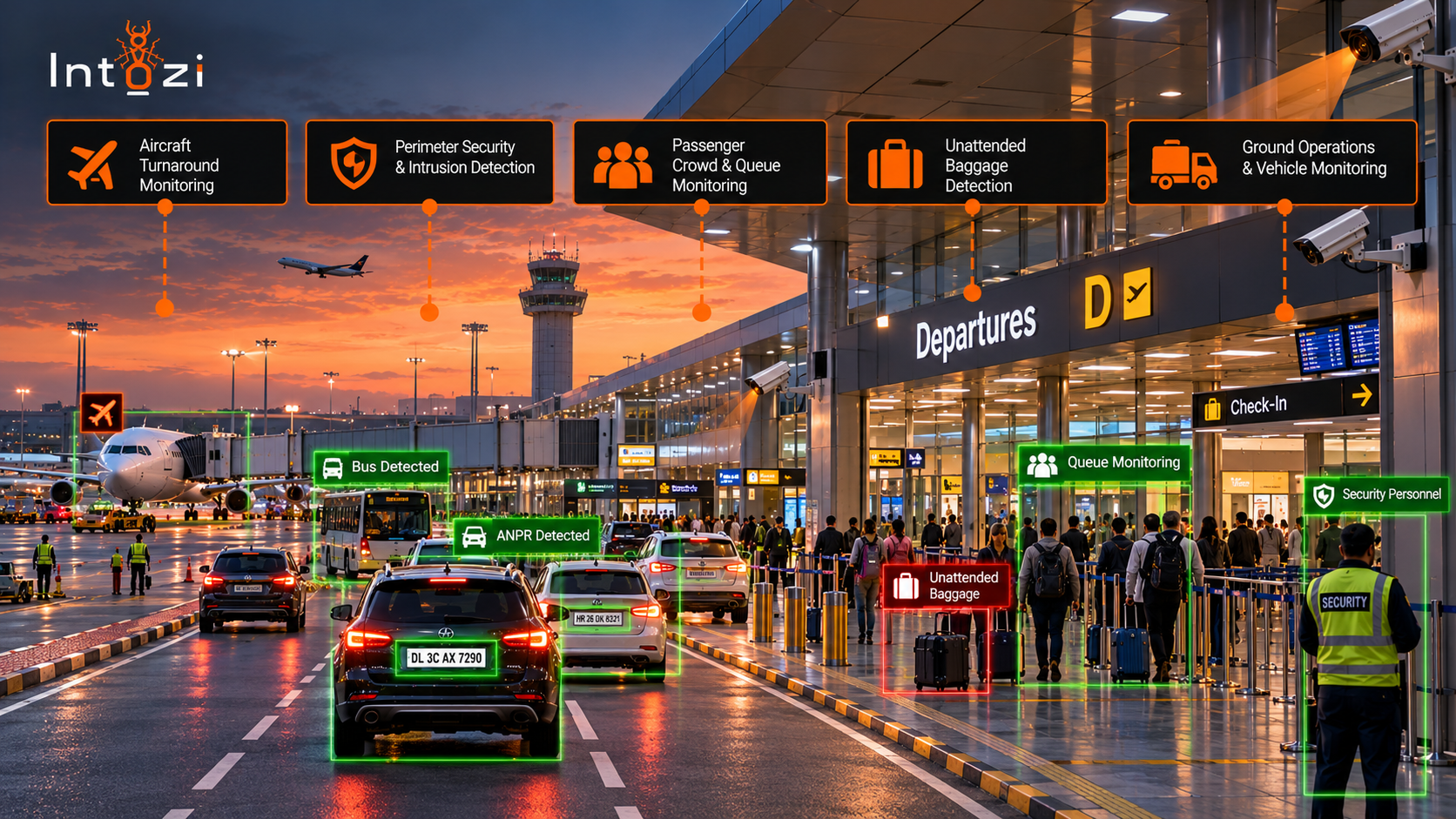
Airports manage constant movement across passenger terminals, restricted zones, aircraft stands, and ground transport areas. Effective airport security solutions need to address these environments while helping security teams identify events that require attention. AI video analytics can analyse camera footage to flag selected activities, monitor movement, and provide useful information for security and operational teams.
How Airport Surveillance Solutions Improve Security Visibility
Modern airport surveillance solutions can help security teams monitor multiple areas without relying entirely on continuous manual observation. Configured video analytics can flag events such as unauthorised entry, unusual movement, or activity in restricted zones.
Key applications include:
- Monitoring access to restricted areas.
- Detecting movement across designated boundaries.
- Identifying unattended objects for human review.
- Reviewing security events across terminals and airport facilities.
Detection performance depends on camera coverage, visibility, and the analytics model used. Alerts should support security procedures rather than replace human assessment.
How Airport Ground Operations Monitoring Supports Coordination
Airport ground operations monitoring helps teams observe activity around aircraft stands, service roads, and ground-handling areas. Video analytics can provide visibility into vehicle movement and selected operational events.
Potential applications include:
- Monitoring ground-service vehicle movement.
- Observing activity around aircraft stands.
- Identifying congestion in designated operational zones.
- Reviewing events that may contribute to ground-handling delays.
Combining video observations with operational records can provide more context when investigating delays or coordination issues.
Why Airport Safety Monitoring Matters Around Aircraft
Airport safety monitoring helps identify selected unsafe activities in areas where aircraft, ground vehicles, and personnel operate close together. Video analytics can flag configured events for review by airport safety teams.
Depending on camera coverage and model capabilities, monitoring may include:
- People entering restricted operational zones.
- Vehicles moving through designated safety areas.
- Unusual activity near aircraft stands.
- Potential obstructions in monitored routes.
These capabilities complement established aviation safety procedures. They cannot detect every hazard or replace trained personnel and airport safety protocols.
How Aircraft Turnaround Monitoring Helps Identify Delays
Aircraft turnaround monitoring focuses on activities that take place between an aircraft’s arrival and its next departure. Video analytics can help teams observe visible ground-handling activity and identify events that may need investigation.
For example, monitoring may support:
- Reviewing activity around aircraft stands.
- Observing the movement of ground-service vehicles.
- Identifying prolonged inactivity in monitored areas.
- Comparing visible activity patterns across turnaround periods.
Video can show what is happening in its field of view, but determining whether a turnaround task is complete may require integration with airline, ground-handling, or airport operational systems.
How Airport Crowd Monitoring Supports Passenger Safety
Airport crowd monitoring helps teams observe passenger movement and congestion in busy areas such as departure halls, arrivals zones, and terminal corridors.
AI video analytics can help identify:
- Increasing crowd density in selected areas.
- Congestion near entrances and exits.
- Passenger accumulation around service points.
- Movement patterns that may require operational attention.
These insights can help staff assess where additional assistance or crowd-management measures may be needed. Results depend on camera positioning, visibility, and suitable crowd-analysis models.
What Airport Queue Monitoring Can Reveal About Waiting Areas
Airport queue monitoring can help airports assess congestion at check-in counters, security checkpoints, immigration areas, and boarding gates.
Video analytics may support estimates of queue length, waiting-area occupancy, and changes in passenger accumulation. Teams can use these observations to review staffing arrangements and identify recurring bottlenecks.
Accurate waiting-time measurement may require additional information, such as timestamps or passenger-processing records. Visual estimates alone may not capture the full reason for delays.
Where Airport Facial Recognition Fits Into Security
Airport facial recognition uses specialised AI models to compare facial images for defined identification or verification purposes. Depending on the airport’s approved systems and applicable regulations, it may support identity verification or authorised access workflows.
Implementation requires careful consideration of privacy, consent or other lawful grounds, data security, accuracy, and human review. General video analytics does not automatically provide facial recognition; the capability requires appropriate technology and governance.
How Unattended Baggage Detection in Airport Environments Works
Unattended baggage detection in airport environments involves identifying bags or objects that remain in a monitored area under configured conditions. Video analytics may flag an object that appears stationary for a defined period so security personnel can investigate.
Useful considerations include:
- Defining suitable monitored zones and time thresholds.
- Accounting for temporary passenger movement and visual obstructions.
- Ensuring alerts reach the appropriate security team.
- Reviewing flagged objects before taking action.
Detection identifies a potential event; it does not establish that an object is dangerous.
How Apron Safety Monitoring Helps Protect Ground Operations
Apron safety monitoring focuses on activity around aircraft parking stands and other apron areas. AI video analytics may flag people or vehicles entering restricted zones, movement in designated safety areas, or other configured events.
These alerts can help teams review potential risks, but performance depends on camera placement, weather, visibility, and the specific analytics deployed.
How Intozi and Ikshana Support Intelligent Airport Monitoring
Intozi develops AI video analytics software, and its Ikshana platform supports configurable video monitoring applications. Depending on airport requirements, camera infrastructure, and deployment configuration, video intelligence can help teams monitor selected security events, passenger movement, and ground operations. Clear use cases, validated detection performance, and defined response procedures are essential for integrating analytics into existing airport security and operational workflows.
Frequently Asked Questions (FAQs)
Can AI video analytics work with existing airport CCTV cameras?
Yes, if the cameras provide suitable image quality, coverage, and compatibility. Some specialised applications may require improved camera positioning or additional equipment.
Can airport video analytics detect every security threat?
No. Analytics can flag configured events, but occlusion, lighting, camera coverage, and model limitations affect detection. Human review and established security procedures remain essential.
Can crowd and queue monitoring operate in real time?
Suitable systems can analyse video feeds and generate alerts or estimates in near real time. Accuracy depends on camera views, crowd density, and the specific model being used.
Does unattended baggage detection confirm that a bag is dangerous?
No. It identifies a potential unattended-object event for investigation. Security personnel must assess the situation and follow the airport’s established response procedures.
What should airports consider before implementing AI video analytics?
Airports should assess the intended use cases, camera compatibility, detection accuracy, privacy obligations, system integration, alert handling, and performance under actual operating conditions.