





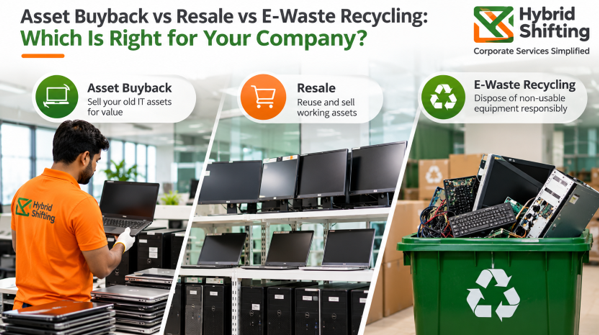
Buyback, resale and e-waste recycling are three different ways to retire old company assets. Buyback sells working assets to a provider under one agreement and recovers value. Resale means finding buyers yourself. Recycling responsibly processes non-working or end-of-life equipment. Most companies need a mix: buyback for assets with value, recycling for the rest, and documentation for both.
Every company reaches the same moment. A technology refresh, an office closure or a data centre decommission leaves a pile of laptops, servers, furniture and fixtures. The question is not just “how do we get rid of these?” but “what is the right route for each asset?” Choose wrongly and you either throw away money, expose data or create a compliance problem.
This guide compares the three routes and gives you a way to decide.
What Is Asset Buyback?
Asset buyback is the independent valuation and structured purchase of decommissioned assets by a provider, who then resells, refurbishes or recycles them. The company recovers value instead of writing assets off. It is typically run under a signed agreement with transparent pricing and documentation. Read more in our guide to IT asset buyback for corporates in India.
What Is Resale?
Resale means your company sells assets directly, for example to employees, dealers or online buyers. You control the price, but you also own the work: finding buyers, testing and listing items, arranging pickups, handling payment and clearing data.
What Is E-Waste Recycling?
E-waste recycling is the responsible processing of equipment that has no resale value, such as faulty, obsolete or damaged items. Materials are recovered and hazardous components are managed instead of being dumped. In India, e-waste handling is governed by the E-Waste (Management) Rules, 2022, so use an authorised recycler and keep records.
How Do the Three Routes Compare?
| Factor | Asset buyback | Resale (by you) | E-waste recycling |
|---|---|---|---|
| Value recovered | Yes, through valuation and offer | Potentially highest per item, but uneven | Little or none |
| Your effort | Low: one provider handles assessment, removal and paperwork | High: you find buyers, test, list and ship | Low to medium |
| Data risk | Lower, if chain of custody and data destruction are documented | Higher, as devices leave through many hands | Lower, if the recycler documents destruction |
| Documentation | Agreement, reconciliation, certificates and audit trail | Usually thin | Disposal or recycling certificates |
| Speed | Quick for bulk lots | Slow | Quick |
| Best for | Mixed lots of working assets, office exits and refreshes | A few high-value items | Non-working and end-of-life equipment |
| Main risk | Choosing a provider with weak controls | Data exposure and no audit trail | Losing value on assets that still have demand |
Which Route Fits Which Asset?
| Asset situation | Usually best route |
| Working, recent, in demand | Buyback, or direct resale for a few high-value items |
| Mixed lot of working and ageing assets | Buyback, with the provider sorting by value |
| Working but low demand | Buyback with refurbishment, or recycling |
| Faulty, damaged or obsolete | E-waste recycling |
| Data-bearing devices | Secure first, then buyback or recycling |
| Branded furniture in good condition | Buyback or resale |
| Fixed fit-out and partitions | Dismantling, as part of reinstatement |
How Do You Decide? Six Questions
- Do the assets still work and have market demand? If yes, recover value. If no, recycle.
- How many are there? Large lots suit buyback. A handful may justify resale.
- What data do they hold? The more sensitive the data, the more you need documented custody and destruction.
- How much time and staff do you have? Resale consumes both.
- What will auditors and compliance teams ask for? You need records for any route.
- Is this part of a bigger project? For an office move or closure, one partner handling everything usually wins.